

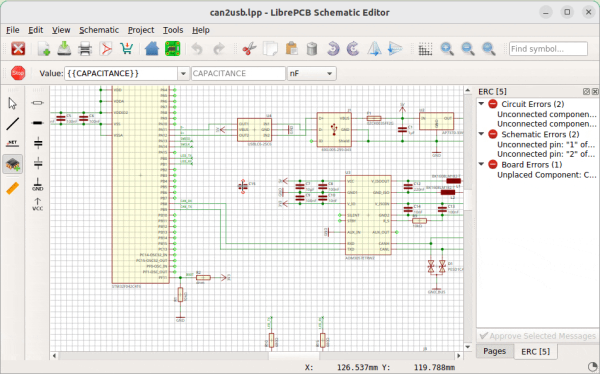
A new release of the free PCB design automation package LibrePCB 1.3.0 has been announced. LibrePCB is positioned as an intuitive package for rapid board development, which lags behind KiCad in functionality but is much easier to work with, catering to the needs of both beginners and professional engineers. The program is available in builds for Linux (Flatpak, Snap, AppImage), FreeBSD, macOS, and Windows. The project code is written in C++ (with a Qt interface) and is distributed under the GPLv3 license.
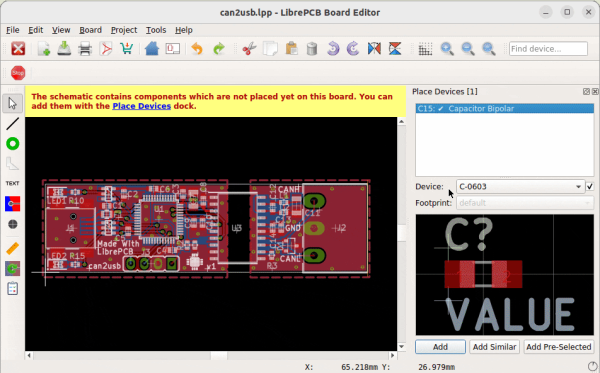
Notable features include the integration of a schematic editor and project management tools in one package; a simple cross-platform graphical interface based on Qt; the application of a 'smart' library concept; the use of formats for manual parsing of component libraries and projects; a Multi-PCB mode for the parallel development of different board variants based on a single schematic; automatic synchronization of the netlist between the schematic and the board layout. The program comes with a multilingual interface supporting Russian (96% translation coverage) and Ukrainian (91% translation coverage), allowing for element naming in different languages.
LibrePCB includes a project management interface; an electronic schematic editor; a multilayer PCB editor; a service for generating data to start production; a command-line utility, librepcb-cli, for automating routine tasks (such as checking and exporting data); and a library of electronic components with navigation via a tree-structured categorized list. It has an interface for connecting various existing component libraries, which can be added as archives or through integration with repositories. Importing DXF files and exporting in PDF, SVG, and CSV BOM formats, pick & place X3/CSV, Gerber/Excellon, and STEP is supported.
Key innovations:
- The ability to generate an interactive Bill of Materials (BOM) and an assembly plan has been added, including descriptions sufficient for step-by-step manual fabrication of the PCB. The list is saved in HTML format and utilizes handlers, styles, and JavaScript libraries developed for the KiCad plugin InteractiveHtmlBom. Unlike static PDF instructions, the interactive format allows for operations such as sorting, filtering, and searching components.
- Compatibility with the updated component library format proposed in KiCad 9 has been ensured.
- Support for using the Rust language for LibrePCB development has been added. The aforementioned BOM generator is written in Rust. It is expected that supporting Rust will accelerate development and positively impact product stability. Plans include a gradual shift from C++ to Rust and the intention to completely redesign the user interface using the Rust-based framework Slint instead of the Qt library.
- Instead of the QuaZip library for reading and writing ZIP archives, the Rust-written crate package zip is used.
- The C++ code has been updated to use the C++20 standard (tl::optional in the code has been replaced with std::optional).
- Support for Qt5 has been discontinued.
Source: opennet.ru
