

The number of manufacturers trying their hand at producing solid-state drives has long become uncountable. The threshold for entering this market is very low — independent controller developers are ready to take on the entire burden of SSD production, allowing their clients to focus solely on distribution of the resulting product. As a result, store shelves are crowded with numerous SSD models bearing obscure names. Russian buyers are particularly aware of this trend: with the cessation of official supplies from a number of international brands, Chinese companies have rushed into the domestic market, seeing opportunities to increase their sales volumes.
Most of these Chinese SSDs often do not deserve much attention. They compete for consumer interest with low prices and hardly require detailed technical reviews. However, not all Chinese SSDs are the same: among them, one can find quite interesting solutions. For instance, the Dahua C970 Plus, which is the subject of this review.
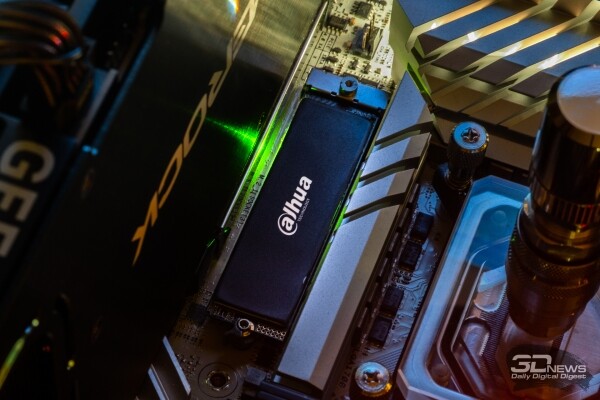
This drive is interesting at least because Dahua is not some obscure manufacturer, but one of the leaders in the video surveillance system market, which alongside another Chinese manufacturer, Hikvision, produces up to 40% of the cameras used worldwide. This means that the company has sufficient engineering resources and manufacturing capabilities to produce quality ancillary products, including SSDs.
Moreover, it is worth noting that in recent years, China has made significant progress in creating its own component base for quite respectable SSDs. The country has its own flash memory manufacturer, YMTC, which has not only caught up with South Korean and American competitors, but has also surpassed them in some technological aspects, such as increasing the number of layers in 3D NAND. Furthermore, there are also local controller developers in China, such as the well-known Maxio Technology, whose chips have gained a good reputation.
Thus, Chinese SSDs have a good chance of becoming popular not only in lower market segments but also as mid-range solutions. This is exactly the league in which the Dahua C970 Plus intends to compete. It is a bufferless yet high-speed drive with a PCIe 4.0 x4 interface that is guaranteed to come equipped with TLC memory and is produced by a manufacturer with a world-renowned name. In this review, we will see how this SSD compares to competing models like the Kingston KC3000 and Samsung 990 Evo Plus.
Appearance and Internal Structure
The developers of the Dahua C970 Plus clearly did not aim to drastically lower the cost of the product, as evidenced by the packaging. The drive comes in a cardboard box, includes a paper manual, and even comes with a mounting screw for the M.2 slot. Attention to user experience is also reflected in the design of the SSD itself. Despite being a bufferless drive with performance that is not record-breaking, it is equipped with an aluminum heat dissipation plate that contacts all of the chips, helping to dissipate heat from them.
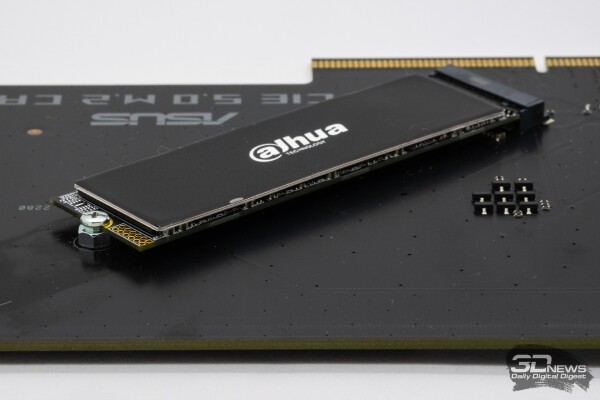
This is a simple yet quite effective cooling system that adds minimal thickness to the drive. It will fit in both the PlayStation 5 and any laptop. Moreover, it does not need to be removed even when the SSD is intended for use in an M.2 slot on a motherboard with its own heatsink.
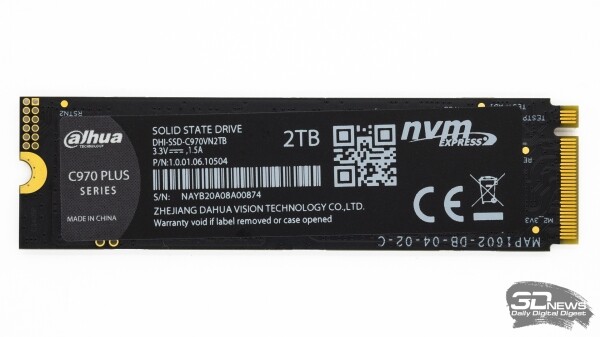
The technical information sticker on the Dahua C970 Plus is located on the backside, where there are no chips and it doesn’t interfere with anything. It lists only the most essential details—the SSD name, part number, and serial number—so it doesn’t warrant much attention. It's worth noting that, as seen in the photo, this review is about the 2TB version of the C970 Plus.
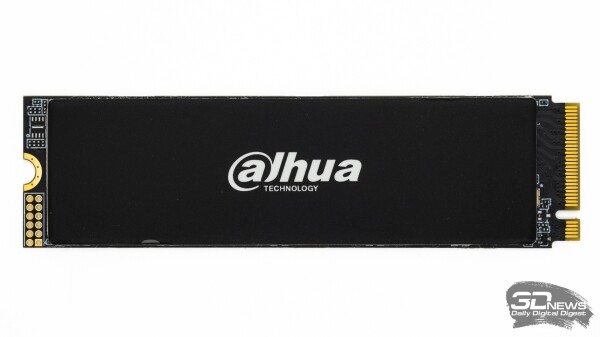
Beneath the heat dissipation plate are three chips. The first is the Maxio MAP1602 controller, which we are already quite familiar with. To date, it is one of the most common controllers for high-speed PCIe 4.0 SSDs without DRAM buffer, having four channels for forming the flash memory array and supporting NAND chips with 2400-MHz interface.
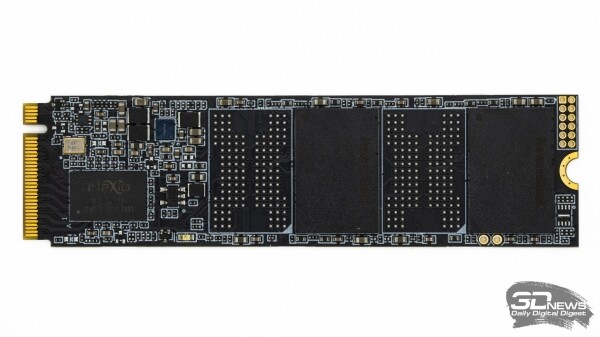
Two other chips are flash memory. For the Chinese Dahua storage, the expected choice is the Chinese TLC 3D NAND from YMTC, specifically its most modern and fastest version—featuring 232 layers. This means that the C970 Plus is built on a robust and time-tested component base. The YMTC memory belonging to the Xtacking 3.0 generation with 232 layers, in combination with the MAP1602 controller, can fully utilize the bandwidth of four PCIe 4.0 lanes, which is a significant achievement for a no-cache SSD.
Interestingly, the memory chips on the C970 Plus are labeled MasonSemi, indicating the company Mason Technology. This is one of the Chinese semiconductor firms that acted as a contractor for the slicing and packaging of the flash memory chips produced by YMTC. It was previously believed that there were close ties between YMTC and Mason, but after the sanctions impacting YMTC were introduced, both companies vehemently deny any relationships.
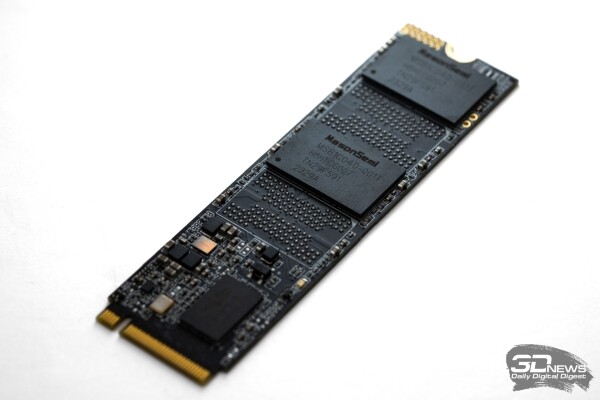
Besides the three chips, there’s nothing interesting on the Dahua C970 Plus board. The DRAM chip is absent in this storage device; it is replaced by Host Memory Buffer (HMB) technology, which allows the SSD to use a small portion of the system's RAM for its needs. In the C970 Plus, this is limited to 40 MB.
Additionally, it can be noted that the design of the printed circuit board housing the reviewed storage device is standard. Dahua simply adopted existing developments from Maxio without making any changes. Therefore, from a hardware perspective, the C970 Plus is completely analogous to many other SSDs built on a combination of the MAP1602 controller and 232-layer TLC memory from YMTC.
A good illustration of the lack of any changes in design is the LED embedded on the front surface of the C970 Plus, which indicates the drive's activity. In this case, its existence is pointless, as the installed heat-dissipating plate completely conceals it from the user's view. Yet, Dahua left it there.
Technical Specifications
An important advantage of the C970 Plus over similar drives from many other manufacturers is its detailed specifications. Dahua provides specific speed metrics without using terms like “up to...”, meaning the internals of its SSD cannot unexpectedly downgrade, and the C970 Plus won’t suddenly switch to QLC memory. This fact needs to be emphasized, as such migrations are quite common practice and even manufacturers on the scale of Adata do not shy away from it. For example, the same Legend 900, originally based on the same component base as the Dahua C970 Plus, has recently started being supplied with QLC memory. Fortunately, the Dahua drive in question is not at risk of such metamorphosis, as confirmed by its clear specifications.
| Manufacturer | Dahua | ||
|---|---|---|---|
| Series | C970 Plus | ||
| Model Number | DHI-SSD-C970VN512G | DHI-SSD-C970VN1TB | DHI-SSD-C970VN2TB |
| Form Factor | M.2 2280 | ||
| The PerformanceResourceTiming | PCI Express 4.0 x4 – NVMe 2.0 | ||
| Capacity, GB | 512 | 1024 | 2048 |
| Configuration | |||
| Flash memory: type, process, manufacturer | YMTC 232-layer 1-Tbit TLC 3D NAND | ||
| Controller | Maxio MAP1602 | ||
| Buffer: type, size | No | ||
| Performance | |||
| Max. Sustained Sequential Read Speed, MB/s | 7000 | 6290 | 7200 |
| Max. Sustained Sequential Write Speed, MB/s | 4300 | 5680 | 6400 |
| Max. random read speed (4K blocks), thousands IOPS | 915 | 985 | 1026 |
| Max. random write speed (4K blocks), thousands IOPS | 763 | 749 | 766 |
| Physical Specifications | |||
| Max. power consumption, W | 3,6 | 3,5 | 4,3 |
| MTBF (mean time between failures), million hours | 1,5 | ||
| Write endurance, TB | 300 | 600 | 1200 |
| Warranty period, years | 3 | ||
| Dimensions: L × H × W, mm | 80 × 22 × 2,25 | ||
However, there are certain oddities in the specifications table. In particular, Dahua only provides a three-year warranty for its drive, while the standard for SSDs based on TLC 3D NAND has long been a five-year warranty. But this three-year warranty effectively works in our conditions because the company has its own service center in Russia. Not many drives can boast a full-fledged branded warranty in the current reality, and the Dahua product in question is among them.
As for the speed metrics, the C970 Plus actually turns out to be even slightly faster than the manufacturer claims. At least, if we judge by the 2 TB model that we received for testing.
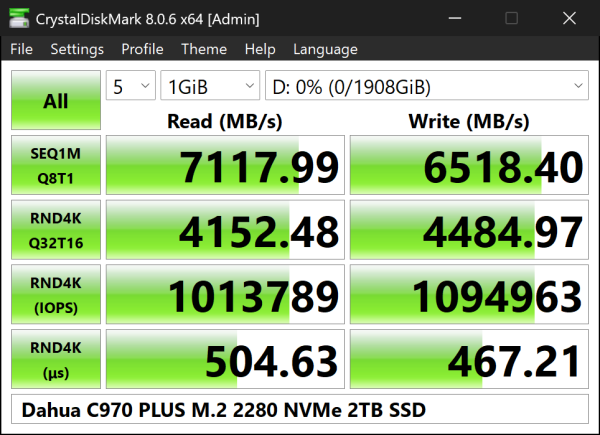
The linear read and write speeds are 7.1 and 6.5 GB/s respectively, while the peak speeds for small block operations reach 1.0 and 1.1 million IOPS. Based on these figures, the Dahua C970 Plus slightly outperforms the new Samsung 990 Evo Plus, which gives it the right to claim a spot among the best bufferless SSDs with PCIe 4.0 interface. However, it's important to mention the interface here: bufferless drives with the faster PCIe 5.0 interface based on the Phison E31T controller have already hit the market, and they are naturally significantly faster.
Nonetheless, Dahua does not try to pretend that the C970 Plus is a high-end solution. For instance, there is currently no 4 TB variant of this drive in the lineup, which is typical for mainstream models. However, in the future, the manufacturer could well release such a version—as the MAP1602 controller allows for that.
Along with quite high speed characteristics, the C970 Plus is offered at a relatively low price. To be fair, this SSD is currently priced slightly higher than similar products from smaller brands. But a small markup for the Dahua drive can be forgiven. Although Dahua is a Chinese brand, it is not just some 'no-name'; it is a well-known name on a global scale.
Software
No service software for the Dahua C970 Plus is offered by the manufacturer. However, this is a completely typical situation for drives based on Maxio controllers.
Description of the test system and testing methodology
For comparison with the Dahua C970 Plus, we selected several modern drives with PCIe 4.0 and PCIe 5.0 interfaces. Its main competitors will be the similarly equipped Netac NV7000-t, the new bufferless PCIe 4.0 drive Samsung 990 Evo Plus, as well as the Kingston KC3000, which represents an army of drives based on the Phison E18 controller, many of which are still available on the market.
Details about all participants in the tests are summarized in the table.
| Drive | Article | The PerformanceResourceTiming | Controller | DRAM buffer | Flash memory | Firmware |
|---|---|---|---|---|---|---|
| Adata Legend 900 2048GB | SLEG-900-2TCS | PCIe 4.0 x4 | Maxio MAP1602 | No | YMTC 232L QLC NAND | SN14436 |
| Dahua C970 Plus 2048GB | DHI-SSD-C970VN2TB | PCIe 4.0 x4 | Maxio MAP1602 | No | YMTC 232L TLC NAND | H231255a |
| Digma Meta P31 2048GB | DGSM5002TP31T | PCIe 5.0 x4 | Phison PS5031-E31T | No | Kioxia 218L TLC NAND | EVFM00.0 |
| Kingston KC3000 2000GB | SKC3000D/2048G | PCIe 4.0 x4 | Phison PS5018-E18 | 2 GB | Micron 176L TLC NAND | EIFK31.6 |
| MSI Spatium M570 Pro Frozr 2000 GB | SM570PN2TBF | PCIe 5.0 x4 | Phison PS5026-E26 | 4 GB | Micron 232L TLC NAND | EQFM22.2 |
| Netac NV7000-t 2000GB | NT01NV7000t-2T0-E4X | PCIe 4.0 x4 | Maxio MAP1602 | No | YMTC 232L TLC NAND | H230827a |
| Samsung 990 Evo Plus 2000 GB | MZ-V9S2T0BW | PCIe 4.0 x4 | Samsung Piccolo | No | Samsung 236L TLC NAND | 2B2QKXG7 |
| Samsung 990 Pro 2000 GB | MZ-V9P2T0BW | PCIe 4.0 x4 | Samsung Pascal | 2 GB | Samsung 236L TLC NAND | 4B2QJXD7 |
The configuration of the test system was as follows:
- Processor: Intel Core i9-14900K (Raptor Lake Refresh, 8P+16E cores, 3.2-6.0/2.4-4.4 GHz, 36 MB L3).
- CPU cooler: Noctua NH-D15.
- Motherboard: ASUS ROG Maximus Z790 Apex (LGA1700, Intel Z790).
- Memory: 2 × 16 GB DDR5-6400 SDRAM (G.Skill Ripjaws S5 F5-6400J3239G16GX2-RS5K).
- Graphics Card: GIGABYTE GeForce RTX 4090 Gaming OC (AD102 2235/2535 MHz, 24 GB GDDR6X 21 Gbps).
Test drives during the tests are installed on the motherboard in the second PCIe 5.0 x16 slot (via Asus PCIe 5.0 M.2 Card adapter), to which PCI Express lines are directly connected from the processor.
Testing was carried out in the Microsoft Windows 11 Pro (24H2) Build 26100.2605 operating system. The system used the Microsoft Standard NVMe Express Controller driver 10.0.26100.2454.
SLC caching: writing, reading, and deleting files
SLC caching is a crucial algorithm that in modern drives accelerates write operations. Its essence lies in the fact that data on SSDs with TLC or QLC memory is first written in fast single-bit mode, while its compaction occurs later, during idle times of the drive. This means that modern drives can demonstrate high speeds only on limited amounts of data, the size of which depends on the specific implementation of the SLC caching algorithm.
To find out how this works in practice and the speeds of the flash memory array of specific drives operating in various modes, we conduct a continuous file write test on the SSD until its capacity is completely exhausted while measuring performance at the same time. This test uses standard single-threaded file copy operations for the Windows OS on the tested SSD (from a RAM disk), and the trial is conducted in three passes: for a completely clean SSD; for an SSD half-filled with data; and for an SSD that is initially three-quarters full.
SLC caching operates on the Dahua C970 Plus on a dynamic principle, meaning the size of the SLC cache depends on the amount of free space on the drive. On a clean and half-filled 2 TB SSD, it is possible to write about 320 GB of data at high speed, but if three-quarters of the capacity is occupied by data, the size of the SLC cache reduces by half to 160 GB.
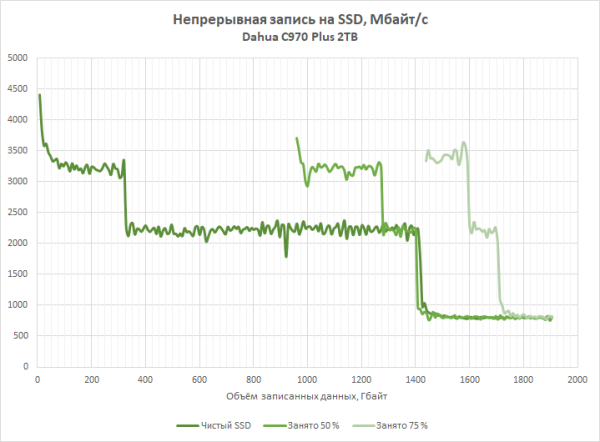
The speed of SSD data filling has three gradations, typical for TLC memory drives. The SLC mode provides a write speed of 3.1-4.4 GB/s, while in standard TLC mode, the speed drops to 2.0-2.2 GB/s. In the most unfavorable case, when internal data compaction occurs along with writing, switching SLC cache cells to TLC mode results in a write speed of about 800 MB/s.
When discussing the average speed across the entire capacity of the drive, the Dahua C970 Plus performs quite well — among options with a four-channel flash memory array, it ranks as one of the fastest solutions. Filling all 2 TB of this SSD’s capacity with files takes about 20-22 minutes. Only eight-channel drives achieve better results, and even then, not all of them.
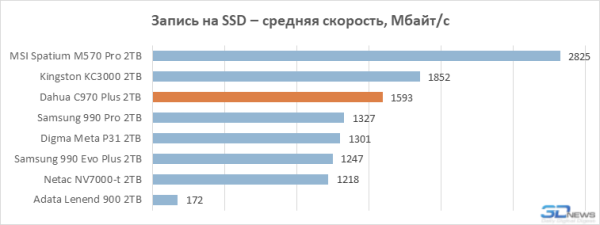
It is worth noting that in terms of average filling speed, the Dahua C970 Plus noticeably outperforms the Netac NV7000-t — a similar drive with the same hardware components. However, they differ in firmware logic, resulting in completely different SLC cache behavior. In the C970 Plus, its size is almost halved, allowing the drive to write data outside its bounds significantly quicker.
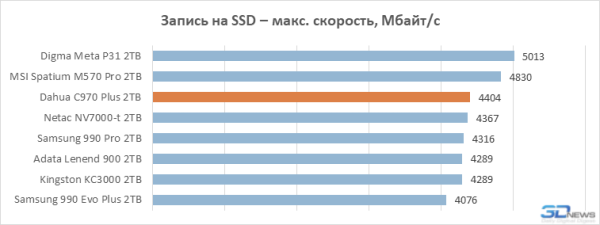
If we look at maximum speed for writing using Windows on various SSDs, all drives with a PCIe 4.0 x4 interface will be similar. The best results are achieved only by models using the PCIe 5.0 x4 bus.
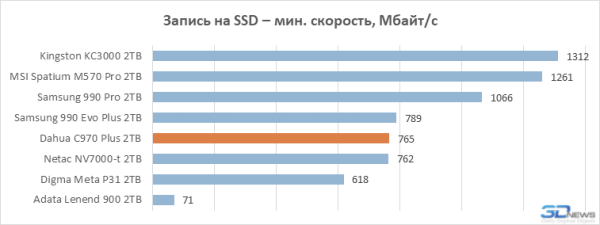
In terms of minimum speed, the Dahua C970 Plus falls into the subgroup of drives with four-channel controllers and TLC memory: all of them deliver approximately the same lowest level of write performance.
The analyzed drive does not demonstrate significant differences from similar-class solutions when evaluating average file reading speeds using Windows. Moreover, the four-channel memory array of this SSD performs no worse than the eight-channel array in the Samsung 990 Pro, which serves as clear evidence of the success of the 232-layer TLC 3D NAND from the Chinese manufacturer YMTC.
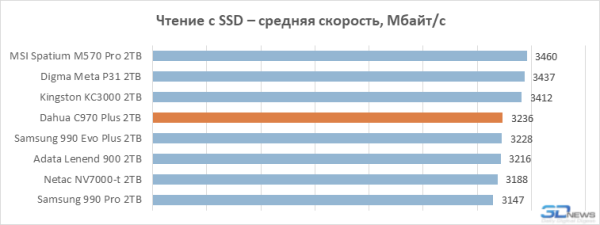
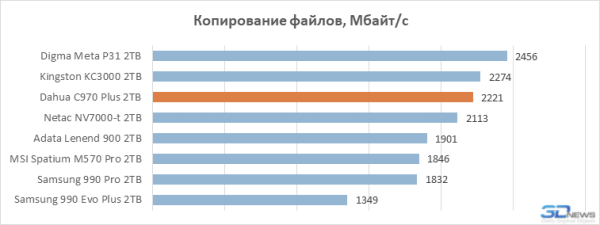
Thus, the Dahua C970 Plus confidently handles basic file copy operations between drives. The Maxio MAP1602 platform equipped with 232-layer TLC memory from YMTC is considered one of the best options for bufferless drives with a PCIe 4.0 interface, and the drive reviewed here currently confirms this with confidence.
There are no complaints regarding its performance when examining how it processes file deletion operations. After deleting large volumes of data on the Dahua C970 Plus, its performance dips for only a few seconds, and this behavior is quite acceptable for a consumer SSD. Moreover, although the drive temporarily loses speed, it retains enough responsiveness so that users do not suspect anything is amiss. This is clearly illustrated by the chart below, which shows what happens to the performance of the C970 Plus after deleting 16 files, each 8 GB.
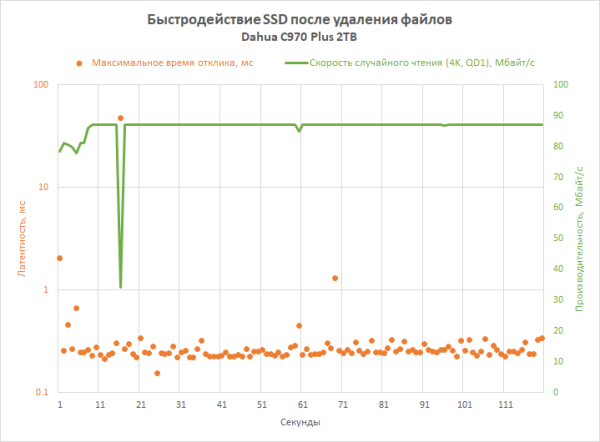
The consequences of file deletion manifest to some extent within 15 seconds after the operation, but noticeable negative effects, such as a more than twofold drop in speed, occur only momentarily and not immediately.
Performance of complex file operations
Another file operation in Windows that we check while getting to know new SSDs is copying, archiving, and unarchiving files within the drive's space. These scenarios are more complex than copying to or from the drive, as they require the drive to handle two divergent data streams, where the power of the controller and its algorithms play a more significant role.
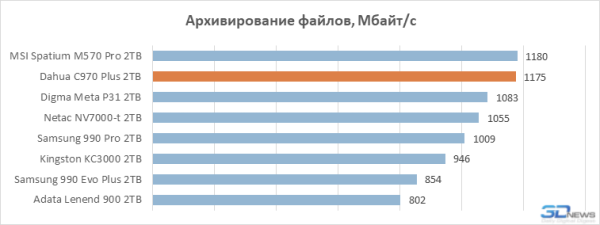
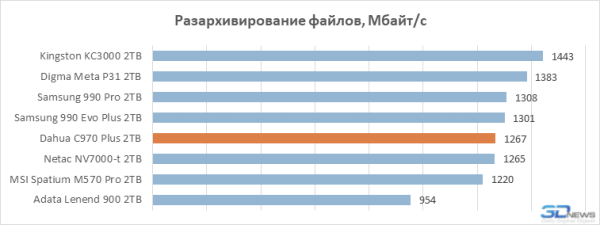
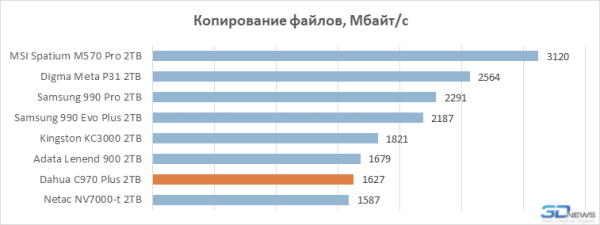
However, under such load, the Dahua C970 Plus performs very commendably. Overall, its results can be quite comparable to those of the Kingston KC3000, a drive with a DRAM buffer and an eight-channel flash memory array. In other words, for use as storage, the reviewed SSD is quite suitable: its results are at the top of the charts both for normal folder copying and for archiving tasks.
Performance in applications
To study the performance of storage devices in various applications, we use two tests that replicate the disk activity occurring on PCs when solving practical tasks. The first test, PCMark 10, is focused on assessing performance in common scenarios typical for home and office use. The second, SPECworkstation 4.0, as the name suggests, has a professional focus and simulates significantly more intense workloads characteristic of workstations used for engineering or scientific tasks.
The result of the Dahua C970 Plus in PCMark 10 is quite predictable. This SSD demonstrates exactly the same performance as its relatives based on the Maxio MAP1602 controller with TLC or even QLC memory. This means that, on one hand, the C970 Plus outperforms the Kingston KC3000 on the Phison E18 platform, but on the other hand, it falls short compared to the bufferless Samsung 990 Evo Plus.
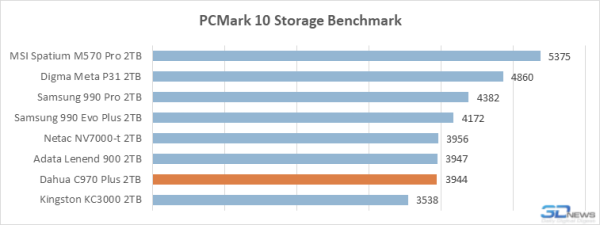
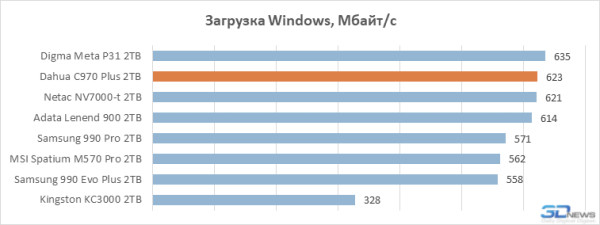
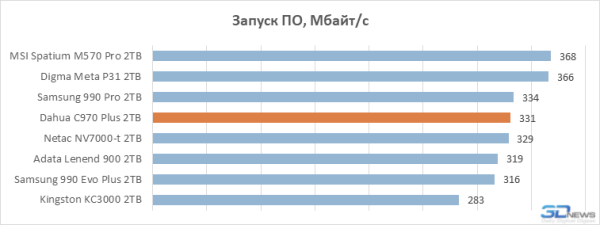
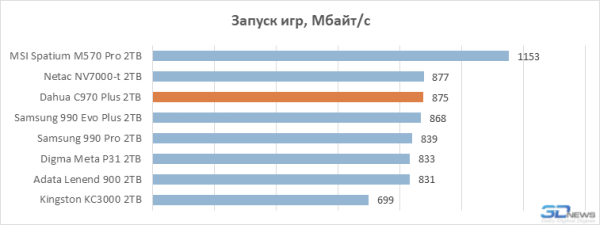
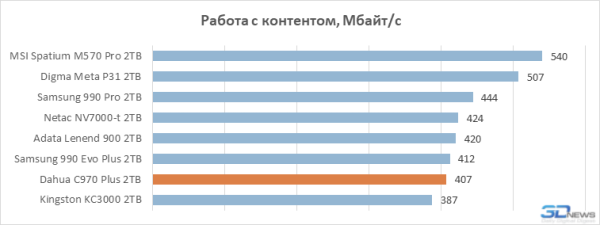
If we focus on how the SSD in question performs across the various workloads included in PCMark 10, we can conclude that launching the operating system, applications, and games are more suitable usage scenarios for it than utilizing it as a primary drive for creating and processing digital content.
Source: 3dnews.ru
