

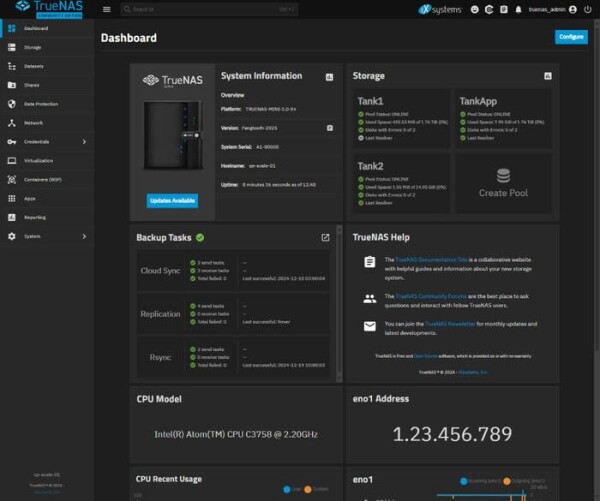
iXsystems has released the TrueNAS 25.04 distribution, which uses the Linux kernel and Debian package base. After transitioning the TrueNAS Core branch, based on FreeBSD, to maintenance mode, the Linux edition has been renamed to TrueNAS instead of TrueNAS SCALE. The size of the ISO image is 1.9 GB. Source texts specific to TrueNAS build scripts, web interface, and layers have been published on GitHub.
Key features of TrueNAS include the ability to create storage pooled across multiple nodes, the use of isolated containers, and suitability for building software-defined infrastructures. The ZFS (OpenZFS) file system is utilized. Support for Docker containers, KVM-based virtualization, and scaling across multiple nodes with Minio or Syncthing is provided.
Access to the storage is supported through SMB, NFS, iSCSI Block Storage, S3 Object API, and Cloud Sync. The storage can be deployed on a single node and can later expand horizontally by adding additional nodes as needs grow. Besides handling storage organization tasks, nodes can also be used to provide services and run applications in containers orchestrated via the Docker platform or in KVM-based virtual machines. For secure access, connections can be made through VPN (OpenVPN).
Among the changes in the new version:
- The Linux kernel has been updated to version 6.12 (previously version 6.6 was used).
- OpenZFS now includes the "fast_dedup" mode, which uses a new deduplication table format that significantly speeds up operations related to the deduplication of data blocks.
- The process of expanding RAID-Z arrays has been accelerated fivefold.
- Experimental support for LXC containers and QEMU/KVM-based virtualization has been added. Incus tools (a fork of LXD) have been used for managing containers and virtual machines.
- It is now possible to specify (the key to connect to is specified, and iroh finds the associated host and establishes an encrypted connection using the QUIC protocol). Direct P2P connections are established whenever possible, but if not, it falls back to using relays, which are also employed for host discovery by keys. You can run your own relay or connect to public relays supported by the community. for additional applications running in isolated containers.
- The login interface for the web interface has been improved.
Source: opennet.ru
