

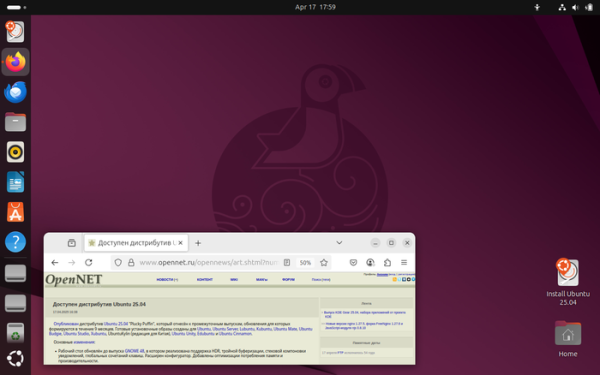
The Ubuntu 25.04 "Plucky Puffin" distribution has been released, classified as an intermediate release, with updates provided for 9 months. The installation images are available for Ubuntu, Ubuntu Server, Lubuntu, Kubuntu, Ubuntu Mate, Ubuntu Budgie, Ubuntu Studio, Xubuntu, UbuntuKylin (the edition for China), Ubuntu Unity, Edubuntu, and Ubuntu Cinnamon.
Key Changes:
- The desktop has been updated to the GNOME 48 release, which introduces HDR support, triple buffering, a notification stack layout, and global keyboard shortcuts. The configurator has been expanded, with optimizations for memory usage and performance added.

- In Ubuntu Desktop, Papers (a fork of Evince rewritten in GTK4 and partially in Rust) has been proposed as the alternative PDF viewer instead of Evince.
- The xdg-terminal-exec wrapper is enabled by default, simplifying the replacement of the terminal emulator invoked by the Ctrl+Alt+T keyboard shortcut.
- After the closure of the Mozilla Location Service project, location services have transitioned to using the BeaconDB database with information about the locations of known wireless access points.
- By default, system startup sound effects are turned off.
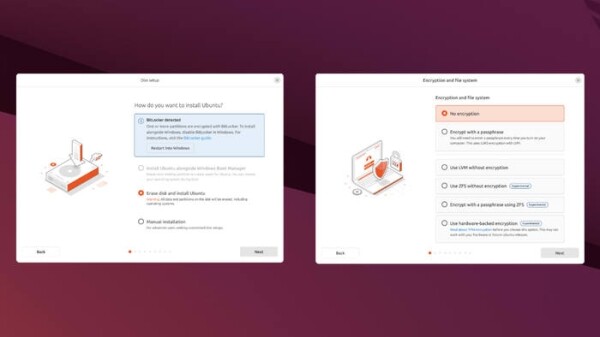
- The installer in Ubuntu Desktop now includes a mode for replacing existing Ubuntu installations. When installing in dual-boot mode, if other operating systems are already in use on the system, installation on encrypted partitions is permitted, and advanced settings for disk partitions are provided. It is now possible to install Ubuntu on the same drive as Windows systems that use BitLocker encrypted partitions.

- The APT 3.0 package manager has been implemented, featuring a new dependency resolution engine, Solver3, which offers a clearer display of the dependency list, adds a crypto backend for the OpenSSL library, removes the apt-key command, supports snapshots, and has revised handling of keys and digital signatures.
- Instead of releasing separate builds tailored for each ARM64 device, the distribution has moved to providing a single common ISO image of Ubuntu Desktop for ARM64 architecture devices. This image can be used for installations on workstations with Ampere processors, laptops with Snapdragon chips, and in virtual machines on Apple Silicon Mac systems.
- Improvements have been made to the capabilities for using ARM64 architecture devices as workstations with graphical environments. Support for new devices, such as those based on Qualcomm Snapdragon X Elite 13, has been added. Packages ubuntu-x1e-settings and qcom-firmware-extract have also been introduced.
- In addition to initramfs-tools, optional support for the Dracut toolkit for creating initial RAM disk (initrd) images has been added. In the Ubuntu autumn release 25.10, the Dracut toolkit is intended to be used by default. The issues with initramfs-tools that will be resolved after switching to Dracut include: inability to use systemd in initrd, lack of NVMe over Fabric (NVM-oF) support, maintenance complexity due to separate handling of initrd and root FS, stagnation in the development of initramfs-tools, and an abundance of shell code in initrd.
- The crypto-config toolkit has been added to the repository, intended for working with a system-wide profile of settings related to cryptography. Currently available profiles include default, legacy, and future.
- The Linux kernel has been updated to version 6.14. Among the kernel-related innovations is support for the 'sched_ext' (SCX) mechanism, which allows the use of eBPF to create CPU schedulers, as well as the implementation of the NTSYNC driver, which provides a set of Windows NT synchronization primitives that significantly enhance the performance of Windows games running via Wine. The bpftools and linux-perf toolkits have been separated into distinct packages. Instead of a separate package with the linux-lowlatency kernel, the built-in capabilities of the base kernel and the lowlatency-kernel utilities are used.
- System packages have been updated: glibc 2.41, systemd 257, binutils 2.44, OpenSSL 3.4.1, GnuTLS 3.8.9, BlueZ 5.79, NetworkManager 1.52, Pipewire 1.2.7, Poppler 25.03, xdg-desktop-portal 1.20.
- Developer tools have been updated: GCC 15 (snapshot of the future release), LLVM 20, Python 3.13.3, Go 1.24, Rust 1.84, .NET 9.0, PHP 8.4, Ruby 3.3, OpenJDK 24, PostgreSQL 17, Valkey (a Redis fork) 8.0.2, MySQL 8.4.4, Qt 6.8.3.
- User applications have been updated: GIMP 3.0, LibreOffice 25.2, Firefox 137, Thunderbird 128.
- Server packages have been updated: Nginx 1.26.3, Apache httpd 2.4.63, OpenSSH 9.9, cloud-init 25.1.1, runc 1.2.5, Docker 27.5.1, Containerd 2.0.2, HAProxy 3.0.7, libvirt 10.10.0, ClamAV 1.4.2, OpenLDAP 2.6, QEMU 9.2.0, Squid 6.13, SSSD 2.10.1, Samba 4.21.
- In Chrony, time synchronization is now by default based on servers accurate time from the Ubuntu project, using the NTS protocol.
- The Fish shell has been updated to branch 4.0, rewritten in Rust.
- On laptops with NVIDIA GPUs, the nvidia-powerd service is enabled by default, providing support for the Dynamic Boost mechanism that balances power consumption between the CPU and GPU to enhance performance. Proprietary NVIDIA drivers have been updated to branch 570.x.
- Full support is provided for Intel GPU based on the Xe2 architecture, such as Intel Core Ultra Xe2 with integrated Intel Arc graphics and discrete Intel Arc B580/B570 'Battlemage' GPUs. In applications supporting Intel Embree library, such as Blender, rendering performance has increased by 20-30% due to 2-4 times acceleration of ray tracing. Discrete 'Battlemage' GPUs offer hardware acceleration for video encoding in AVC, JPEG, HEVC, and AV1 formats.
- The creation of the file /run/utmp containing data about users currently working in the system has been discontinued. The utmp format, which uses a 32-bit time_t value, is considered outdated due to susceptibility to the year 2038 problem. Support for cgroup v1 and services launched through System V init style scripts will be discontinued in the next release.
- The toolkit for configuring network parameters has been updated to the Netplan 1.1.2 release, which introduces the capability to use the 'wpa-psk-sha256' authentication method in wireless networks and adds support for the 'routing-policy' parameter in NetworkManager.
- Builds for Raspberry Pi boards now include a stack for working with cameras based on libcamera 0.4 and libpisp. The package gnome-initial-setup is utilized for initial system setup, executed at first boot. The libraspberry-bin utilities have been replaced with raspi-utils. Network booting is enabled using nbd-client.
- Changes have been made to the AppArmor configuration aimed at blocking circumvention of access restrictions to 'user namespace'. A special 'bwrap-userns-restrict' profile has been added, allowing for the creation of 'user namespace' and setting up isolated environments prior to transitioning to more stringent constriction of process capabilities. Profiles for busybox and nautilus that allowed the creation of 'user namespace' have been removed. The number of applications protected by AppArmor profiles has been expanded.
- The ADSys package (Active Directory Certificate Auto Enrollment) has been updated, allowing for the automatic retrieval of certificates from Active Directory services when group policies are enabled. Automatic certificate retrieval through Active Directory is also applied when connecting to corporate wireless networks. VPN.
- Libraries for supporting JPEG XL image format, which do not require the installation of additional packages, have been included in the main composition.
- The package va-driver-all has been added to the 'main' repository, including the libva library and necessary components for its operation, allowing the use of VA-API (Video Acceleration API) for hardware-accelerated video encoding and decoding.
- Work continues on the atomically updatable version of Ubuntu Core Desktop, which uses Ubuntu Core technologies and only includes applications packaged in Snap format.
- Xubuntu has adopted the release of the Xfce 4.20 desktop environment.
- Ubuntu Cinnamon offers version 6.4.8 of the Cinnamon desktop. Unnecessary packages have been cleaned up, allowing for a slight reduction in the build size. The Yaru-Cinnamon theme has been improved. Dark and light variants of the default wallpapers have been added.
- Ubuntu Mate continues to ship with the MATE 1.26 desktop.
- Lubuntu has included the release of the LXQt 2.1.0 desktop environment. The transition from Qt 6.6 branch to Qt 6.8 has been made. The installer, based on the Calamares framework, has been significantly sped up.
- Ubuntu Studio now uses the KDE Plasma 6.3 desktop by default and features a dark icon set on the panel. Software versions have been updated, with Darktable 5.0.0, Ardour 8.12.0, Qtractor 1.5.3, Audacity 3.7.3, digiKam 8.5.0, Kdenlive 24.12.3, Krita 5.2.9, and GIMP 3.0 all available.
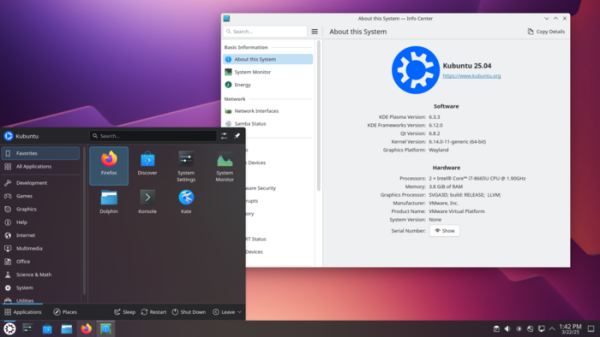
- Kubuntu features releases of KDE Plasma 6.3, Qt 6.8, KDE Frameworks 6.12.0, and KDE Gear 24.12.3. A Wayland-based session is offered by default, with X11 support available as an option.
Source: opennet.ru
