

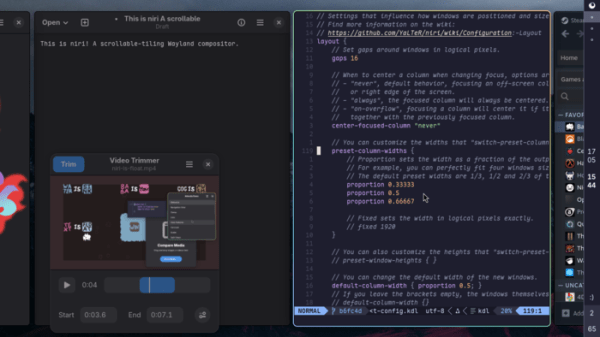
The release of the composite server Niri 25.05 has been published, implementing the tiling layout method in the style of the GNOME extension PaperWM, which groups windows into an endlessly scrollable ribbon on the screen. Opening a new window expands the ribbon, while previously added windows do not change their size. The project is based on the use of the Wayland protocol, but also allows launching X11 applications using the Xwayland DDX server. The project's code is written in Rust and is distributed under the GPLv3 license. Packages are built for Fedora, NixOS, Arch Linux, and FreeBSD.
A fundamental difference between Niri and PaperWM is the binding of its own window ribbon for each monitor, which does not overlap with ribbons on other monitors (in PaperWM, separate monitor handling cannot be implemented due to the binding to global window coordinates in GNOME Shell). Niri supports HiDPI and can operate on systems with multiple GPUs (for example, hybrid systems with a discrete graphics card and an integrated GPU). It features a built-in interface for taking screenshots and recording screencasts, with the ability to exclude specific windows that contain confidential information from the recording.
Virtual desktops in Niri are created dynamically and, similar to GNOME, are arranged vertically (the window ribbon rotates horizontally while the desktop ribbon is vertical). An independent set of desktops can be displayed on each monitor. virtual desktops. To switch between desktops and windows, control gestures on the touchpad can be used. When a monitor is disconnected, the layout of virtual desktops is remembered and transferred to the remaining monitor, and when the monitor returns, it is restored to its original state. Configuration is done through a configuration file, allowing changes to parameters such as frame width, padding, output modes, and window sizes. Changes made to the configuration file are applied automatically without restarting the compositing server.
In the new version:
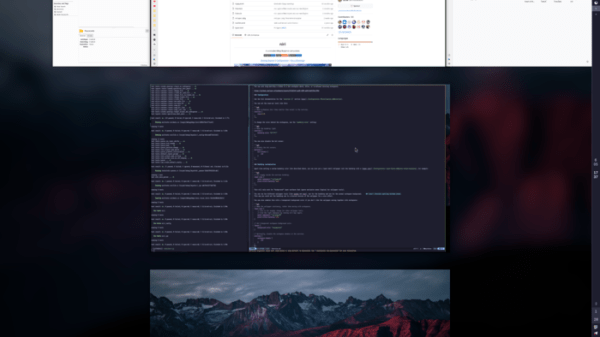
- A preview mode has been added for navigating through virtual desktops and the windows open on them. This mode is activated by moving the cursor to the top left corner or by sweeping four fingers on the touchpad, after which the scale is reduced and a ribbon of the available virtual desktops and the windows open on them is displayed. Windows can be regrouped or moved between desktops using the mouse or screen gestures.

- Expanded capabilities for creating screencasts and screen sharing. Added the ability to dynamically select the object for screencasting — initially, an empty video stream is created, which can be switched to capture the active window or the entire screen on the current monitor. Support for recording the output of fullscreen applications in the form of a virtual window has been implemented.
- The screenshot creation interface has been enhanced with the ability to select the area of the snapshot using a graphics tablet or touchscreen. A separate button for taking a screenshot has been added to the bottom panel.
- The ability to highlight windows that require special attention has been added. Such windows are highlighted with a colored border (the color is set via the urgent-color setting) and are provided with a separate indicator on the panel.
- The capabilities of the IPC interface used for interaction with external systems have been expanded. proxy serverAdded commands: “niri msg pick-window” (returns the identifier of the window that the user clicked on) and “niri msg pick-color” (returns the color of the selected pixel).
- Added window actions: focus-monitor, move-window-to-monitor, move-column-to-monitor, focus-column, move-column-to-index.
- Settings for input devices have been added: disabling tap-and-drag, disabling touchscreens, changing the modifier key, selecting trackpad orientation, enabling Num Lock on startup.
- The efficiency of rendering windows into intermediate textures (offscreening) has been improved, which can be further processed (for example, layer overlay) before being displayed on the monitor.
Source: opennet.ru
