

Microsoft has announced the launch of a toolkit that supports the WSL (Windows Subsystem for Linux), allowing Linux applications to run on Windows. It is noted that anyone can now build WSL from the source code and participate in its development. Among other things, Microsoft has started accepting fixes and new features for WSL prepared by community members. The code is published under the MIT license. For developers who wish to participate in the project, the website wsl.dev has been launched.
WSL provides a virtual machine with a complete Linux kernel (based on branch 6.6), in which Linux distributions can run. The kernel includes WSL-specific modifications, such as optimizations for reduced startup time and lower memory consumption, the ability to return memory released by Linux processes to Windows, and configurations to exclude unnecessary drivers and subsystems. The system is installed in a separate disk image (VHD) with an ext4 file system and a virtual network adapter.
The WSL components related to the Linux kernel and the wslg graphics stack, used for running GUI applications based on Wayland and X11, were initially developed in an open manner, but all accompanying tools remained proprietary. From now on, the following components have been made open-source:
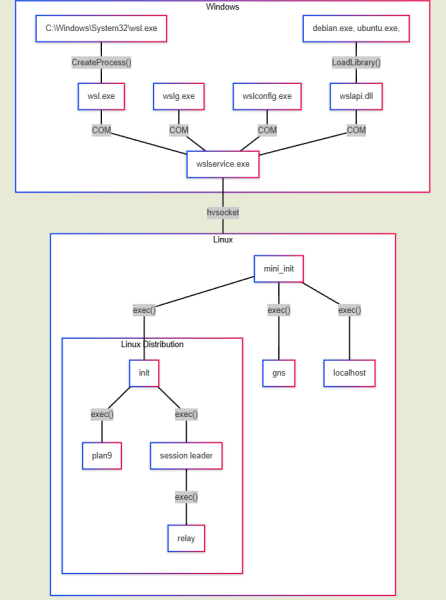
- Command line utilities wsl.exe, wslconfig.exe, and wslg.exe used for interacting with WSL.
- The service wslservice.exe, used for starting the virtual machine, activating the Linux environment within it, and mounting file systems.
- Background processes running in the Linux environment to access WSL functionality. For example, the init process for initial initialization, gns for network access configuration, localhost for port forwarding.
- The plan9 process with implementation server Plan9, used in WSL for sharing Linux files from Windows.
Remain part of Windows and are not open at this time:
- The kernel driver Lxcore.sys, used for running executable files in ELF format through a compatibility layer.
- The driver P9rdr.sys and library p9np.dll, providing access redirection to the FS ‘\\wsl.localhost’ when accessing Linux from Windows.
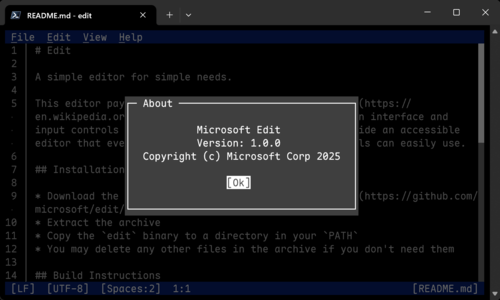
At the same time, Microsoft has open-sourced under the MIT license the source code for the console text editor Edit, written in Rust and intended to be included by default in 64-bit versions of Windows. In the coming months, the editor will be made available for review and testing in Windows Insider Program builds, after which it will be included in the standard distribution of Windows 11.
The editor features a modern interface reminiscent of VS Code. Its goal is to provide an interface that is clear and easy to use, even for those without terminal experience. The editor is compact, occupying only 250kB on the disk. Key features include a menu system, keyboard shortcuts or mouse control, tab support, simultaneous editing of multiple files, search and replace functions, and an automatic line wrapping mode.
Additionally, it is worth noting that the issue in the May update of Windows, which prevented some Linux systems from booting in dual-boot configurations where both Windows and Linux are installed, has been resolved. This problem arose last August and was addressed only now (previously, the fix required manual removal of SBAT data set in UEFI). The crux of the issue was that Microsoft sought to block bypassing Secure Boot mode using vulnerable versions of GRUB on computers running only Windows, but overlooked certain nuances. Ultimately, this change disrupted the boot process for users with dual-boot systems using Linux distributions with outdated SBAT settings and the GRUB bootloader.
Source: opennet.ru
