

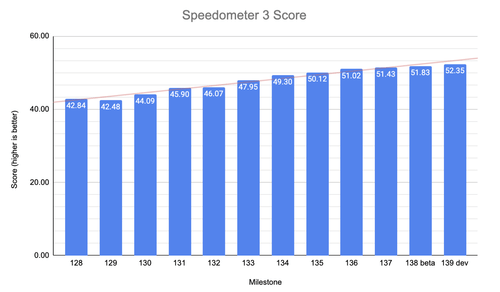
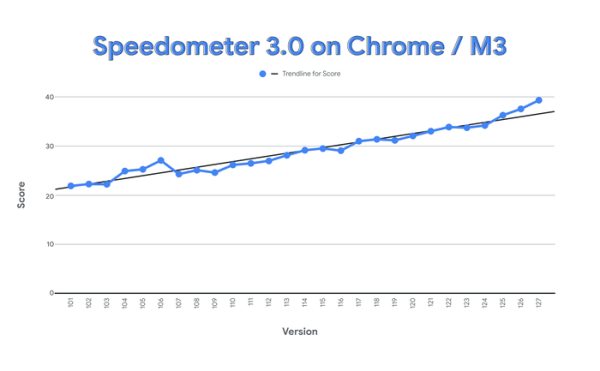
Google has summarized the optimizations made in Chrome since August of last year. These changes accelerated the Speedometer 3 test score by 22% (from 42.84 to 52.35 points) and achieved the best results among all browsers. It was mentioned that the performance gain would collectively reduce website loading wait times by 58 million hours for all users of the browser, assuming each user spends only 10 minutes a day on Chrome. Notably, from April 2022 to August 2024, the performance of Speedometer 3 in Chrome grew by 94% (Chrome 101 scored approximately 22 points, while Chrome 128 scored 42.84 points).
Among the changes that contributed to the browser's performance increase are:
- Optimization of memory layout for internal structures related to DOM, CSS, page layout, and rendering;
- Saving only necessary states in the Blink engine;
- Improving CPU cache efficiency;
- Optimizing the Oilpan garbage collector;
- Enhancing string operations and switching to the rapidhash hashing algorithm during rendering;
- Employing optimal hashing, filtering, and verification algorithms in various data structures;
- Accelerating the glyph shaping operation during text output.
The Speedometer 3.0 test suite was prepared jointly by Mozilla, Google, Microsoft, and Apple and aims to evaluate delays when simulating user interaction with typical web applications. The tests assess the performance of frameworks such as Angular, Backbone, jQuery, Lit, Preact, React, React+Redux, Svelte, and Vue, rendering using the Canvas element, generating SVG, handling complex CSS, managing very large DOM trees, and using methods applied in WYSIWYG content editing as well as working with news sites. During testing, the speed of note handling in various implementations of the TodoMVC framework is measured, text processing in WYSIWYG editors such as CodeMirror and TipTap is evaluated, operations with charts using libraries like Observable Plot, chart.js, and react-stockcharts are performed, and interaction with content on sites using web frameworks Next.js and Nuxt is simulated.
Source: opennet.ru
