

The release of the MariaDB Database Management System 11.8.2 has been announced, marking the first stable release of the 11.8 branch. The MariaDB 11.8 branch is designated for long-term support and will be maintained for at least 5 years. At the same time, MariaDB 12.0.1 is available, which is designated as a release candidate.
The MariaDB project develops a fork from MySQL, preserving backward compatibility and distinguished by the integration of additional storage engines and enhanced capabilities. The development of MariaDB is overseen by the independent MariaDB Foundation in accordance with an open and transparent development process that is not dependent on individual vendors. MariaDB is supplied instead of MySQL in many Linux distributions (RHEL, SUSE, Fedora, openSUSE, Slackware, OpenMandriva, ROSA, Arch Linux, Debian) and is implemented in major projects such as Wikipedia, Google Cloud SQL, and Nimbuzz.
Changes in the MariaDB 11.8 branch compared to the previous LTS release 11.4 include:
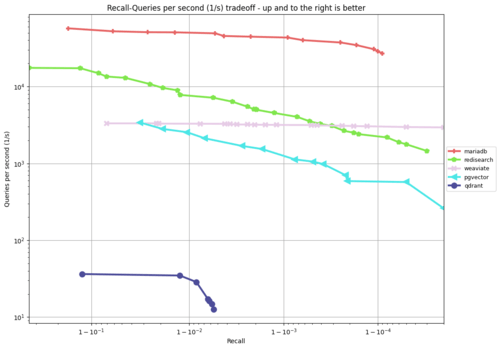
- The integration of developments from the MariaDB Vector project, which enhances capabilities for vector search, in demand in machine learning systems. Built-in support for the data type VECTOR has been implemented, along with the functions VEC_DISTANCE_EUCLIDEAN(), VEC_DISTANCE_COSINE(), and VEC_DISTANCE() to calculate vector similarity, as well as the functions VEC_FromText() and VEC_ToText() for converting between binary and text representations of vectors. Optimizations for vector processing using Intel CPU SIMD extensions (AVX2 and AVX512), ARM, and IBM Power10 have been implemented. Testing has shown that the performance of vector queries in MariaDB exceeds that of Redis, pgvector, qdrant, and weaviate.

- The year 2038 problem has been addressed. The boundary value for the TIMESTAMP type has been increased from 2038 to 2106.
- By default, the encoding has been changed from latin1 to Unicode (utf8mb4) with full emoji support. The locale properties 'Collation', defining sorting and matching rules considering the meaning of characters, have been updated to UCA version 14.0.0.
- A new password authentication plugin PARSEC (Password Authentication with Response Signed by Elliptic Curves) has been added, which uses the PBKDF2 function for password hashing and verifies responses using a public key based on the ed25519 digital signature scheme.
- Authentication for database access from the local system has been improved using UNIX sockets.
- Support for multithreaded backup creation and restoration has been added to mariadb-dump and mariadb-import. Parallelization is applied both when dumping a single large database and during simultaneous backups of multiple databases.
- Replication performance has been significantly enhanced. A mechanism for switching segments of the binary log (binlog) has been implemented to speed up the acceptance of very large transactions, allowing for the avoidance of resource-intensive file copying operations. To reduce restart time after failures, a rollback of transactions in asynchronous mode has been ensured. A setting named 'slave_replication_delay_abort_timeout' has been added to automatically cancel transactions that block replication for too long.
- Monitoring tools have been expanded. Additional columns for performance analysis and problem diagnosis have been added to the statistics tables.
- A USERS table has been added, containing information about users, the restrictions applied to them, and the duration of their passwords.
- Commands 'FLUSH GLOBAL STATUS', 'REPAIR TABLE … FORCE', and 'SHOW CREATE SERVER' have been added.
- The ability to return values with a ROW type from stored procedures has been introduced.
- Compatibility with Oracle DBMS has been improved when working with sequences. The 'CREATE SEQUENCE … AS' operation can now be used with any integer types, including 'BIGINT UNSIGNED'.
- New functions for generating UUIDs have been added — UUID_v7 and UUID_v4.
- A FORMAT_BYTES function has been introduced for converting byte counts into a human-readable format (for example, FORMAT_BYTES(1000000000) will yield 953.67 MiB).
- The ability to limit disk space used for temporary files and temporary tables has been added. Settings max_tmp_session_space_usage and max_tmp_total_space_usage have been introduced to set limits for both individual users and all users.
- In the query optimizer, the processing of UPDATE/DELETE operations with a single table has been accelerated. By default, optimizations for reducing encodings to a smaller subset of characters have been included. Queries with expressions 'SUBSTR(col, 1, n) = const_str' have been sped up. Support for the optimization of virtual columns has been added.
Source: opennet.ru
