

The Blender Foundation has released the free 3D modeling package Blender 4.5, suitable for a variety of tasks related to 3D modeling, 3D graphics, game development, simulation, rendering, compositing, motion tracking, sculpt modeling, animation creation, and video editing. The code is distributed under the GPL license. Ready builds are available for Linux, Windows, and macOS. The release has received Long Term Support (LTS) status and will be supported until July 2027. The LTS branch of Blender 4.2 is also still being supported, with updates planned until July 2026. Support for the Blender 3.6 LTS branch has been discontinued.
Among the added improvements:
- The EEVEE rendering engine has implemented full support for the Vulkan graphics API backend. Compared to the previous version, performance has significantly improved when using Vulkan, and the functionality level of the Vulkan backend has been brought up to parity with the OpenGL-based backend (for instance, support for OpenXR, Subdivision, and USD/Hydra has been added). It is recommended to use the latest versions of graphics drivers and Mesa for the proper functioning of the Vulkan backend. By default, the OpenGL backend is still in use.
- Texture loading has been accelerated by more than twice (from 5.7 seconds to 2.5 seconds), and launch time has noticeably reduced (from 7.2 seconds to 4 seconds). Multithreaded shader compilation is enabled by default. A setting has been added to choose the shader compilation method (multithreaded or separate process).
- A new property called 'Shadow Terminator Normal Offset' has been added, allowing rays to be offset from the surface to reduce shadow terminator artifacts on low-polygon geometry.
- The Reverse-Z algorithm has been implemented to reduce artifacts in the depth buffer.
- Support for offloading subdivision operations to the GPU has been added.
- A '--profile-gpu' option has been added to save profiling data in the profile.json file, including information about the CPU and GPU load.
- The tools for working with geometry nodes have added modules for importing files in CSV, PLY, OpenVDB (.vdb), STL, Wavefront, and TXT formats. To import a file, simply drag and drop it into the geometry node editor.
The node tools have introduced the ability to collapse panels. The geometry node editor now supports mesh normal adjustment. A 'Set Mesh Normal' node has been added for normal adjustment, along with a 'Format String' node for inserting values into strings and a 'Match String' node for string matching.

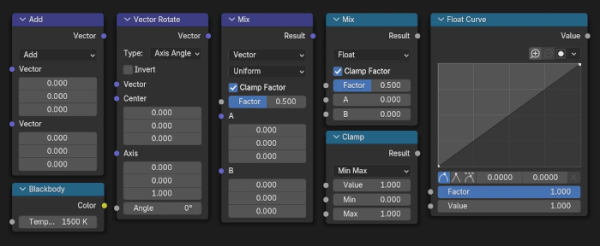
- The compositing system (Compositor) has implemented procedural nodes for texture creation, along with support for standard nodes such as Vector Math, Vector Rotate, Mix Vector, Math, and Clamp. The operation of noise removal has been accelerated with GPU support.

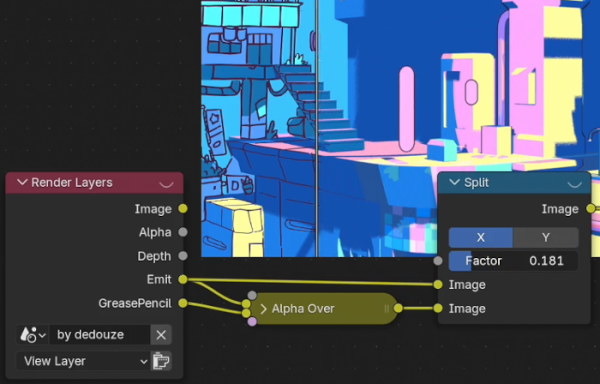
- The capabilities of the Grease Pencil 2D drawing and animation system have been expanded, allowing for sketches in 2D that can then be used in a 3D environment as three-dimensional objects (forming a 3D model from multiple flat sketches at different angles). Integration with the compositing system (Compositor) has been ensured. A new rendering pass has been added, outputting visible strokes and fills of Grease Pencil to a separate layer, which can be useful for isolating, enhancing, or applying effects to Grease Pencil elements during compositing. The ability to disable Grease Pencil rendering for each layer (View Layer) has been added via the Filter option. A new smoothing method (SSAA) has been implemented, making lines smoother. Support for exporting animated SVG files has also been included.

New tools (Node Tools) have been introduced, allowing the use of nodes to create Grease Pencil objects. New nodes for color filling, depth adjustment, and stroke smoothing in Grease Pencil have also been added.
- In the UV editor, the option to view UV unwraps for the active or all selected objects is now available, regardless of the current mode, including in the image editor. The visibility and transparency of UV unwraps can be adjusted through the Overlays pop-up menu.
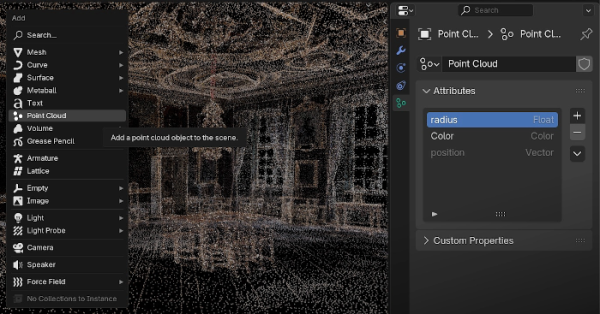
- A new object type "Point Cloud" has been added to represent a large number of individual points in 3D space. Each point in the point cloud can store additional attributes such as radius, position, and color. The new object is significantly more efficient than regular meshes and can be used for visualizing scanned 3D data and particle simulations.

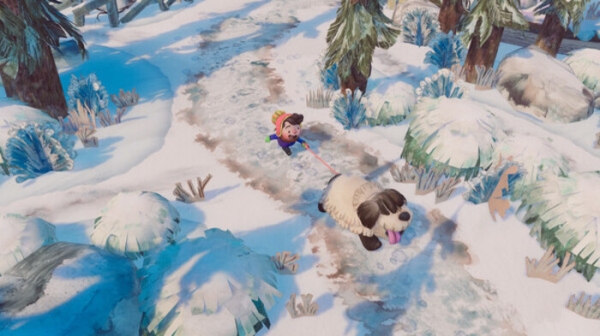
- A screensaver inspired by the new game DOGWALK from Blender Studio has been deployed. The game is created in the interactive story genre (a child walks a dog through a winter forest and decorates a snowman with hidden items) and has developed to refine tools for using Blender as a platform for asset and game level development for the Godot engine.

- In sculpting, texturing, and vertex painting modes, a randomization feature for hue, saturation, and brightness values has been introduced, applicable to both the entire stroke and individual brush strokes.
- In sculpting mode for the "Trim" tool, a new Manifold solver has been implemented, used only with deployable meshes. Manifold operates faster than the Fast mode, which has now been renamed to Float. The new solver is based on the eponymous library already in use within the Boolean modifier and geometry nodes.
- The user interface modernization continues. In the node editors, adding nodes to frames has been simplified (now you just need to press the F key after selecting the nodes).
- In the properties editor, the ability to hide unused tabs has been provided to reduce clutter in the interface (for example, in a video editing workspace, the Object and Shading tabs can be hidden).
- In the asset and file browsers, a content viewing mode has been implemented in the form of a horizontal list, allowing more content to fit on the screen. Long labels are split into two lines with priority given to showing the beginning and end of the label (so that the file extension remains visible).
- In the asset browser, a Screenshot Capture mode has been implemented for quickly previewing edited assets, allowing for viewing without needing to transition to rendering (simply select an area on the screen for previewing).
- The non-linear video editor (Video Sequencer) has improved content caching. HDR support has been implemented in the preview area.
- The table editor now allows arbitrary reordering of columns and changing their width.
- It is now possible to import several SVG files at once.
- You can now customize the color of error, warning, and informational message notifications.
- Large cursors for high-density pixel monitors have been added for Linux systems.
- Compatibility with the CY2025 specification, which outlines utilities and libraries for the VFX reference platform, has been ensured.
- The add-ons directory offers 497 free extensions and 128 themes.

Source: opennet.ru
