

Developers of the GNU MP (GMP) library, which provides functions for arbitrary precision arithmetic, have alerted users about an incident involving repeated failures of AMD Ryzen 9000 processors based on the Zen 5 microarchitecture during library testing. It is believed that the processor damage was caused by overheating occurring during intensive execution of GMP functions. Until a complete analysis of the problem is finished, users are advised not to actively use GMP on systems with AMD Zen 5 CPUs.
The concerns arise from the repeated failure of the AMD Ryzen 9950X (AMD Zen5 X16 4300MHz) CPU in server the project's testing infrastructure. The first failure occurred in February 2025, after which the processor was replaced under warranty. At the end of August, the situation repeated itself, and the CPU that had been replaced under warranty, installed in a system with a different power supply unit and motherboard, also ceased functioning with the same signs indicative of overheating (a discolored area approximately 1 centimeter in diameter appeared on the chip).
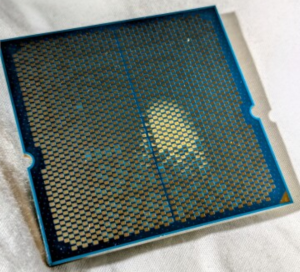
Preliminary data suggests that the GMP library uses cycles with the MULX instruction too intensively, leading to significantly greater power consumption on systems with AMD Zen 5 than specified, and an inability to mitigate heating with the cooling system chosen according to the specifications. During both failures, tests were conducted using manual assembly cycles with a single MULX instruction, creating maximum load.
The systems used Asus Prime B650M-K and Asus Prime B650M-A WIFI II motherboards, as well as Corsair SF450 and Corsair RM650 power supplies. In both configurations, a Noctua NH-U9S cooling system was used, but in the first case, the heatsink was installed centrally, while in the second, it was offset towards the area with higher heat, as per the manufacturer's recommendation.
It is noted that in the second case, the thermal paste was not distributed evenly (the layer was thinner on one side), and it cannot be completely ruled out that the second failure was caused by improper installation of the cooler. The CPU Ryzen 9950X has a stated thermal dissipation requirement of 170 W (TDP, Thermal Design Power), while the cooling system used provided a heat dissipation of 165 W. The missing 5 W were compensated by additional fans in the case and a low room temperature of around 20°C. Both processors failed after a few months of operation under high load. Meanwhile, in the project's infrastructure, another processor has been operational for other tasks for an extended period. server in the same configuration and under the same load, with no issues arising.
Source: opennet.ru
