

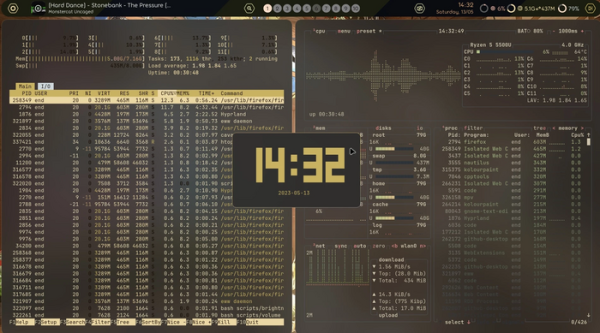
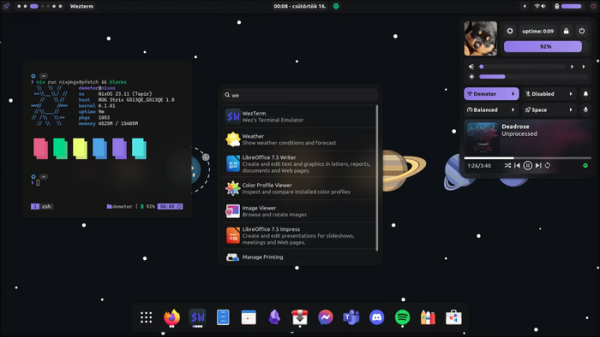
The composite server Hyprland 0.51 is available, utilizing the Wayland protocol. The project focuses on tiled window management but also supports traditional freeform window placement, tabbed window grouping, a pseudo-tile mode, and fullscreen window expansion. The code is written in C++ and distributed under the BSD license.
It offers capabilities for creating visually appealing interfaces: gradients in window borders, background blur, animation effects, and shadows. Plugins can be integrated to extend functionality, and an IPC based on sockets is available for external control. Configuration is handled through a configuration file, with changes applied on the fly without requiring a restart. Notable features also include: dynamically created virtual desktops; layout modes for elements on the screen; global hotkey handling; gesture control on the touchpad/touch screen.
In the new version:
- Gesture control capabilities on the touchpad have been enhanced. Support for assigning specific actions for different combinations of touch finger counts, modifier keys (Ctrl, Alt, Shift), and gesture movement directions has been added. Gesture binding configuration is now defined in the format 'gesture = fingers, direction, action, options'. For example, to close a window, a three-finger pinch gesture can be assigned ('gesture = 3, pinch, close'), and to switch between virtual desktops — a three-finger horizontal swipe ('gesture = 3, horizontal, workspace'). Support for old gestures: workspace_swipe, gestures:workspace_swipe_fingers, and gestures:workspace_swipe_min_fingers has been discontinued.
- A new configuration parameter dim_modal has been added to control the dimming of parent windows when displaying modal dialogs.
- An option 'getprop' has been added to the hyprctl utility to display the values of individual properties.
- Scroll behavior (scroll_factor) can now be configured for individual devices.
- An option 'cursor:invisible' has been added to hide the cursor.
- Support for DPMS animation (smooth dimming of content when switching the display to power-saving mode) has been implemented.
- For hints, context menus, and dialog windows created directly through the use of Wayland protocols, a smooth fade-in and fade-out effect has been implemented.
- When sharing the screen, the default color depth is limited to 8 bits per channel. This limitation addresses screen sharing issues in Chromium and Firefox on displays with an extended color range (Wide Gamut).
- A window rule parameter 'novrr' has been added to block the application of VRR (Variable Refresh Rate) for selected windows.
Source: opennet.ru
