

The distribution of Ubuntu 25.10 "Questing Quokka" has been published, categorized as an intermediate release, with updates provided for 9 months. Installation images are available for Ubuntu, Ubuntu Server, Lubuntu, Kubuntu, Ubuntu Mate, Ubuntu Budgie, Ubuntu Studio, Xubuntu, Ubuntu Kylin (version for China), Ubuntu Unity, Edubuntu, and Ubuntu Cinnamon.
Key Changes:
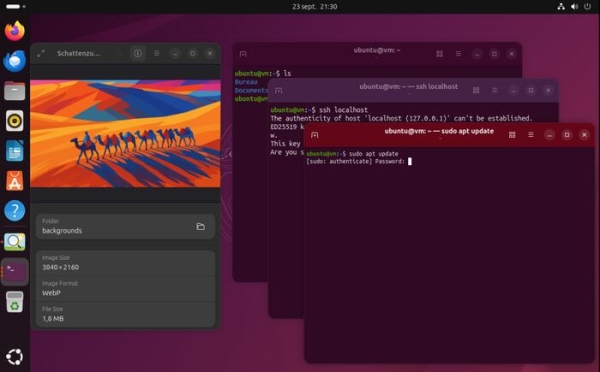
- The desktop has been updated to GNOME version 49. Support for the X11 session has been discontinued, leaving only the Wayland session, which uses XWayland to run X11 applications. Packages containing X.org components and alternative desktop environments using X11 continue to be provided in the repository.

- A user interface for managing application autostart has been added to the configurator (Settings → Apps).
- Fractional scaling options in GNOME have been optimized to minimize blur.
- The size of the monospace font used in the terminal emulator has been reduced and now matches the default font size in the user interface.
- The Loupe application, which offers a lightweight interface optimized for quick image viewing, has been implemented as the default image viewer instead of Eye of GNOME. The glycin library, which uses sandbox isolation and is written in Rust, handles image decoding. Features include smooth transitions between images, visual effects when scaling and rotating images, a properties sidebar, buttons for quick copying and deletion, and editing tools (cropping, rotating, flipping).
- The Ptyxis application has replaced GNOME Terminal, providing additional functionalities for container management using Toolbox, Distrobox, Podman, and JHBuild. Ptyxis also features advanced settings, an overview mode for visual navigation through open sessions, and very high rendering speed by utilizing Vulkan and OpenGL.
- In the Mutter compositor, HDR support has been improved and color management features have been expanded. The VRR (Variable Refresh Rate) mechanism has been implemented, allowing for adaptive changes in monitor refresh rates to ensure smoothness and eliminate tearing during gaming and video playback.
- Wayland support has been enhanced on systems with NVIDIA GPUs.
- The minimally supported version of the RISC-V architecture is the RVA23 profile (RISC-V Application), which includes extensions for vector operations and hypervisors. Currently, only a limited number of RISC-V boards support the vector extensions of the RVA23 profile, while most devices available on the market correspond to the RVA20 profile.
- For systems based on the RISC-V architecture, a fully functional desktop session is provided, supporting applications such as Firefox and Thunderbird.
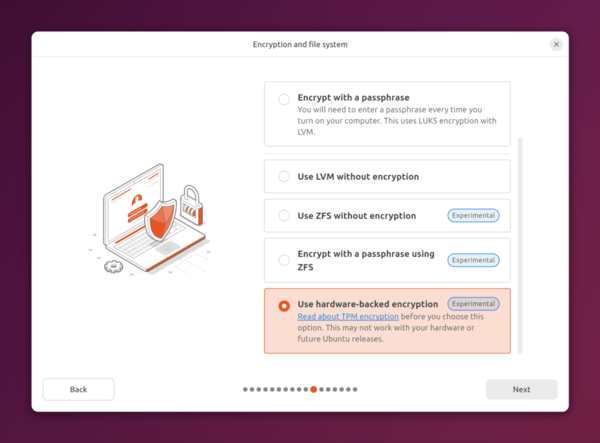
- Support for full disk encryption has been stabilized, eliminating the need to enter a disk unlock password at boot, thanks to storing decryption key information in the TPM (Trusted Platform Module). Capabilities for recovering keys used for full disk encryption based on TPM have been implemented.

- Work continues on the permission request output system, which requires user confirmation for access, such as when snap packages attempt to access files in the home directory. Dynamic access provision is organized using the AppArmor mechanism. Integration of permission requests with GNOME Shell has been improved.
- Support for Landscape, a management system for groups of workstations, has been integrated into the installer. serversThis change will allow enterprise administrators to upload automatic installation configuration files directly from the Landscape platform.
- When notifications about available updates are displayed, options are now provided to open the Software Updater application or install the suggested updates. If the notification was missed, a corresponding indicator appears in the system tray, which can also be used to initiate update installation.
- The GNU Coreutils have been replaced in the base distribution with the Rust Coreutils (uutils) toolkit, and the sudo application has been replaced with sudo-rs. The replacement of system components is part of an initiative to enhance the quality of the system environment by providing applications originally developed with a focus on security, reliability, and correctness. The supply of utilities written in Rust will help reduce the risk of memory-related errors, such as accessing memory after it has been freed and buffer overflows.
- By default, the Chrony project is used for precise time synchronization. The previously used systemd-timesyncd service has been replaced by Chrony due to the desire to implement the NTS (Network Time Security) protocol for cryptographic protection of time synchronization. Chrony provides an independent implementation of the NTP client and server and is used for precise time synchronization in Fedora, SUSE/openSUSE, and RHEL.
- To create initial RAM-disk images (initrd), the Dracut toolkit is used by default instead of the initramfs-tools package. Transitioning to Dracut will resolve issues such as the inability to use systemd in initrd, lack of support for NVMe over Fabric (NVM-oF), excessive shell code in initrd, and maintenance difficulties due to separate handling of initrd and the root filesystem.
- The intel-compute-runtime package has been rebuilt with the NEO_DISABLE_MITIGATIONS flag, which disables protection against attacks of the Spectre class. According to the developers, having such protection reduced the package's performance by approximately 20%, as package-level protection is unnecessary since blocking Spectre class attacks can be achieved with kernel-level protection.
- A new version of the APT package manager 3 (3.1.6) is implemented, which has a revamped user interface, activated the dependency resolution engine Solver3, added support for snapshots, discontinued the use of the apt-key utility, added a crypto backend for the OpenSSL library, and implemented the 'dist-clean' command.
- The Linux kernel has been updated to version 6.17. Packages linux-modules-extra-* are deprecated — all kernel modules are now provided in the linux-modules packages.
- Versions of packages have been updated, including systemd 257.9, GCC 15.2, binutils 2.45, glibc 2.42, Python 3.13.7, LLVM 20, Ruby 3.3, Rust 1.85, Go 1.24, OpenJDK 25, PHP 8.4.11, .NET 10, Pipewire 1.4.5, BlueZ 5.83, Netplan 1.1.2, Firefox 142, LibreOffice 25.8, Qt 6.9.2, VLC 3.0.21, cloud-init 25.3, Django 5.2, Dovecot 2.4, libvirt 11.6.0, PostgreSQL 17, MySQL 8.4, QEMU 10.1, Samba 4.22, Valkey (a Redis fork) 8.1.1, Mesa 25.2.3, OpenSSL 3.5.3, nginx 1.26.3, OpenLDAP 2.6.10, OpenSSH 10.0, GRUB 2.14-beta.
- Instead of the Ubuntu Report, a new system for collecting and sending telemetry, Ubuntu Insights, has been integrated, which implements periodic metric collection. The system is optional and can be enabled at the user's discretion in the initial setup wizard (GNOME Initial Setup).
- The nvidia-powerd service is enabled, providing support for the NVIDIA Dynamic Boost mechanism, which balances power consumption between the CPU and GPU to enhance performance.
- On systems with proprietary NVIDIA drivers, proper sleep mode transition support has been implemented.
- The composition of the Ubuntu Server edition has changed. The ubuntu-server package set has removed the utilities screen, wget, byobu, cloud-guest-utils, and dirmngr, which are available for installation from the repository or as dependencies (for instance, screen is among the dependencies for ubuntu-release-upgrader, cloud-guest-utils is for cloud-init, and dirmngr is for gnupg and vanilla-gnome-desktop).
- The authd service for integration with cloud authentication systems now includes support for device registration using EntraID. The authctl utility has been added for managing authd.
- Full support has been added for integrated Intel Core Ultra Xe3 GPUs and discrete Intel Arc Pro B50 and B60 "Battlemage" graphics cards.
- Kubuntu features releases of KDE Plasma 6.4, KDE Gear 25.08, Qt 6.8, and KDE Frameworks 6.17.0. The base environment of Kubuntu no longer includes the KDE session based on the X server. A package "plasma-session-x11" is available in the repository for using an X server-based session.
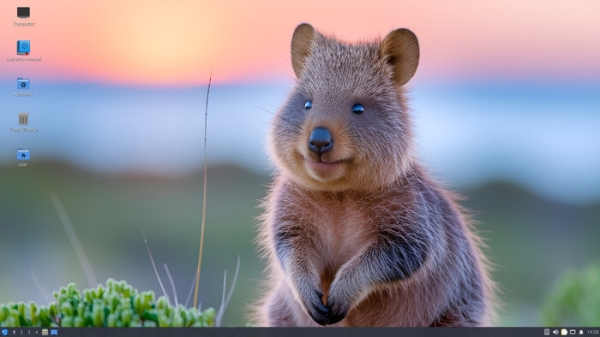
- Lubuntu now includes the release of the LXQt 2.2 desktop environment.

- Ubuntu Cinnamon offers version 6.4.12 of the Cinnamon desktop (6.4.8 was in the previous version). The Yaru-Cinnamon theme has been updated.
- Ubuntu Studio now uses the KDE Plasma 6.4 desktop. An optional macOS-style interface theme with a bottom panel and global menu has been added. The Ubuntu Studio Audio Configuration tool has received additional sound settings, many of which can be modified without root access. The JackTrip package with a graphical interface for network audio transmission has been added. Versions of Qtractor 1.5.8, Audacity 3.7.5, digiKam 8.7.0, Kdenlive 25.08.1, Krita 5.2.11, and GIMP 3.0.4 have been updated.
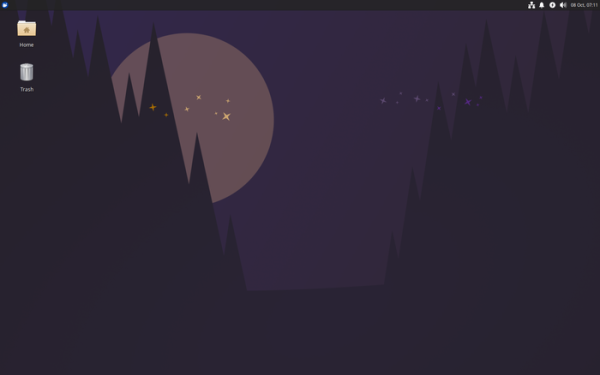
- Xubuntu continues to ship Xfce 4.20.

Source: opennet.ru
