

A vulnerability (CVE-2025-62518, codename TARmageddon) has been identified in the Rust library async-tar, which provides functions for reading and writing tar archives. This vulnerability allows specially crafted tar archives to extract not only files contained within them but also files present in nested tar archives upon extraction. This vulnerability can be exploited to bypass archive verification systems and extract files that were not subject to checks.
The vulnerability is also present in forks of the async-tar library, such as tokio-tar, krata-tokio-tar, and astral-tokio-tar, as well as in tools based on these, for example, the uv package manager, developed as a high-performance alternative to 'pip' for Python projects. Popular projects utilizing vulnerable libraries include the testcontainers toolkit for running Docker containers and the WebAssembly runtime wasmCloud. In the crates.io repository, the async-tar library has recorded 1.3 million downloads in the last 90 days, tokio-tar has 2.2 million, and testcontainers has 2.9 million.
The vulnerability is caused by an incorrect choice of position when parsing different size values in ustar and PAX headers. In PAX format tar archives, two headers are specified for each file within the archive — the classic ustar header and the extended PAX header. The problem arises because vulnerable libraries, when extracting files, relied on the size from the outdated ustar header instead of calculating the offset based on the size from the expanded PAX header. With a zero size in the ustar header, the following file contents were processed as a valid TAR header block for the next file.
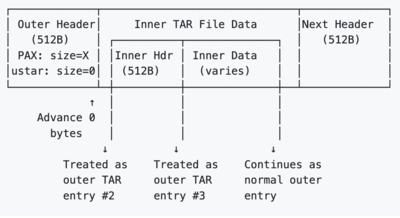
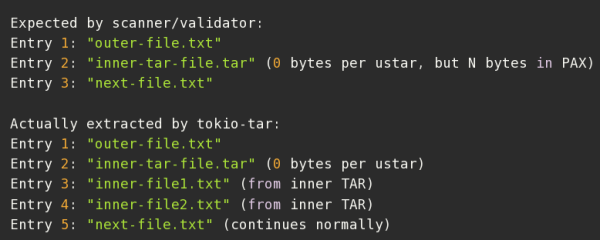
To exploit the vulnerability, it is sufficient to create a TAR archive where the ustar header specifies a zero size, and the PAX header contains the actual size, causing the contents of the file with another tar archive to be processed as part of the main archive. Example code for creating such archives is available on GitHub. The vulnerability has been patched in releases of tokio-tar 0.5.6 and uv 0.9.5. Fixes for other libraries have not yet been published, but patches have been prepared separately for astral-tokio-tar, async-tar, and krata-tokio-tar.
Vulnerabilities in the libraries have been assigned a danger level of 8.1 out of 10, as the issue can be exploited to overwrite unpacked files (vulnerable implementations will unpack files different from those visible in the archive). Meanwhile, the vulnerability in the uv package manager is marked as non-threatening, as if an attacker can influence the contents of the original archive, there is no point in complicating the attack and exploiting the vulnerability through a nested archive when code execution can be achieved through build scripts in the main archive.
The researchers who discovered the vulnerability proposed several hypothetical attack scenarios that allow bypassing security checks and achieving code execution through configuration file replacements or interference in the build process. It is implied that the submitted archive will pass automated checks by the security scanner and manual audits, during which the auditor may not notice the suspicious nested archive containing other files. Consequently, when unpacked using Rust libraries, different content than expected will be extracted from the archive.
For instance, an attacker could upload a modified archive to the PyPI repository, which would pass verification based on the analysis of the main archive's contents, containing a legitimate pyproject.toml file. When processing this package using the uv utility, the legitimate pyproject.toml will be replaced with a malicious version from the nested archive containing commands that will execute during the building process on the developer's computer or in the continuous integration system. Similarly, files in the container can be overwritten when extracting the container image using the testcontainers toolkit.
Source: opennet.ru
