

The developers of the AlmaLinux project, which builds on the Red Hat Enterprise Linux (RHEL) distribution, have announced the addition of support for the Btrfs file system and the implementation of storage partitioning using Btrfs in the installer. The reason mentioned is the progress made in Btrfs development and its advanced features, such as checksums for detecting data and metadata corruption, snapshots, easy volume management, transparent compression, and the reflink operation for creating file copies through metadata cloning.
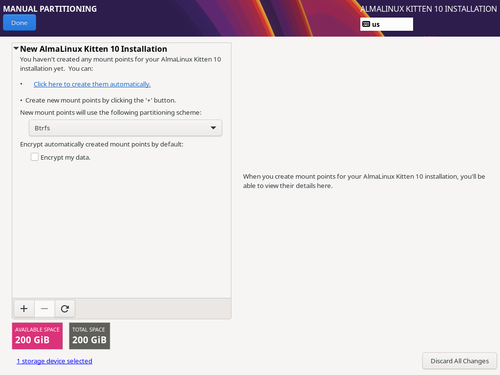
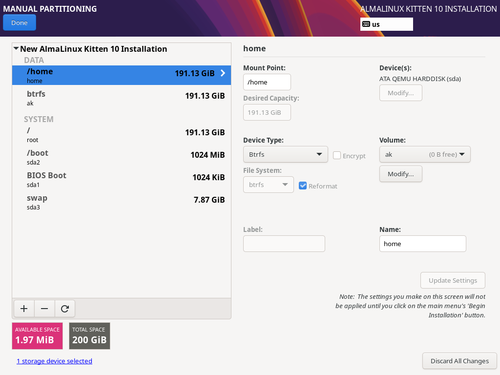
You can test Btrfs support in the beta version of AlmaLinux OS 10.1 released a few days ago or in the builds of the AlmaLinux OS Kitten distribution based on CentOS Stream 10. The work to reintroduce Btrfs support was done in collaboration with developers from the Fedora and CentOS projects, which are part of the Fedora Btrfs SIG and CentOS Hyperscale SIG working groups.
Red Hat announced the deprecation of Btrfs in the RHEL 7.4 release (2017) and completely discontinued its support in the RHEL 8 branch (2019), removing the btrfs.ko kernel module, the btrfs-progs utilities, and the snapper package from the base distribution. However, support for the Btrfs file system has continued in Oracle Linux.
In addition to adding Btrfs to the installer, installing the kernel module, and reintroducing the btrfs-progs utility set, AlmaLinux has also worked on adapting its data storage management stack for Btrfs and verified the functionality of packages such as bcc, buildah, cockpit, ignition, libblockdev, libguestfs, osbuild, osbuild-composer, podman, pykickstart, python-blivet, skopeo, udisks2, and virt-v2v in Btrfs environments.
Source: opennet.ru
