

Google announced the inclusion of automatic redirection of HTTP requests to HTTPS in the upcoming Chrome 154 release, scheduled for October 2026. For sites not supporting HTTPS, a confirmation dialog will appear on the first HTTP access. Currently, this behavior is optional and requires the setting "Always Use Secure Connections" to be enabled.
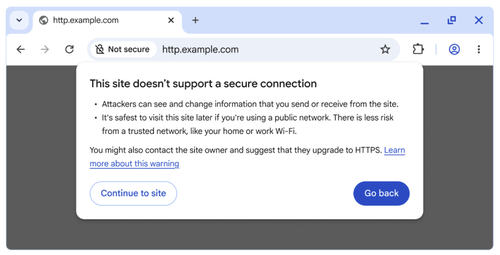
Initially, the always-on HTTPS mode was planned to be activated by default as early as 2023, but its rollout for all users was postponed and limited to activation in "incognito" mode and specific experiments. According to Google statistics, the most significant growth in HTTPS adoption occurred from 2015 to 2020, after which the level of HTTPS support reached 95-99% and has maintained that level.
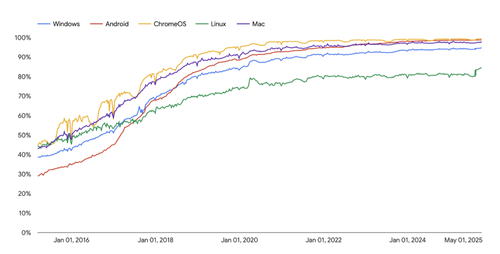
Achieving 100% HTTPS coverage is still not feasible, as HTTP support remains necessary for accessing internal and local sites hosted on enterprise local networks or current systems. For such sites that use non-public domain names and intranet addresses like 192.168.x.x and 10.x.x.x, it is problematic to obtain a TLS certificate validated by a certificate authority. Excluding such resources and considering only publicly accessible sites, the share of HTTPS adoption increases from 84% to 97% for installations on Linux, from 95% to 98% on Windows, and reaches 99% on Android and macOS.
To avoid annoying users of internal sites with unnecessary confirmation prompts, the always-on HTTPS mode in Chrome 154 will be applied by default only to publicly accessible sites, although this behavior can be changed in the settings.
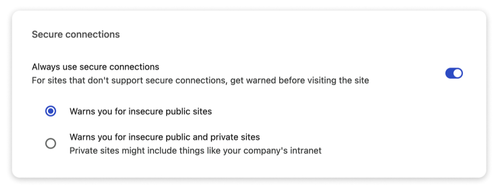
Before the rollout to all users, a trial implementation will take place — in the Chrome 147 release scheduled for April 2026, the always-on HTTPS option will be activated by default for over a billion users who have enabled the Enhanced Safe Browsing setting.
Source: opennet.ru
