

Google has released Chrome browser version 143. At the same time, a stable release of the open-source project Chromium, which serves as the basis for Chrome, is available. The Chrome browser differs from Chromium in its use of Google logos, the presence of a crash reporting system, modules for playing protected content (DRM), an automatic update installation system, constant Sandbox isolation, provisioning of keys to Google APIs, and transmission of RLZ parameters during searches. For those needing more time to update, an Extended Stable branch is separately maintained, lasting 8 weeks. The next Chrome release, version 144, is scheduled for January 13.
Key changes in Chrome 143:
- Support for the XML Transformation Language XSLT has been deprecated and is planned to be disabled in Chrome version 155. This includes the deprecation of the XSLTProcessor API and XML stylesheet parsing instructions. The reason mentioned involves security risks associated with the libxslt library, which has maintenance issues and is a source of browser attacks, despite the estimated usage of XSLT on web pages being only 0.02%.
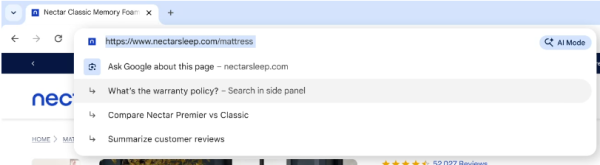
- New features have been added to the AI mode, allowing interaction with an AI agent from the address bar or the page displayed when a new tab is opened. The AI mode enables users to ask complex questions in natural language and receive answers based on aggregated information from the most relevant pages on the given topic. Users can refine their inquiries with follow-up questions if needed. The mode also allows users to ask questions about the content of a page directly from the address bar. To switch to AI mode, currently available only on macOS and Windows platforms, simply press the tab key before starting to type in the address bar.

- The ICU library has been updated to version 77.1 with support for Unicode 16 and updated locale data.
- The CSS selector "@container anchored(fallback)" has been added, allowing the style of elements anchored to the position of other elements to change based on the alternative position selected by the browser, set via the "position-try-fallbacks" property to prevent the element from exceeding the boundaries of the outer block or viewport.
- The CSS properties "background-position-x" and "background-position-y" now allow the specification of the background image's position relative to one of the block's edges. For example, "background-position-x: left 30px;".
- The CSS property "font-language-override" has been added to override the language used for glyph substitution in OpenType fonts that provide language-specific glyph variants. For example, 'font-language-override: "RUS";'.
- Support for handling the events "ongamepadconnected" and "ongamepaddisconnected" has been added in the WindowEventHandlers API to track gamepad connections and disconnections.
- In the JavaScript API for working with the DOM, the use of all characters allowed in the HTML parser is now permitted in the names and prefixes of created elements and attributes.
- When using the WebTransport API, the negotiation of the protocol used for interaction with the web application is allowed. server This occurs when creating a WebTransport object, where the application can specify a list of allowable protocols.
- In the Origin trial mode, the Web Install API has been added, providing the method navigator.install() to initiate the installation of web applications by websites, which can be used when creating web application store catalogs or to simplify the installation of web applications that work with the current site. Installation occurs after the user explicitly confirms the operation.
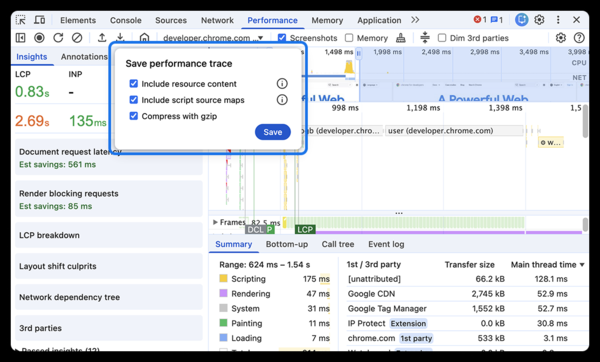
- Improvements have been made to the web developer tools. The capabilities of the experimental MCP (Model Context Protocol) server have been expanded, allowing access to Chrome DevTools capabilities from external AI assistants. The Elements panel has gained support for debugging CSS rules @starting-style. The audit panel has been updated to Lighthouse release 13. When exporting performance tracking results, an option to include the content of HTML, CSS, and JavaScript files, as well as "source map" data, has been provided.

In addition to new features and bug fixes, the latest version has addressed 13 vulnerabilities. Many of these vulnerabilities were identified through automated testing using tools such as AddressSanitizer, MemorySanitizer, Control Flow Integrity, LibFuzzer, and AFL. Critical issues allowing circumvention of all browser security layers to execute code outside of the sandbox environment were not found. As part of the vulnerability reward program for this release, Google has established 13 rewards, distributing a total of $18,000 (one reward of $11,000, two rewards of $3,000 each, and one reward of $1,000). The amount for 9 rewards has yet to be determined.
Source: opennet.ru
