

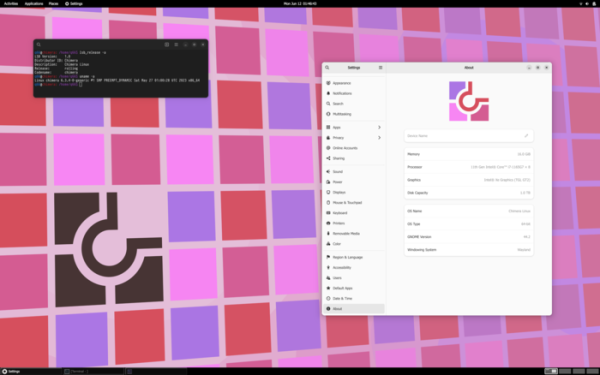
An update for the Chimera Linux distribution has been released, notable for its use of the Linux kernel along with utilities from FreeBSD, the dinit system manager, and the standard C library Musl. The build is created using the Clang compiler. Live boot images have been formed for the x86_64, ppc64le, aarch64, riscv64, and ppc64 architectures in GNOME (1.8 GB), KDE (2.5 GB), and minimal environment (1 GB) variants.
The project aims to create a Linux distribution with alternative tools and is developed based on the experience of developing Void Linux (the author of Chimera was a former maintainer of Void, responsible for POWER and PowerPC architectures). Like Void Linux, the project is developed using a continuous version update cycle (rolling model). User components from FreeBSD have been chosen as less complex and more suitable for lightweight and compact systems than the standard GNU tools.
In addition to utilities from FreeBSD, supplied instead of packages like coreutils, findutils, diffutils, sed, and grep, the distribution involves GNU Make, util-linux, syslog-ng, udev, pam, dinit, clang, lld, libc++, and musl. Memory allocation functions in musl have been replaced with mimalloc. The ZFS file system is employed. The /var partition does not retain its state between reboots (stateless). PipeWire is used for managing multimedia streams. By default, the Wayland display server is utilized in graphical environments.
For installing additional programs, both binary packages and a custom build system from source code — cports, written in Python, are offered. Currently, it maintains over 4000 ports. The build environment runs in a separate unprivileged container created with the bubblewrap tool. The APK package manager (Alpine Package Keeper, apk-tools) is used for managing binary packages, while Flatpak can optionally be utilized.
In the new release:
- An experimental console installer has been added, initiated with the command chimera-installer after booting in Live mode. The installer supports local and remote installation, selection of the APK repository mirror, basic configuration settings (hostname, timezone, root password, and user account creation), installation of additional packages, kernel version selection, and bootloader setup (GRUB and systemd-boot). Partitioning and formatting of disk partitions are not yet supported (partitioning, formatting, and mounting must be done manually before starting the installer).
- Linux kernel 6.18 has been utilized. Software versions have been updated, such as GNOME 49.1, KDE Plasma 6.5.4, enlightenment 0.27.1, icewm 3.8.2, chromium 143, clang 21.1.4, docker 28.3.2, ffmpeg 8.0, flatpak 1.16.1, gtk 4.20.2, musl 1.2.5, python 3.13.9, pipewire 1.4.9.
- In the Live images, automatic importing of LVM and ZFS pools has been disabled, which in some cases led to system malfunctions.
Source: opennet.ru
