

The eighth release of the Orbitiny Desktop environment, written from scratch using the Qt framework, has been published. The project aims to combine some innovative ideas that have not been seen before in user environments with traditional elements such as a plugin-supported panel, an application menu, and a desktop where shortcuts can be placed. The current focus is on launching in X-server-based environments, but future support for Wayland is not ruled out. The code is written in C++ and is distributed under the GPL license.
Notable features specific to Orbitiny include: calling actions through screen gestures (tracing a specific outline with the mouse on an empty desktop area); labels on icons (shown for new, modified, empty, or moved files via the clipboard, as well as for empty directories); the ability to paste a file simultaneously into several selected directories; support for placing desktop content in any directory (not just in $HOME/Desktop); and the use of separate desktop directories for each virtual desktop and monitor. A list of standard Orbitiny features can be found in the previous announcement.
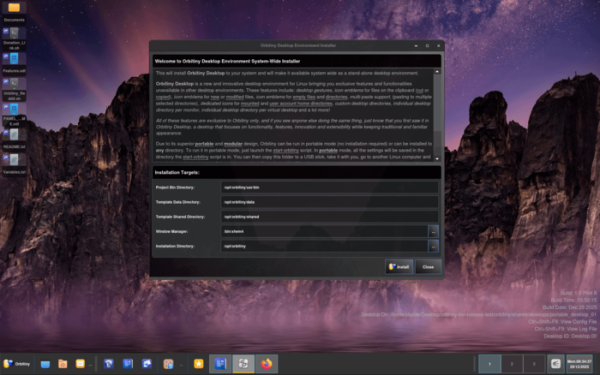
It is noted that this release has become the largest in the history of the project in terms of changes. Among the changes are:
- The mode of using Orbitiny as a system-wide desktop environment has been implemented, with each user's settings stored in the $HOME/.config/orbitiny directory. A graphical installer for system-wide installation of Orbitiny has been added. At the same time, the ability to run Orbitiny on top of existing user environments, such as KDE and GNOME, has been preserved, as well as support for portable operation, where all necessary files and programs are placed in a separate directory or on a Flash drive to recreate the existing environment on another system.
- The project has been restructured, resulting in many functions being moved to separate applications that are not tied to the desktop. Automatic restart of crashed processes has been implemented. Failures in components like panels or desktops no longer lead to the entire desktop environment crashing.
- A dynamic theming engine has been added. Themes are no longer statically defined and can be modified on the fly by changing CSS files on the disk.
- Functionality has been expanded. virtual desktops, allowing the configuration and content directories of the desktop to change accordingly, i.e., the virtual desktop is not limited to window grouping and can be handled as a separate environment.
- Real-time tracking of desktop setting changes has been added, enabling immediate application of changes after editing the settings.ini configuration file.
- A new configurator (Control Panel) has been proposed, which features icon-based navigation. The configurator's functionality has been moved to separate applications.
- Effects have been added for smooth icon appearance when hovering the mouse cursor over them and for casting shadows from icons to give them depth.
- The file manager (Qutinty) now displays tags on icons for visually highlighting empty files and directories. A 'Paste with rsync' option has been implemented for copying files using the rsync utility. A button has been added to set an image as the desktop wallpaper. A new Coconut theme has been proposed. A confirmation request has been provided when attempting to delete important directories or configuration files, such as .config, .local, and Desktop.
- An option 'Run & Mark as Safe' has been added to the context menu displayed for scripts, allowing the script to be marked safe, so subsequent runs do not show a confirmation dialog if the checksum for the script file has not changed.
- The interface for setting desktop wallpapers has been completely redesigned and is no longer tied to the file manager.
- A panel manager has been added, allowing the addition, deletion, renaming, and activation of panels, as well as creating panel profiles, managing plugins, and choosing panel themes. A new panel configuration interface has been implemented.
- The pavucontrol-qt sound management utility has been ported from LXQt.
Source: opennet.ru
