

The release of the free game engine Godot 4.6 has been announced, suitable for creating 2D and 3D games. The engine supports an easy-to-learn scripting language for game logic, a graphical environment for game design, a one-click game deployment system, animation capabilities, and physical simulation options, along with a built-in debugger and performance bottleneck detection system. The code for the game engine, game design environment, and associated development tools (physics engine, audio server, 2D/3D rendering backends, etc.) is distributed under the MIT license.
The source code of the engine was opened in 2014 by OKAM studio after ten years of developing a professional-grade proprietary product that was used to create and publish many games for PC, gaming consoles, and mobile devices. The engine supports all popular desktop and mobile platforms (Linux, Windows, macOS, Wii, Nintendo 3DS, PlayStation 3, PS Vita, Android, iOS, BBX), as well as web game development. Ready-to-run binary builds have been created for Linux, Android, Windows, and macOS.
Key changes in Godot 4.6 (1, 2, 3):
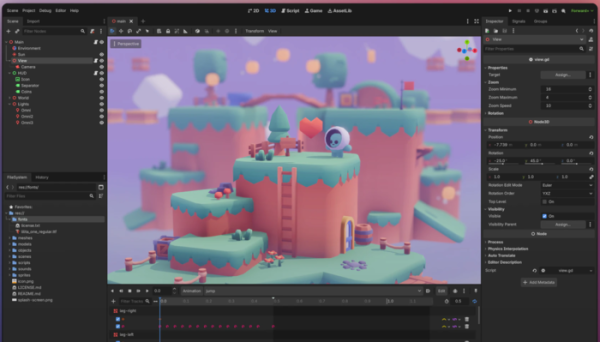
- The editor now features a new default theme called "Modern," notable for its contemporary appearance, more contrasting information highlights for improved readability, optimized spacing between elements, and the use of a gray color scheme. For users accustomed to the old look, there is an option to revert to the classic theme.

- Panel handling in the editor has been unified. Lower panels and most dock panels are now floating and can be detached. Panels can be moved via drag & drop to different parts of the interface.
- For new 3D projects, the JoltPhysics simulation engine, already used in AAA games like Death Stranding 2, is activated by default.
- A new inverse kinematics (IK) system has been added, enabling the creation of more realistic animations. New modifiers and constraints have been introduced to control the rotation and angular velocity of joints to prevent unwanted movements. The specified constraints can be bound to 3D nodes, for example, so that a character's arm can reach for and grasp a weapon. A new IKModifier3D has been created based on the SkeletonModifier3D. Deterministic solvers, such as TwoBoneIK3D and SplineIK3D, as well as iterative solvers like FABRIK3D, CCDIK3D, and JacobianIK3D, are available for use. The modular architecture of the IK framework allows it to be combined with other modifiers and constraints for fine-tuning procedural animation directly within the engine.
- The SSR (Screen Space Reflection) system, responsible for visualizing materials with reflective surfaces like metal, water, and glass, has been completely redesigned. The new implementation achieves greater realism, enhances performance, and introduces two modes—full-resolution (maximum quality) and half-resolution (more efficient). high performance).
- Unique internal node identifiers (Node ID) have been implemented, which are saved in scene files and remain unchanged after reorganizing the scene, changing the hierarchy of elements, or moving or renaming nodes.
- A library called libgodot has been added, allowing the embedding of Godot Engine into custom applications instead of running it as a separate process, which can be useful, for example, in developing custom game editors. Support is provided for Linux, Windows, and macOS.
- 2D scenes placed as tiles in TileMap (such as animated chests, lamps, and torches) can now rotate in 90-degree increments.
- To bring the workflow closer to modern 3D editors, selection and transformation modes have been separated. The previous "Select" mode has been renamed to "Transform," and a new mode for selection only has been added, allowing nodes to be selected without showing the transformation gizmo, thus preventing accidental operations of moving, rotating, and scaling.
- The 3D drawing and erasing tool in GridMap has been improved. It is now based on Bresenham's algorithm for interpolation between points, resulting in smoother lines and faster creation of new levels and voxel maps by reducing manual adjustments.
- The 3D gizmo now includes the ability to rotate objects aligned with the camera direction.
- The graphical interface simplifies the process of centering the pivot point.
- Focus handling for mouse/trackpad and keyboard has been separated — clicking with the mouse no longer changes the keyboard input focus.
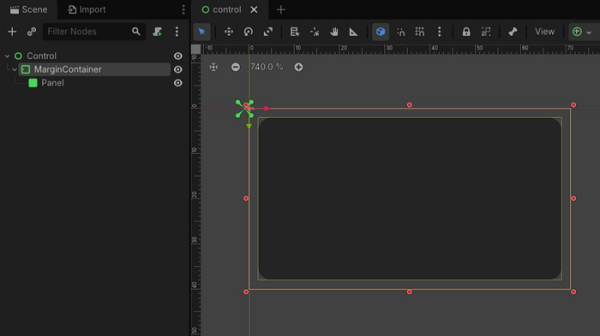
- When selecting a MarginContainer node in the editor, margin visualization is now provided in the viewport.

- Navigation between tabs has been improved: when moving a resource in Drag & Drop mode, you can now hover over the desired tab and automatically switch to it without clicking.
- In the Output panel, you can now click the file name in the error or warning message to open it in the editor.
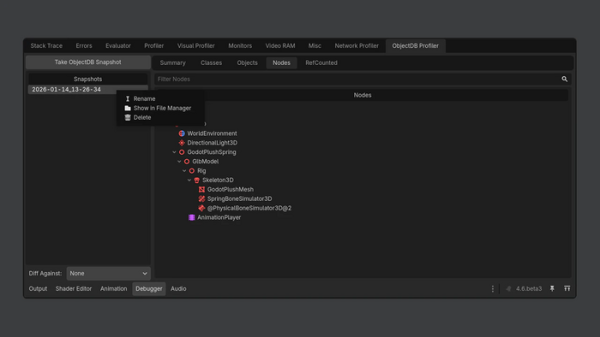
- The object tracking tool has added the ability to create snapshots of the ObjectDB and compare state slices with lists of existing objects at specific points in time.

- The Quick Open dialog has been updated to support previewing the selected resource in the context of the current scene.
- In the animation editor, there's now a capability to change the length of the animation by stretching or compressing clips on the timeline. The Bezier curve interface has added buttons for showing, locking, and deleting groups of nodes.
- Support for delta patch coding in PCK has been added, allowing only modified parts of resources to be included in patches.
- The ability to customize the color of LED indicators on game controllers has been added. Future support is expected for motion sensors, touch panels, haptic feedback, adaptive triggers, and obtaining information about controllers.
- By optimizing the processing of RGB textures, which are now converted to RGBA on the GPU and used directly, import operations for compressed textures have been accelerated by up to two times.
- By default, the rendering mode 'Screen' is activated, and a glow effect is applied before tonemapping. The ability to adjust the parameters of the AgX tonal mapping has been added.
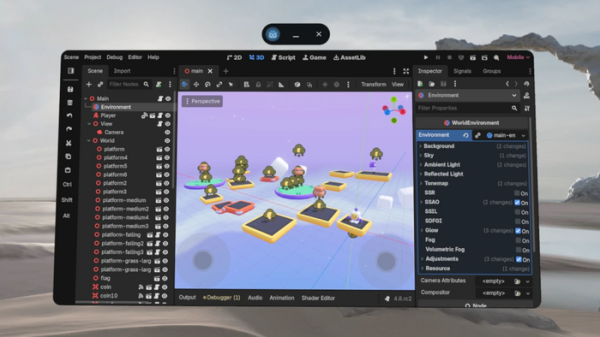
- The Godot XR editor now supports Android XR devices, simplifying the testing and debugging of augmented and virtual reality projects. Support for the OpenXR 1.1 specification has been added.
- Support has been added for launching exported applications on Android devices via scrcpy, enabling screen mirroring from a smartphone to a PC.
- When building projects for Windows, Direct3D 12 is used by default.
Additionally, the development of the Redot project continues, a fork of Godot created in response to the strict moderation policies in the official communication channels and the rejection of opinions differing from those of the Godot developers. The founders of Redot aimed to build an inclusive community that accepts any personal beliefs of developers, where the politicization of the development process is not acceptable, and the main focus is solely on game creation. A few days ago, a candidate release of Redot 26.1 was published, incorporating many improvements from Godot 4.6.
Source: opennet.ru
