

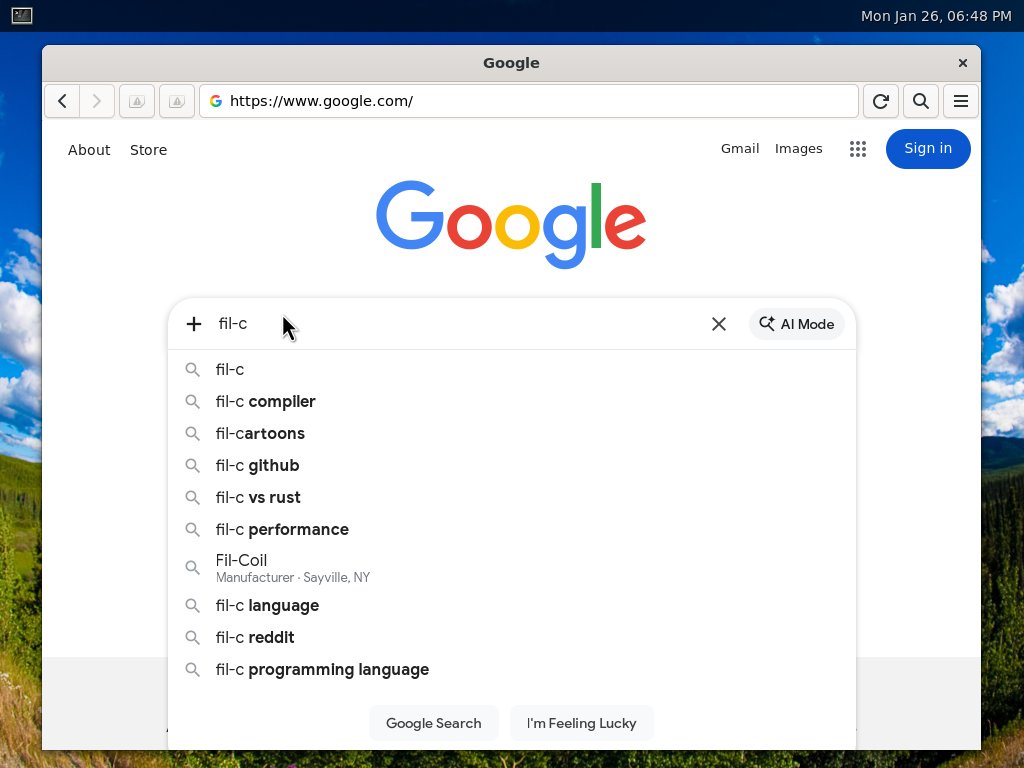

Introducing Pizlix — an experimental operating system built on Linux From Scratch (LFS) 12.2. The key feature of this project is the userland build using the Fil-C compiler, which, according to the author, enables the safest memory-safe Linux-like distribution available today.
The development of Pizlix became possible due to the high compatibility of Fil-C with traditional C and C++ code. Most packages from the LFS book were successfully compiled with minimal changes to the source code or just slight patches.
Key features and technical details:
Basic build utilities (such as ld, make, ninja) and all user applications are compiled using Fil-C or Fil-C++.
A memory-safe OpenSSH daemon is included.
Graphics support: the distribution includes the composite server Weston (Wayland) and GTK 4 toolkit, allowing for a fully memory-safe graphical interface.
For compiling the Linux kernel, the traditional GCC is kept in the system (located in /yolo/bin/gcc), as the kernel is compiled in a mode that the author ironically calls "Yolo-C" (meaning without memory safety guarantees from Fil-C).
The architecture of the distribution employs the concept of "libc sandwich": a trimmed version of glibc ("yolo glibc") is used by the Fil-C runtime for system calls, while the main user glibc 2.40 is fully ported to Fil-C.
The distribution is intended for the x86_64 architecture. The images have been tested to work on QEMU (recommended), VMware, and Hyper-V. For those interested in building the distribution themselves, a set of scripts is provided for step-by-step assembly within privileged containers (Podman) based on Ubuntu 22 or 24.
Source: linux.org.ru
