

In the Netherlands, the world's first solar tile using thin perovskite films has been developed. This new element has relatively low efficiency, but it allows tiled roofs to resemble conventional roofs instead of looking like a set of angled solar panels. The "solar" tile is ready for mass production and could become an integral part of urban architecture, combining electricity generation with building aesthetics.
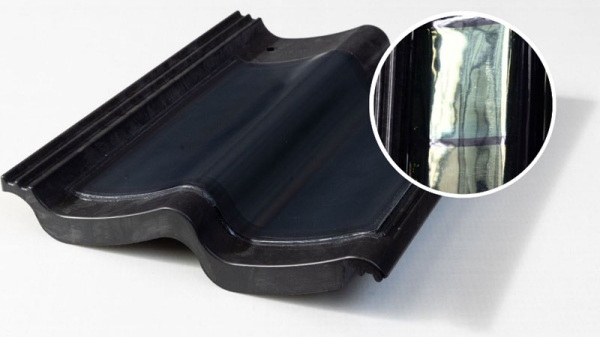
Installing solar panels on rooftops is not always feasible, especially for older buildings that are not designed to handle such additional loads. Placing solar panels on the ground requires open spaces, which is also problematic, particularly in densely populated Europe. Solar elements shaped like ordinary tiles, employing a similar installation method, solve these issues by allowing renewable energy generation in urban settings without disrupting architectural coherence and existing infrastructure.
The module was developed as part of composite tiles by researchers from the Dutch organization TNO (Netherlands Organisation for Applied Scientific Research) in collaboration with ASAT B.V. Technically, the tile operates on flexible perovskite solar cells applied to foil, which is then attached to a curved composite base. The materials and processes have been adapted for large-scale roll-to-roll production, making it the most economically efficient method.
The efficiency of individual modules reaches 13.8%, and after installation on curved tiles, it remains at 12.4%. The curvature of the surface has only a minor impact on performance. The development has progressed from laboratory test cells to flexible modules measuring 10 × 10 cm and finally to ready-to-use functional solar roofing tiles.
Compared to traditional silicon solar panels, the new tiles have key advantages: they fully integrate into the roof, maintaining the building's appearance without requiring additional ground space. This reduces the strain on infrastructure, does not impact the landscape, and simplifies installation, while also opening opportunities for widespread use in residential and commercial construction. The environmental effect lies in increasing the production of 'green' energy directly within urban development, and the technology's readiness for industrial scaling makes it economically promising.
Currently, the prototype has been successfully tested, and measurements have confirmed the stated efficiency. To commercialize, TNO established the subsidiary Perovion Technologies on March 11. In the future, there are plans to enhance the technology's lifespan, reliability, and scalability. As the developers emphasized, this solar tile represents the next step in the energy transition, making solar energy more accessible, affordable, and widespread, thereby laying the foundation for energy security in Europe.
Source:
Source: 3dnews.ru
