

Anthropic has unveiled the Glasswing project, which will provide access to a preview version of the AI model Claude Mythos aimed at identifying vulnerabilities and enhancing the security of critical software. Participants in the project include the Linux Foundation and companies such as Amazon Web Services, Apple, Broadcom, Cisco, CrowdStrike, Google, JPMorgan Chase, Microsoft, NVIDIA, and Palo Alto Networks. About 40 other organizations have also been invited to join the project.
Released in February, the AI model Claude Opus 4.6 has reached a new qualitative level in areas such as vulnerability detection, bug hunting, change review, and code generation. Experiments with this AI model have uncovered over 500 vulnerabilities in open projects and generated a C compiler capable of building the Linux kernel. However, the Claude Opus 4.6 model struggled significantly with creating working exploits.
The next-generation model 'Claude Mythos' claims to outperform Claude Opus 4.6 dramatically in crafting ready-to-use exploits. Out of several hundred attempts to create exploits for vulnerabilities identified in the Firefox 147 JavaScript engine, Claude Opus 4.6 succeeded in only two cases. In repeated experiments using the preview version of the Mythos model, working exploits were successfully created 181 times—raising the success rate from nearly zero to 72.4%.
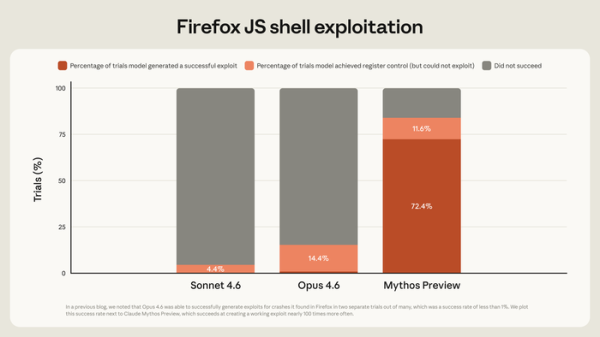
Moreover, Claude Mythos significantly enhances capabilities in error and vulnerability detection, which, combined with its suitability for exploit development, creates new risks for the industry—exploits for yet unpatched vulnerabilities (0-day) can be crafted by amateurs in mere hours. It has been noted that the level of the Mythos model's abilities in finding and exploiting vulnerabilities has reached professional quality, currently only falling short of the most experienced professionals.
Since granting unlimited access to an AI model with such capabilities requires industry preparation, it has been decided to initially open access to a preliminary version to a select group of experts to conduct work on identifying and addressing vulnerabilities in critically important software products and open-source software. A subsidy of $100 million has been allocated to fund this initiative, and it has also been decided to distribute $4 million as donations to organizations involved in maintaining the security of open projects.
In the CyberGym test suite, which evaluates the models' ability to identify vulnerabilities, the Mythos model demonstrated an accuracy of 83.1%, while Opus 4.6 showed 66.6%. In code writing quality tests, the models demonstrated the following results:
During the experiment, Anthropic was able to identify several thousand previously unknown (0-day) vulnerabilities using the Mythos AI model over a few weeks, many of which were marked as critical. Among them, a vulnerability in the OpenBSD TCP stack that had gone unnoticed for 27 years was found, allowing remote initiation of a system crash. A 16-year-old vulnerability in the H.264 codec implementation from the FFmpeg project was also discovered, along with vulnerabilities in the H.265 and AV1 codecs, exploited during the processing of specially crafted content.
Several vulnerabilities have been identified in the Linux kernel that allow a non-privileged user to gain root privileges. Chaining these identified vulnerabilities together has enabled the creation of exploits that allow for the achievement of root privileges when opening specific pages in a web browser. An exploit was also created that allowed code execution with root privileges by sending specially crafted network packets to an NFS server from FreeBSD.
A vulnerability has been identified in one of the virtualization systems, written in a language that provides means for safe memory operations, which can potentially allow code execution on the host side through manipulations in the guest system (the name is not disclosed as the issue has not yet been fixed, but it seems the vulnerability exists in the unsafe block of Rust code). Vulnerabilities have been found in all popular web browsers and cryptographic libraries. Vulnerabilities leading to SQL code injection have been identified in various web applications.
Source: opennet.ru
