

The release of the Deepin 25.1 distribution has been announced, which develops its own Deepin Desktop Environment (DDE) along with about 40 user applications, including the Deepin Music player, Deepin Movie video player, installer, and Deepin Store software center. The project was initiated by a group of developers from China but has transformed into an international project and supports the Russian language. The distribution repository includes over 8000 packages. All developments are distributed under the GPLv3 license. The size of the bootable ISO images is 6.8 GB (amd64, arm64, riscv64, and loongarch64).
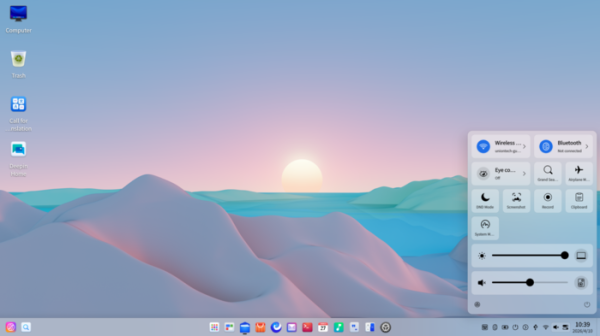
Desktop components and applications are developed using C/C++ and Go languages. The graphical interface is built using the Qt library. A key feature of the Deepin desktop is a panel that supports multiple operating modes. In classic mode, there is a clearer separation of open windows and suggested applications to launch, along with a system tray area displayed. The efficient mode resembles Unity to some extent, mixing indicators of running programs, favorite applications, and control applets (volume/brightness settings, connected drives, clock, network status, etc.). The application launcher interface provides two modes — viewing favorite applications and navigating through the catalog of installed programs.
Among the changes:
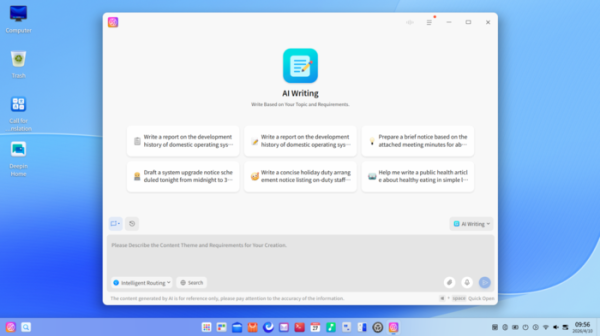
- The AI assistant for text writing has been revamped, adding the ability to upload reference materials. Based on the uploaded samples, the AI generates a structural plan that the user can manually edit before final text generation. After generation, the content can be edited in the AI interface and exported in PDF, MS Word, or Markdown format. Generation can be performed using locally running AI models.
- The AI mode 'Claw Mode' has been added based on the OpenClaw project, allowing control of the computer and automatic execution of system tasks using natural language commands, such as launching applications, editing settings, and processing file sets. Integration of AI with messaging programs has been implemented, enabling complex tasks to be executed through a messenger, such as gathering information from various sources and summarizing documents.
- The ability to call the AI tools panel for translating, summarizing, and explaining text highlighted in any application has been added.
- Adaptive selection of the AI model has been ensured based on task complexity, balancing speed and depth of knowledge. By default, it integrates the use of DeepSeek 3.2 and GLM 4.7 AI models.

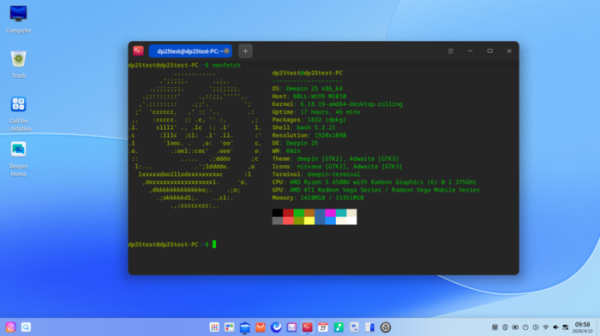
- The Linux kernel has been updated to version 6.18 (previously 6.12). Support for the BORE task scheduler has been integrated, which is used in CachyOS to reduce desktop latency and increase the priority of interactive processes. The kernel memory allocator (SLUB) now features a cache layer called 'sheaves', using multiple caches, each associated with a separate CPU core. This type of cache enhances performance and reduces overhead when allocating and freeing memory in the kernel. A 'Swap Table' mechanism has been employed to improve swap performance. The performance of the Ext4 and XFS file systems has been enhanced. Support for the Intel APX (Advanced Performance Extension) instruction set architecture has been added, providing 16 additional general-purpose registers.
- In the DDE (Deepin Desktop Environment), the taskbar now supports pinning application icons when multiple windows are open simultaneously. A configuration option for mouse cursor size has been added.
- In the file manager, the ability to use the right mouse button for pinning tabs at the top, saving paths to important directories, and moving items between windows in drag & drop mode has been implemented. The image preview now supports mouse zooming. The visual effect for grouping files has been optimized.
- The email client now supports printing emails.
Source: opennet.ru
