

Google has released version 148 of the Chrome web browser. At the same time, a stable release of the open-source project Chromium, which serves as the foundation for Chrome, is also available. The Chrome browser differs from Chromium by using Google branding, having a crash notification system, modules for playing back DRM-protected video content, an automatic update installation system, always-on Sandbox isolation, provision of keys to Google APIs, and transmission of RLZ parameters during searches. For those needing more time to update, the Extended Stable branch is supported separately, accompanied by an 8-week period. The next release, Chrome 149, is scheduled for June 2.
Key changes in Chrome 148 (1, 2, 3, 4):
- Development of the AI mode continues, allowing interaction with the AI agent from the address bar or from the page displayed when opening a new tab. The AI mode enables users to ask complex questions in natural language and receive answers based on information aggregated from the most relevant pages on the topic. Users can clarify information with follow-up questions if needed. The mode also allows questions about the page content directly from the address bar. Chrome 148 supports the use of AI mode for autofilling credit card numbers and addresses (with user permission). The capability of the built-in chatbot Gemini is now expanded to 49 countries in the Asia-Pacific region.
- The ability to autofill web forms with driver's license numbers, passport numbers, national ID cards, KTN numbers (Known Traveler Number), and RCN numbers (Redress Control Number), saved in Google Wallet, has been added.
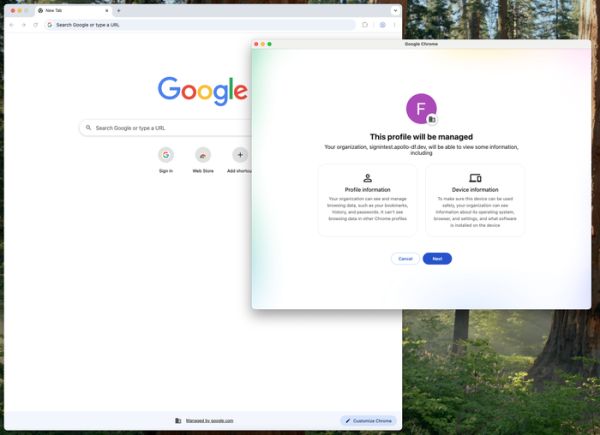
- The visual design of the profile creation interface has been changed (functionality remains the same).

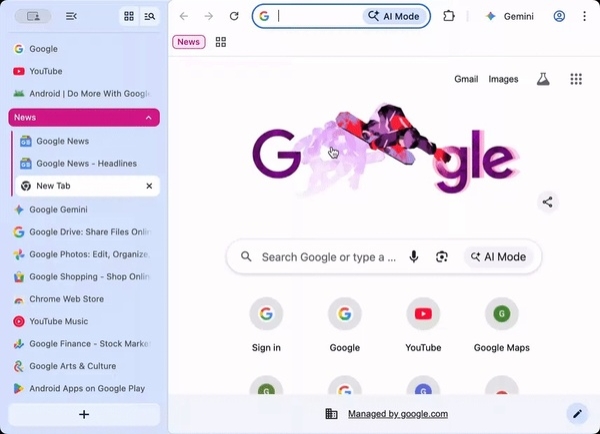
- For ChromeOS, a vertical tab display mode has been implemented, replacing the horizontal top tab bar with a side panel featuring vertical tabs. This mode was previously offered for Linux, macOS, and Windows platforms.

- In the Android version, the 'Enhanced autofill' feature has been implemented, utilizing an AI model to understand web forms and automatically fill fields based on how the user previously filled out similar forms.
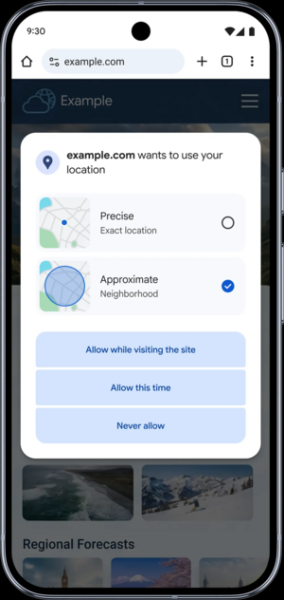
- The Android version now features a mode that returns approximate rather than exact locations to websites.

- Optimizations have been added to expand the use of the HTTP/3 protocol. Improved detection of HTTP/3 support on websites.
- The Prompt API has been implemented, providing calls for interaction with large language models, allowing text, images, and audio input in requests. The result is returned in a structured format that is easy to parse. Examples of use include generating image descriptions, visual search, speech transcription, sound classification, generating text based on given instructions, and extracting information from text. The API is implemented using the local executable large language model Gemini Nano (the model occupies 4 GB, loads automatically, and is installed as the weights.bin file in the OptGuideOnDeviceModel subdirectory).
- In SharedWorker, the option ‘extendedLifetime: true’ has been added to keep the handler active after all clients disconnect, allowing asynchronous operations to continue after the page unload without the need for Service Workers.
- CSS queries ‘@container’ can now be invoked using only the container name (container-name) without specifying the type (container-type). #container { container-name: —foo; } @container —foo { input { background-color: green; } }
- A new keyword ‘revert-rule’ has been added to CSS, allowing you to cancel the current CSS rule and apply the previous one. div { display: if(style(—layout: fancy): grid; else: revert-rule); }
- Support has been implemented for the ‘all’ value of the CSS property ‘text-decoration-skip-ink’, which mandates a mandatory line break in underlines and strikethroughs when crossing text glyphs.
- The Android version now supports the Web Serial API for connecting to devices with serial ports, including serial ports over USB or Bluetooth.
- In
- Support has been added for the second version of the Open Font format extension ‘avar’ (Axis Variation table), which allows the font to change the bindings between normalized and axis values.
- Improvements have been made to the web development tools.
In addition to new features and bug fixes, the new version has resolved 127 vulnerabilities. Many of these vulnerabilities were identified through automated testing using AddressSanitizer, MemorySanitizer, Control Flow Integrity, LibFuzzer, and AFL tools. Three issues (integer overflow in Blink, accessing already freed memory in Chromoting and Mobile) have been assigned a critical severity level, indicating that these vulnerabilities allow bypassing all browser security layers and executing code on the system outside the sandbox environment. As part of the vulnerability reward program for this release, Google has awarded 26 prizes totaling $138,000 (including one prize of $55,000, one of $43,000, and one of $8,000, plus two prizes of $16,000). The amount for 21 rewards has not yet been determined.
Source: opennet.ru
