

Introducing the Flipper One project, which develops a portable computer for network engineers, enthusiasts, and security researchers. The device is designed like a gaming console and includes a computer that can be used independently for system security checks, network problem diagnostics, and traffic analysis, or as a portable workstation connected to a monitor, keyboard, and mouse. The project is developed collaboratively with the community and utilizes open firmware. The goal is to create the most open and documented computer based on ARM architecture, fully supported in the main Linux kernel.
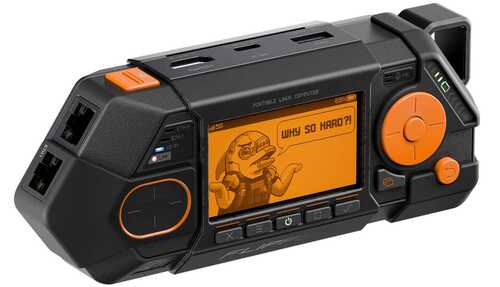
Flipper One is presented as a kind of multitool, combining capabilities for creating wireless access points and routers, emulating USB devices, running server processes in containers, analyzing network packets, creating VPN, integrating with various hardware sensors and modules via the GPIO port, functioning as a transmitter with software-defined radio (SDR), a 5G/LTE network analyzer, a power bank, a 5G/LTE modem, and a multimedia set-top box.
The project's concept is reminiscent of the already available Flipper Zero device, but it is a completely new product. The previous model, Flipper Zero, was based on the STM32WB55 microcontroller (2 cores Arm Cortex-M4 at 64 MHz, 256 KB RAM, and 1 MB Flash) and was designed for analyzing access control protocols based on NFC, RFID, sub-1 GHz wireless communication, infrared communication systems, and wired connection technologies such as iButton, UART, SPI, and I²C.
Flipper One will include both a microcontroller and a high-performance ARM processor capable of running Linux and processing multimedia content. The new device extends low-level signal analysis tools with capabilities for conducting research at the level of network technologies and protocols, Wi-Fi, Ethernet, 5G, and satellite communications. The device's performance is sufficient for the software analysis of radio signals and the local execution of machine learning models.
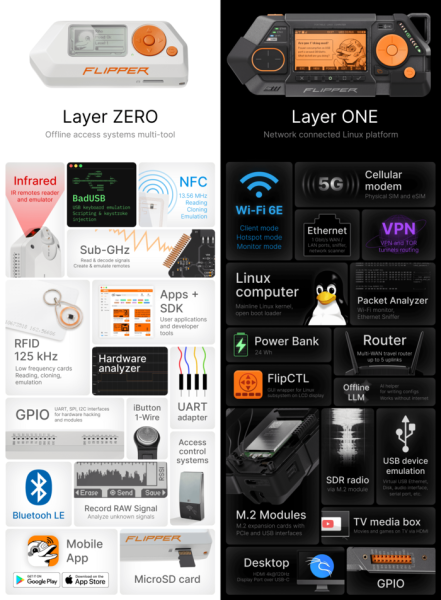
External devices and extensions can be connected via USB 3.0, PCI Express, SATA, and GPIO ports. For example, a 5G/LTE modem, SSD drive, or satellite NTN modem can be connected through the M.2 slot (PCI Express 2.1). The standard configuration includes 2 Gigabit Ethernet ports, USB Ethernet (5 Gbps), HDMI 2.1 (4K @ 120Hz), and Wi-Fi 6E (2.4/5/6 GHz) based on the MediaTek MT7921AUN chip. The device is equipped with a Rockchip RK3576 SoC (4 high-performance Cortex-A72 cores + 5 energy-efficient Cortex-A53 cores, Mali-G52 GPU, NPU for AI models, and 8 GB of RAM).
The RP2350 microcontroller from the Raspberry Pi project is employed, for which a significant amount of ready-made code has already been accumulated.
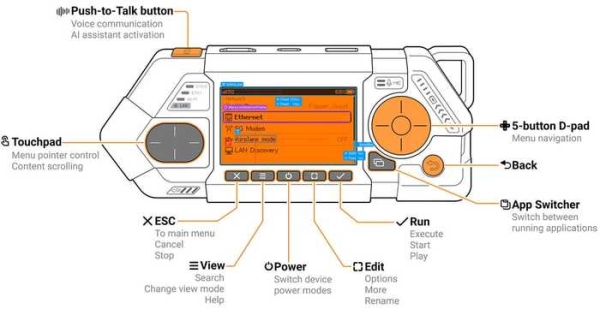
The firmware uses the Flipper OS Linux distribution (based on Debian) with its own FlipCTL framework to create a user interface optimized for a 7-inch screen. The interface is menu-based, navigated through a D-pad and several control buttons. The menu provides wrappers for launching standard applications and utilities such as ping, nmap, and traceroute. In the future, FlipCTL intends to be packaged as a universal solution suitable for use on any embedded devices, not just on Flipper One. When the device is connected to a monitor via the HDMI port, a full KDE desktop can be launched.
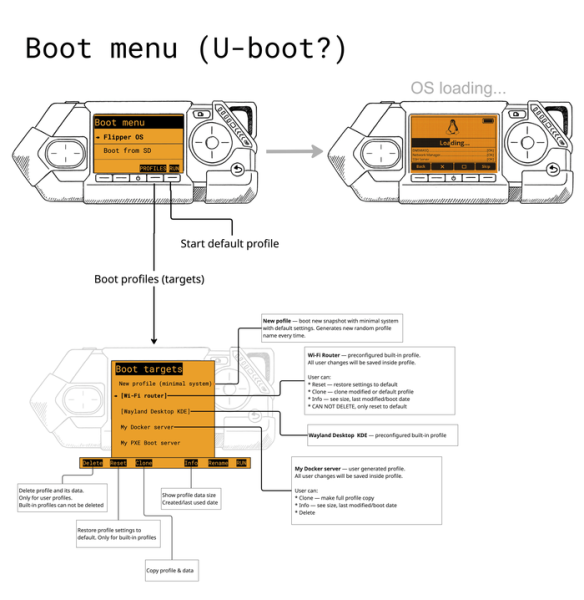
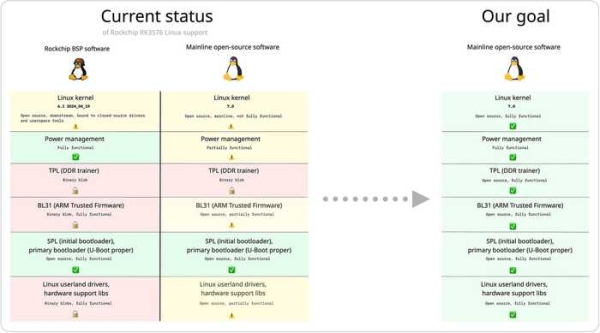
The project fundamentally uses only open-source software without binary blobs, closed drivers tied to BSP (board support package) manufacturers, and proprietary firmware. Collabora is responsible for implementing open drivers for the Rockchip RK3576 SoC and integrating them into the Linux kernel. Most drivers for the RK3576 SoC have already been accepted into the mainline Linux kernel, leaving only the binary blob for RAM initialization to be replaced and the drivers for the NPU and video decoding accelerators to be prepared.
Source: opennet.ru
