

The release of TileOS 2.0 "Sauropod" is available, built on a Debian package base and offering a desktop that uses tiling window managers. TileOS aims for the same goals as the Ubuntu Sway Remix distribution (developed by the same author), providing a ready-to-use interface that requires no additional configuration, catering both to experienced Linux users and newcomers looking to try tiling window manager environments without spending a lot of time on setup.
Unlike Ubuntu Sway Remix, TileOS is much more open to various modifications and customizations, while also being free of any potential copyright issues (Ubuntu Sway Remix uses registered trademarks of Canonical, but no official response has been received regarding the inclusion of the distribution in the official Ubuntu family). Builds for the amd64 architecture are prepared for download (support for arm64, specifically Raspberry Pi boards, is planned for the future). The source code of TileOS components is distributed under the GNU GPLv3 license.
TileOS focuses primarily on window managers that use the Wayland protocol. Official editions are available with Sway, River, Qtile, MiracleWM, and Niri desktops. The distribution utilizes a Debian Stable package base, but various improvements and newer versions of some software and graphics drivers are pulled from the testing branch. Additionally, it includes a number of fixes optimizing disk subsystem and memory performance, as well as some enhancements from Ubuntu, such as mounting drives in the file manager without a password prompt and others.
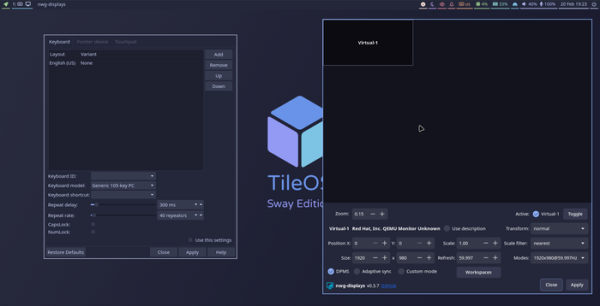
In the new release:
- The package base has been updated to Debian 13. By default, the standard Debian kernel is used, with Secure Boot support. An optional installation of the Liquorix kernel, optimized for desktop tasks, is available.
- A utility called tileos-kernel-manager has been added for installing and updating the Linux kernel.
- The sudo-rs utility is enabled by default — a variant of sudo, rewritten in Rust.
- systemd-resolved is used as the DNS resolver, and dhcpcd5 is the DHCP client.
- The TileOS Welcome utility has been added to facilitate initial system setup.
- When automatically formatting the disk, the Btrfs file system is enabled by default. Support for installation on a partition with the F2FS file system has been added;
- The screensaver swaylock has been replaced with gtklock;
- The system includes the Timeshift backup program and tools for working with Btrfs;
- The system includes the Kdeconnect daemon, which provides synchronization with mobile devices;
- User scripts have been rewritten and optimized, with the built-in capabilities of systemd used for autostarting most components;
- A power-profiles-daemon module has been added to the Waybar panel for quick switching between power-saving modes;
- The swaykbdd component has been added to implement separate keyboard layouts for each window;
- The SwayOSD component has been added to provide an on-screen indicator when the volume or screen brightness changes, as well as the Caps Lock key status;
- The Flatpak package manager is preinstalled and enabled by default;
- Minor improvements in the Plymouth splash screen;
- The Sway Input Configurator tool has been updated, fixing minor bugs and beginning preparations to support other Wayland compositors, such as MiracleWM.
Two new experimental editions have been added:
- Niri Edition — uses the Niri desktop, written in Rust, implementing a mosaic layout method in the style of the GNOME extension PaperWM, where windows are grouped into an infinitely scrollable ribbon on the screen. Niri Edition utilizes all standard components of TileOS, such as the Waybar panel. In the future, the integration of the Dank Material Shell environment is being considered.

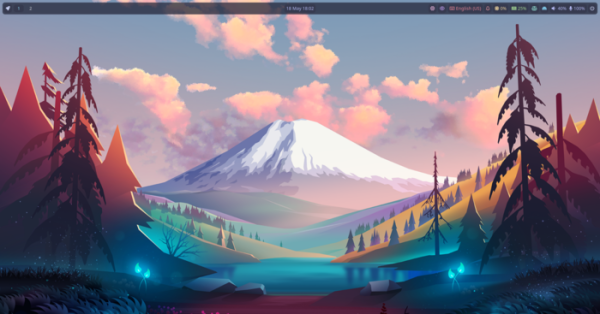
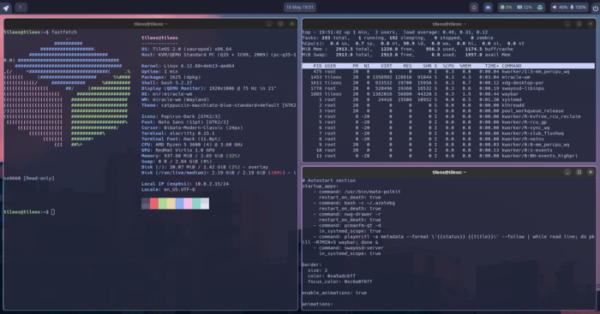
- Miracle Edition — uses the MiracleWM desktop, built on the Mir library. MiracleWM provides an interface in the style of Sway while implementing various graphical effects (window switching animations, transparency, etc.). Configuration is done in YAML format. Since MiracleWM is still in active development, many features are not yet implemented, and stable operation is not guaranteed.
In addition, the TileOS 1.4 'T-Rex' release has been formed, which includes the accumulated updates, including fixes for recently discovered vulnerabilities in the Linux kernel.
Source: opennet.ru
