

Google has released version 149 of the Chrome web browser. At the same time, a stable release of the open-source project Chromium, which serves as the foundation for Chrome, is available. Chrome differs from Chromium by including Google logos, a crash notification system, modules for playing copy-protected video content (DRM), an automatic update system, constant Sandbox isolation, delivery of keys to Google APIs, and transmission of RLZ parameters during searches. For those who need more time to update, a separate Extended Stable branch is available, supported for 8 weeks. The next release, Chrome 150, is scheduled for June 30.
Key changes in Chrome 149 (1, 2,
3, 4):
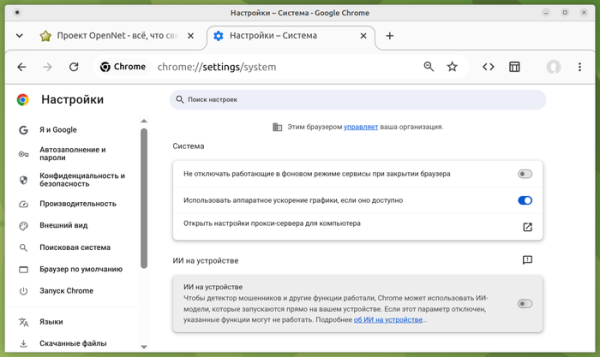
- Settings for managing the loading and use of AI models running on the user's device have been added to the 'System' section in the configurator. For example, users can completely prohibit the use of such models and remove previously downloaded models.

- In June, the official builds of Chrome 149 for Linux systems based on the ARM64 architecture will begin to be released in deb and rpm packages. Previously, official Chrome builds for Linux were only published for the x86_64 architecture, while ARM64 architecture had only third-party Chromium builds available from distributions.
- In Service Workers, the ability for background data loading using the Background Fetch API has been limited.
- CSS now supports customizing the styling of dividers between elements in grid and flexbox containers. New CSS properties column-rule-inset and row-rule-inset have been added for shortening or lengthening the dividers, as well as column-rule-visibility-items and row-rule-visibility-items for controlling the visibility of dividers (only between filled elements or in all gaps of the grid). Width, color, and margins can be animated using transition effects, activated, for example, on hover.
- The impact of active WebSocket connections on page caching in the back-forward cache (BFCache), which allows for instant navigation when using the 'Back' and 'Forward' buttons or navigating through previously viewed pages of the current site, has been removed. Previously, the presence of a WebSocket connection prevented the page from being cached, necessitating a full reload when pressing 'Back' or 'Forward'.
- The CSS property shape-outside now supports the functions path(), shape(), rect(), and xywh().
- The CSS property 'image-rendering' has been updated to include the value 'crisp-edges', which instructs to scale the image without blurring while preserving contrast and clear boundaries.
- A new CSS property path-length has been added, allowing modification of the pathLength attribute in SVG.
- The Intl.Locale object now includes the ability to specify and retrieve information about the variant of the language being used.
- Improvements have been made to the web development tools, stabilizing the implementation of the MCP server (Model Context Protocol) and the command line interface for AI agents. The ability to simulate custom HTTP headers has been added. The AI assistant panel has been significantly redesigned. An experimental debugging feature for pages using the WebMCP API has been implemented. Support for style autocompletion has been added to the CSS panel, utilizing the AI model Gemini.
Source: opennet.ru
