

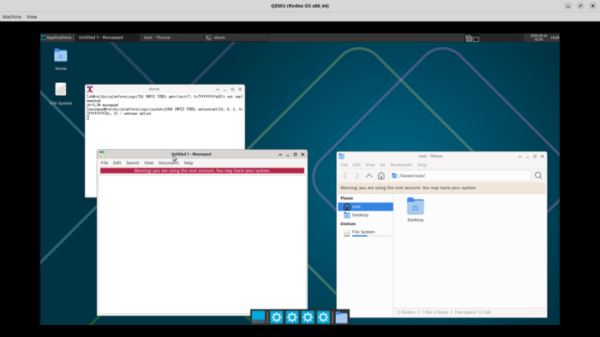
The developers of the Redox operating system, written using the Rust language and the microkernel concept, have published a project development report for May. Among the achievements, the successful port of the Xfce desktop environment is noted. The performance of Xfce in Redox is recognized as more stable than the previously created port with the MATE desktop, which still has unresolved issues with the Caja file manager.
A new task scheduler has also been implemented for Redox, using the EEVDF (Earliest Eligible Virtual Deadline First) algorithm. The new scheduler, when selecting the next process to run, takes into account processes that have been under-allocated CPU resources or have been allocated an undeserved amount of CPU time. In the first case, control is forcibly passed to the process, while in the second, it is deferred.
Work continues to improve compatibility with the POSIX standard C library relibc, written in Rust. The pseudo-terminal driver has been enhanced. Partial support for resource limiting has been added using the rlimit mechanism.
The performance of poll and epoll operations has been significantly increased (up to 4 times during testing in QEMU). Inode caching has been implemented, reducing the time for test compilation in GCC from 2411 ms to 670 ms. Incremental compilation of changes in packages has also been realized.
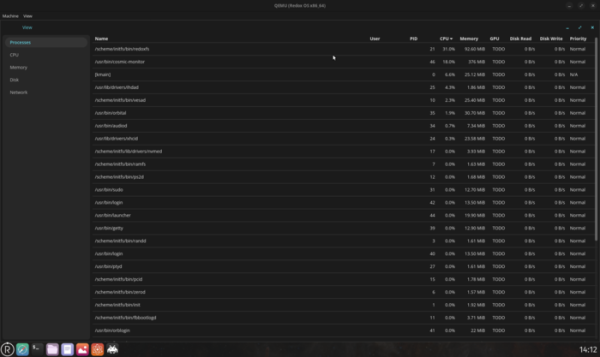
From the COSMIC desktop environment, the graphical interface for monitoring system status has been ported. The ability to customize fonts in the terminal emulator has been added. CPython 3.15 and libdrm have been ported.
The Redox operating system evolves in accordance with the Unix philosophy and borrows some ideas from SeL4, Minix, and Plan 9. Redox uses the microkernel concept, where only inter-process communication and resource management are provided at the kernel level, while all other functionality is moved to libraries that can be used both by the kernel and user applications. All drivers operate in user space within isolated sandbox environments.
The project is developing its own package manager, a set of standard utilities (binutils, coreutils, netutils, extrautils), the ion shell, the standard C library relibc, the vim-like text editor sodium, a network stack, and a filesystem. Configuration is set using the Toml language. To ensure compatibility with existing applications, a POSIX layer is provided, enabling many programs to run without porting.
You can test Redox by using the daily updated builds for of virtual machines and real hardware (aarch64, i586, i686, riscv64gc, x86_64). Supported hardware includes devices with USB interfaces, AC’97 and Intel HD Audio sound chips, USB, SATA (AHCI, IDE), and NVMe.
For graphic output, VESA BIOS API, UEFI GOP, or the Intel GPU driver can be used. Support for Wi-Fi and Bluetooth is still in development.
Source: opennet.ru
