

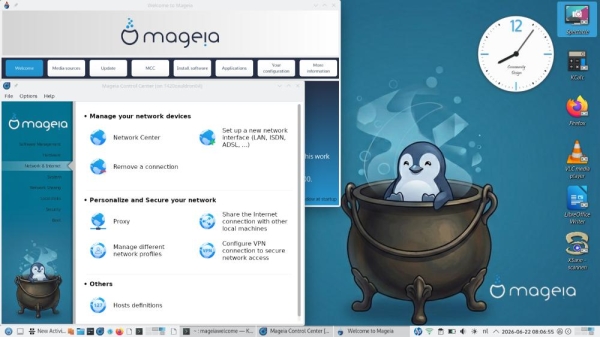
Almost three years after the release of Mageia 9, Mageia 10 has finally arrived.
Key innovations:
- Kernel 6.18, Mesa 26.0, X.Org 21.1, Wayland.
- For 32-bit: requires a processor with SSE2, support has been trimmed.
- Design: new high-resolution wallpapers (up to 4K) in JXL format.
- Installation: prompts for the time zone at the beginning (for correct signature verification), Wi-Fi support (now from the beta version), improved recovery system.
- Package manager: RPM 4.20, DNF v5 (alternative to urpmi), added support for AppStream.
- Tools: updated MCC, MageiaWelcome, Isodumper, dnfdragora, manafirewall, python-manatools (new graphical abstraction for Qt6/GTK4/text).
Drivers:
- AMD: only open-source drivers (AMDGPU / Radeon), proprietary AMDGPU-PRO is not supported (incompatible with X.Org).
- NVIDIA: in the nonfree repositories — drivers for new cards (series 580, package nvidia-current), for old ones (series 470) and experimental (newfeature). For Optimus — three options: Nouveau (DRI_PRIME), Bumblebee, or Mageia-prime.
- Sound: PulseAudio by default, PipeWire installed but disabled (can be switched via MCC).
Desktop environments:
- Plasma 6.5.5 (default Wayland, Qt6) — Live image available.
- GNOME 49 (Wayland, X11 session available) — Live image available.
- Xfce 4.21 — Live image available (32/64 bit).
- Also: LXQt 2.3, MATE 1.28, Cinnamon 6.6, Enlightenment E27, lightweight window managers.
Applications:
- Office: LibreOffice 26.2, Marknote replaces Knotes.
- Browsers: Firefox ESR, Chromium removed (can be installed from Flatpak).
- Multimedia: mp3 codecs now in Core (due to patent expiration), H.264/AAC — in Tainted.
Development and servers:
- Compilers: GCC 15, LLVM 20, Glibc 2.42.
- Languages: Python 3.13 (Python 2 removed), Perl 5.42, PHP 8.4/8.5, Ruby 3.4.7, Rust 1.95, Java 17.
- Virtualization: QEmu 10.2, VirtualBox 7.2, Xen 4.20.
- Servers: Nextcloud returned, Kea replaced the outdated DHCP server.
Known issues and removed packages:
- Dovecot 2.4 requires manual config editing.
- Removed: chromium-browser, sparkleshare, bookworm.
Classic ISOs (32/64 bit): contain all drivers, including proprietary ones, and a large selection of packages. Fit on an 8 GB USB, a dual-layer disc is required for DVD (except for Xfce — fits on a regular DVD).
There are also network ISOs (Netinstall) and Live images (Plasma, GNOME, Xfce).
Source: linux.org.ru
