

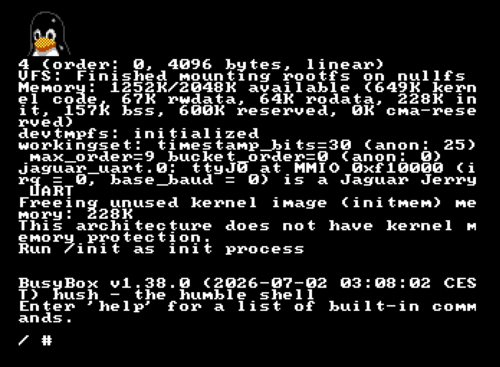
Following the porting of Linux to the Sega MegaDrive, the ability to run the Linux kernel with a set of Busybox utilities on the Atari Jaguar gaming console, released in 1993, was implemented. The console was equipped with a Motorola 68000 CPU, came with 2 MB of RAM, and could use cartridges with a capacity of up to 6 MB for permanent storage. It was equipped with two coprocessors: Tom (a GPU with a 32-bit RISC architecture + a 64-bit video processing unit + a 64-bit logic operation processor) and Jerry (a DSP with a 32-bit RISC architecture for sound processing).
Similarly to the port for the Sega MegaDrive for running the Linux kernel on the Motorola 68000 CPU, which lacks a hardware memory management unit (MMU), the standard kernel 7.2.0-rc1 was built in the 'NOMMU' mode used for microcontrollers, allowing the use of a flat memory model with linear address space (previously, developments for operation without an MMU evolved in the uClinux kernel fork but were later incorporated into the main kernel as the 'NOMMU' option). The issue of insufficient RAM was addressed differently, through the use of the execute-in-place (XIP) mechanism, allowing the kernel code to be executed directly from ROM without copying to RAM.
The RAM on the device is reflected at address 0x000000, while the ROM (cartridge) is at address 0x80000; thus, the components of the Linux kernel were divided into two separate memory areas: the .rodata and .text sections with constants and code were placed on the cartridge, while the .data and .bss sections with mutable data were in RAM. Since the 68000 CPU looks for the interrupt vector table at address 0x0, and the kernel is actually located on the cartridge, the contents of which are reflected at address 0x80000, a hack was additionally applied to copy the interrupt vectors into RAM.
The problem of the missing timer in the Motorola 68000 CPU was solved by utilizing the timers used in the DSP for sound synthesis. These timers were employed to generate interrupts to activate the task scheduler. A separate console driver was written for outputting kernel messages during boot, simulating a parallel port through the TXD and RXD outputs controlled via the DSP processor.
The Buildroot toolkit with patches from the LinuxMD project was used to assemble the user space components. To save memory during initialization, the shell '/bin/busybox sh' was directly invoked, and the malloc function in the uClibc library was replaced with a simplified version, malloc-simple, which does not retain additional metadata. Instead of a full bootloader like U-Boot, control was transferred directly to the kernel with the command 'jmp $80000'.
Source: opennet.ru
