

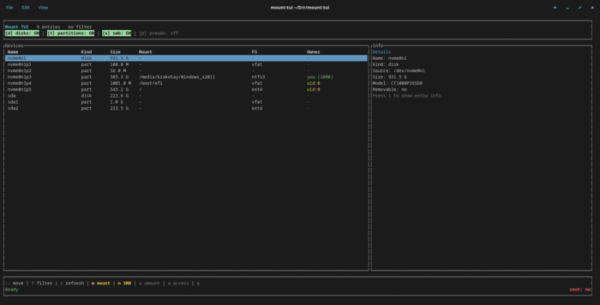
The mount-tui project has been released, developing an interactive text interface for viewing and mounting local block devices, as well as connecting to network resources via the SMB/CIFS protocol. The program is written in Rust using the Ratatui and Crossterm libraries and is distributed under the Apache 2.0 license.
mount-tui displays a list of disks and partitions, indicating the file system, size, mount point, and additional device information. It supports list filtering, viewing pseudo file systems, mounting and unmounting partitions, and changing mount points and mounting options.
For NTFS file systems, there is a choice between the user driver ntfs-3g and the kernel-supported ntfs3 driver. By default, ntfs-3g is used as the more compatible option. If the attempt to mount in read-write mode fails, the program offers to retry in 'read-only' mode.
When connecting SMB/CIFS resources, credentials are entered directly in the program interface. The password is not passed in command line arguments but is placed in a temporary file with 0600 access rights. Guest connections and re-connections of previously mounted resources with modified parameters are allowed.
By default, local file systems are mounted in directories of the form '/media/{user>/'. The program can check the current user's access to the mount point and, if necessary, assign appropriate UID/GID or change the owner of the root directory of the mounted Unix-compatible file system. Ownership of nested files is not affected.
The mount-tui utility can be run by a regular user. When attempting to perform a privileged operation, the program suggests restarting itself via sudo. The cifs-utils package is required for working with SMB, and the ntfs-3g package for using the ntfs-3g driver. Commands for installing the executable in '/usr/local/bin' and building packages in DEB and RPM formats have also been prepared.
Source: opennet.ru
