

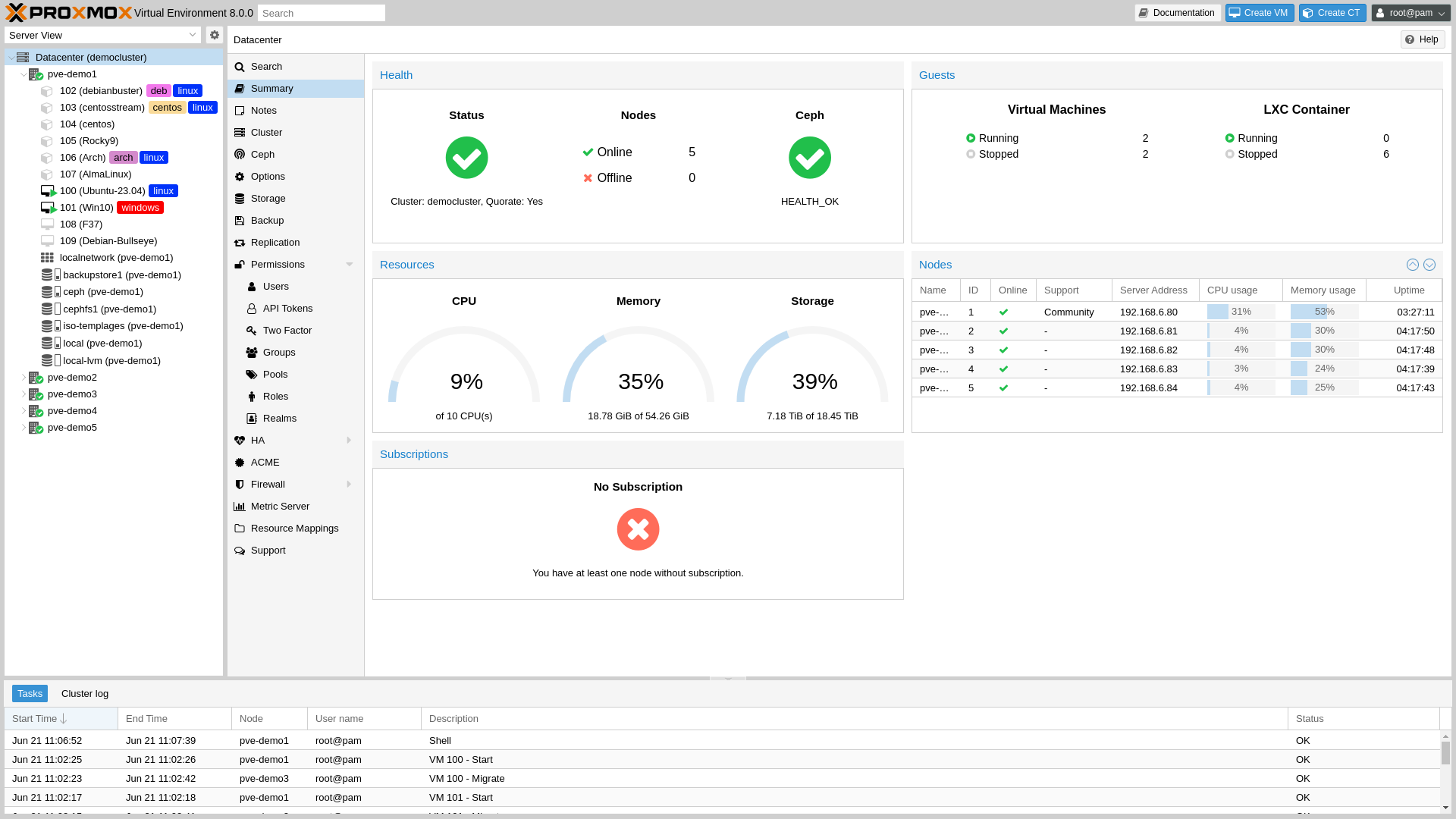
On August 5, 2026, Proxmox Server Solutions released the first officially supported version of Proxmox Virtual Environment for ARM64 architecture.Until now, the Proxmox VE virtualization server platform was officially released for x86-64, although there were third-party ports and experimental methods for running on ARM.
The ARM64 variant is not implemented as a separate fork or a stripped-down edition. Proxmox VE 9.2 for ARM64 shares the same codebase, package repositories, and release cycle, as the x86-64 version. Both architectures are built from the same source code and should receive the same versions of packages, although developers warn that separate ARM64 builds may appear slightly later due to a smaller amount of testing hardware.
The system is based on Debian 13.5 "Trixie" with Linux 7.0 as the default kernel. It uses QEMU 11.0, LXC 7.0, and ZFS 2.4, meaning the same core components as in the x86-64 variant of Proxmox VE 9.2. For Ceph, Squid 19.2 and Tentacle 20.2 branches are available.
Developers claim functional parity of the ARM64 version with x86-64 for the main features of the platform. In particular, available are:
ZFS. Local storage on ZFS is natively supported; developers report that the stack has undergone separate testing on ARM64 and should provide the same set of features and reliability as on x86 servers.
High availability clusters. ARM64 nodes receive native clustering, HA, and load balancing tools. In Proxmox VE 9.2, Dynamic Load Balancer and the new cluster maintenance mode Disarm/Arm are also present.
Software-defined networks. The standard Proxmox VE SDN stack is available, including the newly introduced in 9.2 WireGuard- and BGP-fabric, BGP/EVPN, route maps, and prefix lists.
Backup and recovery. The ARM64 version retains the built-in backup mechanisms for virtual machines and containers. Meanwhile, a separate Proxmox Backup Server for ARM64 has not been officially released yet, — the developers have only reported internal test builds being available.
A unified web interface and management tools. Configuration, administrative utilities, and documentation are nearly identical to the x86-64 version. There is also a separate ARM64 pve-enterprise repository available with commercial technical support.
The port was developed and tested in collaboration with NVIDIA and Supermicro on servers featuring NVIDIA Grace Hopper.Currently, the platforms NVIDIA Grace Hopper and NVIDIA Vera are fully officially supported by Proxmox. For other server hardware based on ARMv9-A and newer, support is claimed on a best-effort basis; ARMv8-A may also work, but without the same guarantees.
There are also hardware requirements. The ARM64 server must boot through UEFI and describe the hardware through ACPI.Therefore, typical boards that use only Device Tree are not officially supported. In particular, the developers separately emphasize that Raspberry Pi is not included in the list of supported hardware,, even despite the possibility of getting Proxmox VE to work on some such systems manually.
Mixing ARM64 and x86-64 nodes in the same cluster is technically not prohibited; however, this configuration is not officially supported. Virtual machines can only run on nodes of the corresponding architecture, so live migration between x86-64 and ARM64 is not possible.Data from a virtual machine can be transferred via backup, offline migration, or shared storage, after which the guest OS will need to be reinstalled or adapted for the different architecture.
Proxmox VE for ARM64 is distributed as a ready-made bare-metal ISO image and through package repositories.It is also possible to install it over Debian 13 ARM64. The source code of Proxmox VE is open and is primarily distributed under the GNU AGPLv3..
Source: linux.org.ru
