

The issue has been published LinuxThe openKylin 3.0 distribution, developed by China Electronics Corporation with the participation of several hundred different Chinese organizations, educational institutions, research centers, software and hardware manufacturers. The distribution maintains its own package base, independent of other distributions. Development is conducted under open licenses (primarily GPLv3) in repositories hosted on gitee.com. Ready-to-use installation builds are available for the X86_64 (8 GB), ARM64 (6.7 GB), Loong64 (4.3 GB), and RISC-V (5 GB) architectures, in server and desktop versions.
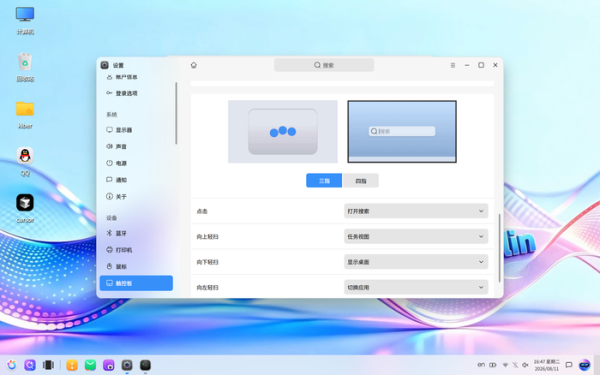
The distribution uses the UKUI (Ultimate Kylin User Interface) user interface, which adheres to the classic desktop organization model for PCs and offers an optional tablet mode, controlled via a touchscreen and supporting an on-screen keyboard. The user interface was initially based on a fork of the MATE desktop, but was subsequently almost completely redesigned and converted to components written in C++ using the Qt library, but also partially borrowed from KDE or created from scratch.
The main panel is a fork of the LXQt project, but the sidebar and menu are custom-built. The application control center and configurator are based on KDE components. A multimedia control is used for sound control. server PipeWire. Peony, a Qt-based fork of MATE's Caja/Nautilus, is offered as a file manager.
Of the specific features of openKylin, the Graded Freeze process lifecycle management mechanism stands out, which allows you to freeze unused applications without shutting them down, but returning the resources allocated to the processes to the system. Graded Freeze also makes it possible for different application classes to have different execution and resource consumption priorities.
The distribution has built-in tools for integration with mobile devices running the platform. Android, organizing interactions between system devices and Android-devices, screen sharing, file synchronization, and search. To run mobile applications written for Android, a special KMRE environment is provided. Launch Windows-applications are provided using Wine.
Changes in openKylin 3.0:
- The KylinBot AI agent has been integrated, enabling the use of AI across all parts of the system. The Kylin-CUA AI toolkit has been added for automating desktop actions. Using the MCP protocol, the AI agent can be used to work with system utilities, perform desktop actions, and manage the system, display, network, and peripheral devices. Alternative AI agents, such as WorkBuddy, OpenClaw, and RaccoonWork, are supported. An AI SDK is available for developing custom AI extensions and leveraging alternative large language models.
- Support for Air Gestures has been implemented, allowing you to control the system using hand gestures in front of the camera (for example, waving your palm up and down to scroll or clenching your fist to take a screenshot).
- The desktop has been updated to UKUI 4.24. The new WLCOM compositing manager, which uses Wayland, is now enabled.
- The taskbar is divided into three independent visual zones for icons of pinned/running applications, widgets, and the system tray.
- Added support for voice input and screen reader.
- Dynamic desktop wallpapers have been implemented.
- The file manager has expanded its functionality for previewing content and performing operations on a group of files in batch mode.
- Support for post-quantum encryption algorithms ML-KEM-768, ML-DSA-2, and SLH-DSA-128s has been integrated. The openHiTLS cryptographic library, developed by Chinese organizations, is used.
- The package includes analogs of the wget and time utilities, rewritten in Rust.
- Added support for 18 languages, including Russian.
- Software versions have been updated, including the kernel. Linux 7.0, GCC 15, glibc 2.42, LLVM 22, JDK 25, glibc 2.42, Python 3.14, Mesa 26, Wayland 1.24, Qt 6.8, GTK 4.22, OpenSSL 3.5, NetworkManager 1.54, PipeWire 1.6, FFmpeg 8.
Source: opennet.ru
