

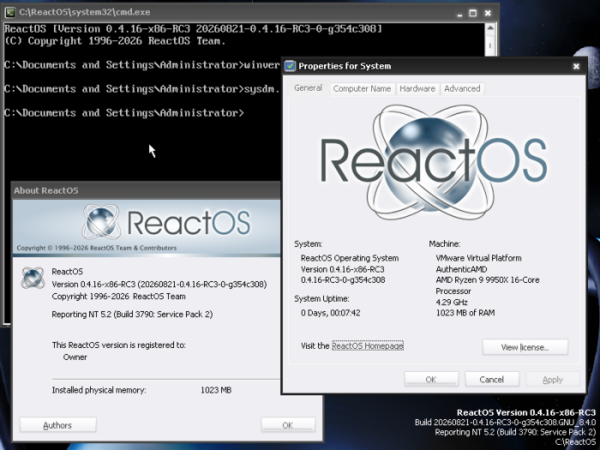
After one and a half years of development, the release of ReactOS 0.4.16 has been presented, aimed at ensuring compatibility with Microsoft Windows programs and drivers, as well as offering a Windows-style interface. The operating system is in the alpha stage of development. A bootable ISO image (198 MB) has been prepared for download. The project's code is distributed under the GPLv2 and LGPLv2 licenses.
Since the last release, 2808 changes have been made and 381 issue reports closed. Key changes include:
- A unified BootCD has been proposed, combining a live environment for getting acquainted with the system and an installer for installing ReactOS on a permanent drive into one ISO file.
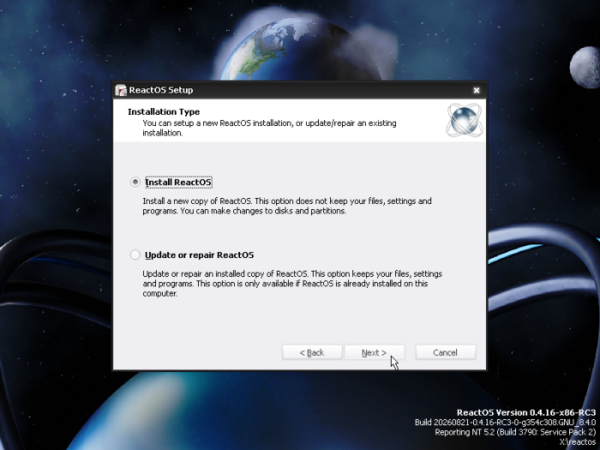
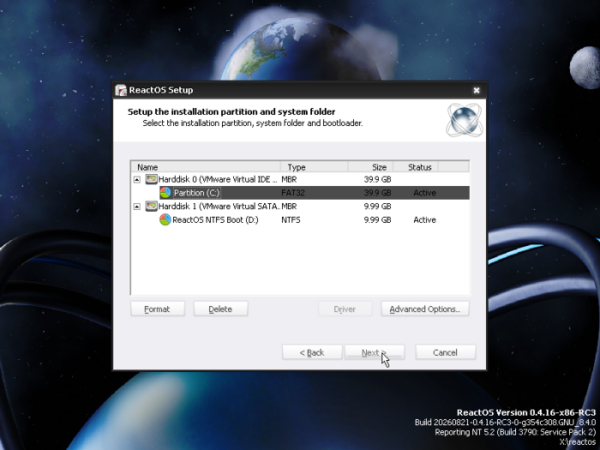
- A graphical interface for installing, updating, and restoring the system has been added, replacing the previously offered text-based installer. The new installer is presented as a multipage 'wizard' and includes a disk partition editor.

- Compatibility with proprietary video drivers has been improved. Among other things, performance drops when using NVIDIA drivers have been eliminated, and issues with the black screen in OpenGL applications when using AMD drivers have been resolved. The implementation of the KMDF (Kernel-Mode Driver Framework) and WDDM (Windows Display Driver Model) subsystems has allowed for support of most video drivers available for Windows XP and Windows Server 2003.
- A new sklhdaudbus driver for HD Audio has been added, built using the KMDF (Kernel Mode Driver Framework) that allows for use with any HD Audio controllers compatible with Windows XP and Windows Server 2003. The driver correctly supports sleep mode, provides access to AudioDSP on Intel platforms, and is compatible with drivers for QEMU and VMWare. The detection of audio devices has been improved, and binary compatibility with the Windows audio stack has been enhanced. The sound settings interface now correctly preserves the state of volume and balance sliders across reboots.
- A new ATA storage driver has been implemented, supporting operation with SATA, PATA, ATAPI, AHCI, and SCSI devices, resolving boot delay issues and compatible with Hyper-V virtual machines.
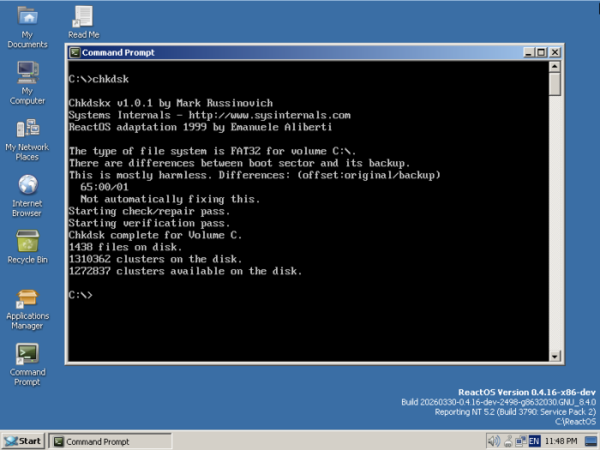
- The chkdsk utility has been enhanced to check and restore the integrity of partitions with FAT file systems when using the Microsoft FastFAT driver.
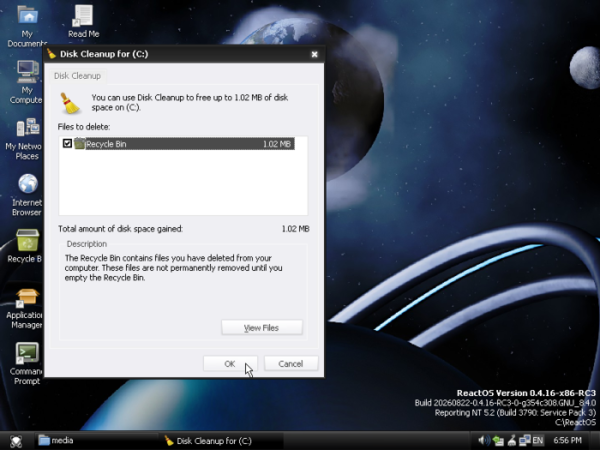
- A cleanmgr utility with a graphical interface has been added to clean unnecessary information on the disk (for example, clearing the Recycle Bin and deleting temporary files). The program is compatible with extensions for the Windows Disk Cleanup utility that define the logic for removing residual and temporary files from third-party programs and the system.
- A new DC21X4 driver for DECchip 21×4 network adapters has been added, which is in demand when using virtualization systems such as Microsoft Virtual PC 2007 and Hyper-V Generation 1.
- Support for asynchronous network operations has been added.
- A new installation type has been implemented — Server Core, which serves as an equivalent to the Windows Server Core mode for booting the system without a graphical shell (without the explorer shell), but with a full Win32 subsystem for running server programs.
- The strict binding to the Windows Server 2003 API has been discontinued, allowing for synchronization with the Wine 10 codebase (previously, code from Wine 2.x and 3.x was used). The WineVDM layer has been included for running 16-bit Windows applications.
Source: opennet.ru
