

For discussion in the mailing list of Linux kernel developers, patches have been published implementing the BeamFS file system, which uses Reed-Solomon coding to detect and recover corrupted data in-place in single-storage configurations. The primary applications of BeamFS include onboard computers of satellites, equipment in radiation therapy offices, and other systems operating in high-radiation conditions, where returning corrupted data is more critical than the inability to read the information.
By default, BeamFS can recover up to 8 lost bytes in each 255-byte block with an overhead of 7% (288 bytes of recovery codes for every 4096 bytes of stored data). Error correction codes are applied not only to data but also to metadata in superblocks, inodes, directory indices, and bitmaps. Integrity checks and attempts to recover missing data are performed with each read operation. If the integrity of the information cannot be guaranteed, the operation ends with an '-EIO' error, which excludes the hidden return of corrupted data.
Experiments showed that when the i.MX 8M Plus board with Linux and the ext4 file system was irradiated with protons with energies ranging from 20 to 58 MeV, 90% of all failures occurred at the file system and storage driver levels. A simulation of single bit distortions during reading from the medium was also conducted: BeamFS and Btrfs successfully recognized data corruption and always returned an error, while ext4 and ext3 silently returned corrupted data.
BeamFS ensures integrity and recovery only from the stage of reading from the physical medium to the transfer to the page cache in RAM. The integrity of storage in RAM can be maintained using memory chips with error correction.
Among the limitations of BeamFS is the lack of journaling support and the Copy-on-Write (CoW) mode — metadata is written to the storage in an unordered manner, so a full check using fsck is required in the event of an improper shutdown.
In addition to BeamFS, two more file systems have recently been proposed for the Linux kernel:
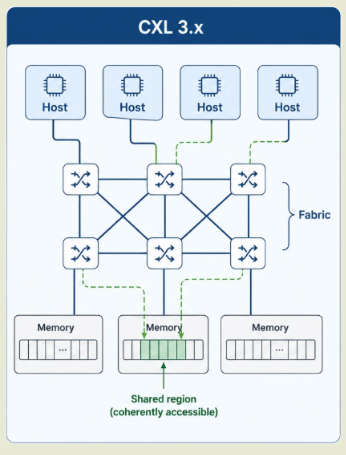
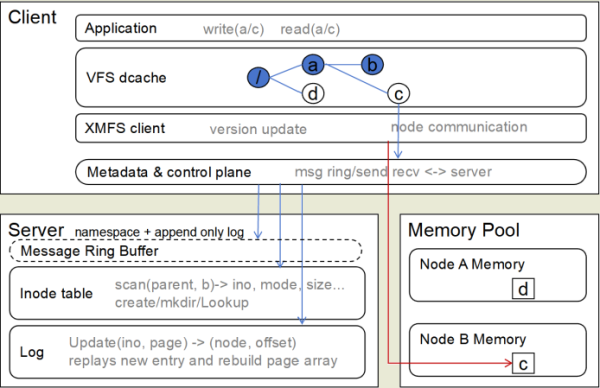
- At the Linux Plumbers Conference 2026 held a few days ago, an engineer from Huawei presented (video, slides) the XMFS (cross-node eXpress Memory File System) file system for the Linux kernel, designed for use in clusters with shared RAM accessible to all nodes (similar to tmpfs, but for memory across all nodes). XMFS enables the use of the standard POSIX interface for file systems to work with external memory directly addressed using technologies such as CXL 3.0 (Compute Express Link) and Huawei United Bus. The project is currently in the experimental prototype stage and undergoing internal testing, and it is not yet ready for inclusion in the kernel.

The file system has a classic architecture typical of distributed file systems with allocation server, responsible for journaling, maintaining inode tables, and mapping content and metadata to the memory of individual nodes.

When testing XMFS for tasks such as sharing container images across different nodes, its implementation exhibited performance close to that of tmpfs when using large memory pages (2 MB huge pages).


- An AI-developed file system, MeshXFS, has emerged as a fork of XFS, adapted for simultaneous use across multiple nodes in a cluster. MeshXFS allows mounting a shared block device in read-write mode on different nodes, maintaining integrity and managing locks during concurrent data access. The project began as an experiment to explore the feasibility of creating a Linux driver with a file system supporting distributed locks, parallel access, and fault recovery using AI models. Most of the work was accomplished with Claude Opus, but particularly challenging issues were addressed using models like Claude Fable, GPT, Gemini, and Astra. The experiment is deemed successful, and several working releases of MeshXFS have already been published.
Among the additional features implemented on top of XFS are two modes of managing distributed locks (network synchronization and state storage on a separate shared disk), cache consistency across different nodes, logging for recovery, and adaptation of the disk format and utilities for the specifics of clustered file systems. Support for working with shared storage connected via iSCSI (tested on 16 nodes) or for block device replication using DRBD is available. Lock coordination, node discovery functions, availability checks, and failure detection for nodes are implemented in a single common kernel module. The operation has been tested in Proxmox VE 9, RHEL 9, Ubuntu 24.04/26.04, and Debian 12/13.

Source: opennet.ru
