

The release of web browser Firefox 161 has taken place, along with updates for previous long-term support branches — 153.8.0 and 115.46.0. As part of the new two-week release cycle, the Firefox 162 branch has entered beta testing, with a release scheduled for December 8.
Key innovations in Firefox 161 (1, 2, 3):
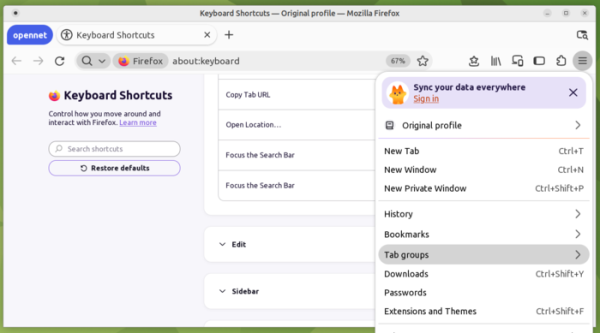
- The ability to assign a keyboard shortcut for copying the URL of the current tab to the clipboard has been added to the settings page about:keyboard (by default, no shortcut is selected).
- A section for quick access to grouped tabs has been added to the main menu.

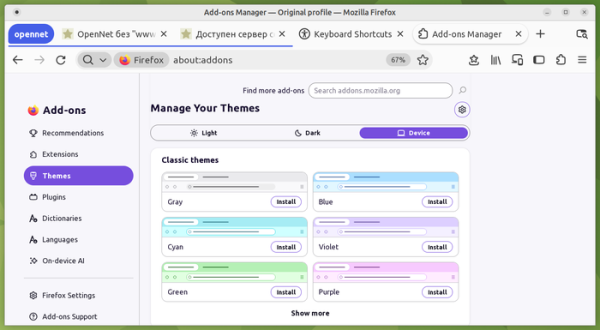
- In the add-ons manager, a section for classic themes has appeared in the theme selection area, including the Proton theme reminiscent of older Firefox versions, the Firefox OLED theme with a black panel background, and a set of monochrome themes.

- The built-in VPN has added the ability to selectively enable or disable it for specific sites.
- When importing browsing history from Chrome, the statistics on how frequently the user opened each page are now transferred. This statistics is employed to rank the contextual suggestions displayed during input in the address bar.
- A random() function has been added to CSS, allowing for the generation of random values within a specified range to be used as style parameters. For example, “rotate: random(property-scoped, 0deg, 360deg);” or “width: random(property-scoped, 50px, 300px);”
- The use of nested substitution functions in CSS has been permitted: such functions can be specified in the first argument of CSS functions var(), attr(), and env(), for example, “var(attr(data-theme-prop type(<custom-identident>)))” and “env(var(—safe-area-block-start)).”
- Support for the CSS Typed Object Model has been added, allowing manipulation of CSS values not as strings but as typed JavaScript objects. With this model, developers do not need to worry about converting typed values to strings and vice versa. In addition to being able to manipulate values assigned to CSS properties, the typed object model also enables writing code that is more maintainable and understandable. For instance, instead of “el.style.opacity = 0.3”, one can write ‘el.attributeStyleMap.set(“opacity”, CSS.number(0.3))’. Support for color values, such as CSSColorValue, is not yet implemented.
- In the Async Clipboard API, which allows for asynchronous reading and writing to the clipboard using a Promise mechanism, support for custom data formats in the clipboard has been added. This enables websites to place and extract data from the clipboard in formats other than the standard MIME types, such as text/plain, text/html, and image/png. The definition of a custom format only applies to the pages of the website where it was defined.
- Support for the ‘Compression Dictionary Transport’ mechanism (RFC 9842) has been enabled, allowing for a reduction in the size of data transmitted between the client and proxy server, by using compression algorithms Zstandard (Content-Encoding: dcz) and Brotli (Content-Encoding: dcb) in combination with the compression of typical structures using dictionaries. There are two usage scenarios for Compression Dictionary Transport — compressing content using dictionaries previously sent by the server and using previously sent content as a dictionary to compress its new version (delta compression, where only changes compared to the existing version are transmitted).
For example, when requesting ‘GET /index.html’ server it can convey information about the availability of a dictionary by returning the path to it in the header ‘Link: ; rel="compression-dictionary". When the client fetches the dictionary ‘…/dict’, the server will provide information about its application to HTML files by setting the header ‘Use-As-Dictionary: match="/*html"‘. In the next request for an HTML resource, such as ‘GET /index2.html’, the client will indicate the presence of the dictionary through the header ‘Available-Dictionary: hash_of_dictionary"‘. If the server has a dictionary with that hash on its side, it will return the content of index2.html, compressed with the use of that dictionary.
For delta compression of different versions of JavaScript files in response to the request ‘GET /app.v1.js’, the server may set the header ‘Use-As-Dictionary: match="/app*js"’, indicating that the returned content can be used as a dictionary for paths ‘/app*js’. In the subsequent request for a file matching this pattern, such as ‘GET /app.v2.js’, the client will send the hash of the existing dictionary via the header ‘Available-Dictionary:’, and the server will return only the changes between the files app.v1.js and app.v2.js.
- In Firefox for Android: More prominent messages have been implemented when confirmation of new permissions is needed during extension updates. Three new search widgets have been proposed for placement on the home screen: image search, opening search in private mode, and voice search. Support for downloading Firefox from Google Play in vehicles with an Android Automotive infotainment system has been added. On some devices, page rendering performance has been improved with blur effects. On the home page, in addition to Google, shortcuts for the most frequently opened sites are now displayed instead of fixed shortcuts.
In addition to enhancements and bug fixes, Firefox 161 has resolved 110 vulnerabilities, most of which were caused by memory-related issues, such as buffer overflows and access to already freed memory areas. These issues could potentially allow an attacker to execute code when opening specially crafted pages.
Source: opennet.ru

 Russian
 Italian
 German
 Polish
 Estonian
 Albanian
 Bosnian
 Bulgarian
 Croatian
 Czech
 Danish
 Dutch
 English
 Finnish
 French
 Hungarian
 Indonesian
 Latvian
 Lithuanian
 Norwegian
 Portuguese
 Romanian
 Slovak
 Slovenian
 Spanish
 Swedish
 Turkish