

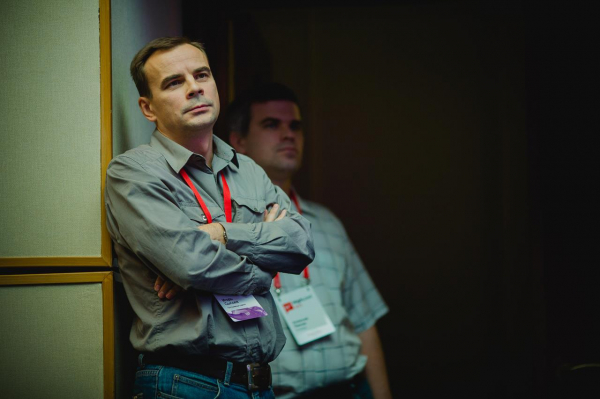
Igor Sysoev, web server developer , a member of a large family , was not just a part of the inception of our conference. I see Igor as my professional mentor, a master who taught me how to work with and understand high-load systems, which has defined my professional path for a decade.
Naturally, I couldn't overlook the resounding of the NGINX team... And I interviewed not Igor (he remains the introverted programmer), but the investors from the Runa Capital, who recognized nginx ten years ago, built a business infrastructure around it, and are now conducting a deal unprecedented in size for the Russian market.
The aim of the article below is to confirm yet again — anything is possible! Give it a try!
Oleg Bunin, Head of the HighLoad++ Program Committee: Congratulations on the successful deal! As far as I can tell, you managed to preserve and support Igor's desire to continue working as a programmer while building the entire business infrastructure around him — that's a dream for any developer, isn't it?
My interlocutor, managing partner of Runa Capital, Dmitry Chikhachev: That's right. This is largely thanks to Igor himself and his co-founders Maxim and Andrey (Maxim Konovalov and Andrey Alekseev), because they were originally ready for this infrastructure to be built around them. Not all startup founders adequately assess their own strengths and capabilities. Many want to lead or manage the entire process.
— So, did the NGINX team essentially distance themselves from the business part, or what?
Dmitry: No, they didn't distance themselves from the business part, why would they? Maxim managed the operations part as the Chief Operating Officer. Andrey handled BizDev, while Igor continued his software development — what he enjoys.
Everyone focused on their strengths and what they liked.
But they all understood that building a multi-million dollar business in the U.S. required a person of a different caliber, with a different background. Therefore, there was an agreement with the investors from the very first round of negotiations that such a person would be found. This person was Gus Robertson, who met all these criteria.
— So, was it initially planned to enter the American market?
Dmitry: NGINX is a B2B business. It's not particularly well-known to users, as it operates at the infrastructure level, one could say middleware. The primary market for B2B is the USA, which accounts for 40% of the global market.
Success in the American market predetermines the success of any startup.
Therefore, a logical plan would be to head to the USA, immediately hire someone to lead the American company, and develop the business while attracting American investors. If you want to sell infrastructure software in the USA, it's important to have American investors backing you.
— Who approached whom: you to nginx, or nginx to you?
Dmitry: We had many different points of contact. We probably took more initiative, because even then nginx was noticeable. Although it wasn’t a company yet and its market share was relatively small (6%), there was already significant investor interest. The deal was competitive, so we were certainly proactive.
— What was the state of the product? There was no company, but were there drafts of a commercial enterprise version?
Dmitry: There was an open-source web server nginx. It had users representing 6% of the global market. In reality, that's millions, even tens of millions of websites. However, there was still no company and no business model. And since there was no company, there was no team: there was Igor Sysoev — the developer of nginx and a small community around it.
It's a very interesting story. Igor started writing nginx quite a while ago — in 2002, and released it in 2004. Real interest in it only emerged in 2008, and in 2011 he attracted funding. Few people ponder why there was such a long delay. There is actually a logical technical explanation for this.
In 2002, Igor was working at Rambler, and there was one problem he was solving as a system administrator — the so-called C10k problem, which is ensuring a server can handle more than ten thousand simultaneous requests at peak load. This issue was just emerging, as heavy loads on the internet were starting to become common. Only a few individual sites faced it — such as Rambler, Yandex, Mail.ru. For most websites, it wasn't relevant. When there are only 100-200 requests a day, there’s no need for nginx; Apache would do just fine.
As the internet became increasingly popular, the number of websites facing the C10k problem grew. More and more websites required a faster web server to handle requests—something like nginx.
However, the real surge in load occurred between 2008 and 2010 with the advent of smartphones.
It's easy to imagine how quickly the number of requests to servers skyrocketed. First, internet usage time increased because clicking on links became possible everywhere, not just while sitting at a computer. Secondly, user behavior changed as well—navigating via touch screens led to more chaotic link transitions. One can also include social media.
This led to exponential growth in peak loads on the internet.Overall load increased fairly evenly, but the peaks became increasingly pronounced. It turned out that the C10k problem had become widespread. At that moment, nginx took off.
— Tell us how events unfolded after meeting Igor and his team? When did the development of infrastructure and business ideas begin?
Dmitry: At first, the deal was being formed. I already mentioned that it was a competitive deal, and eventually, a syndicate of investors emerged. We became part of this syndicate along with BV Capital (now e.ventures) and Michael Dell. We first closed the deal and then started considering the search for an American CEO.
And how did you close the deal? It turns out you didn’t even know what the business model would be or when it would become profitable? You just invested in a team and a great product?
Dmitry: Yes, it was purely a seed deal. We weren’t thinking about the business model at that moment.
Our investment thesis was based on the fact that NGINX is a unique product with a significantly growing audience.
It solved a serious problem for this audience. I have a favorite test, a litmus test for any investment—does the product solve a widespread and painful problem? NGINX passed this crash test with flying colors: the problem was widespread, loads were increasing, and sites were going down. And it was painful because it marked the era when a website became, as they say, mission critical.
In the 90s, people thought this way: the website is down—I'll call the sysadmin, and in an hour it will be up again—everything's fine. By the late 2000s, a 5-minute downtime had become a real loss of money, reputation, etc., for many companies. The fact that the problem was painful is one side of the story.
The second aspect we, as investors, look at is the quality of the team. Here we were impressed by Igor and his co-founders. It was a complementary experience and a unique product that was developed by one person.
— Clearly, the team with a certain level of complementary competencies also played a role.
Dmitry: I think it’s right that Igor developed the product alone, but when it came time to create the business, he didn’t jump in alone but with partners. Looking at my 10 years of investment experience, I can say that having two co-founders definitely reduces risks. The optimal number of co-founders is two or three. One is too few, while four is already too many.
— So what happened next? When the deal was already done, but the business idea hadn’t been developed yet.
Dmitry: The deal is made, the company is registered, documents are signed, money is transferred—everything’s set. At the same time, we worked on the business aspects and hired a team of developers who started working on the product. Andrei Alexeyev, as BizDev, built the initial relationships with potential clients to gather feedback. Everyone thought together about the business model, and everyone searched for a top manager to develop the American business and essentially head the company.
— And how did you find him? Where? I can't even imagine how to do that.
Dmitry: All the investors and the board of directors were involved in this. Ultimately, the choice fell on Gus Robertson. Gus worked at Red Hat, whose top manager was our investor. We reached out to Red Hat since it’s open source and said we were looking for someone capable of leading the business and growing it into a billion-dollar company. They recommended Gus.
The deal with NGINX was closed in 2011, and by 2012 we had already met Gus, and we liked him right away. He had a background in open source from Red Hat—at that time it was the only company with a multibillion-dollar valuation in open source. Plus, Gus was focused on business development and sales—that's exactly what we needed!
In addition to background and experience, we appreciated his personal qualities—he is a perceptive and insightful person with a quick mind, and, importantly, we felt he had a good cultural fit with the team. Indeed, that turned out to be the case. When they met, it turned out that everyone was on the same wavelength, all interacting excellently.
We made Gас an offer, and at the end of 2012, he started working with us. Gас also offered to invest his own money in NGINX. This impressed all the investors. Due to Gас's high involvement, he integrated into the founding team and was regarded by everyone as one of the co-founders of the company. Subsequently, he became one of the four. There is a famous photograph where all four are in NGINX t-shirts.
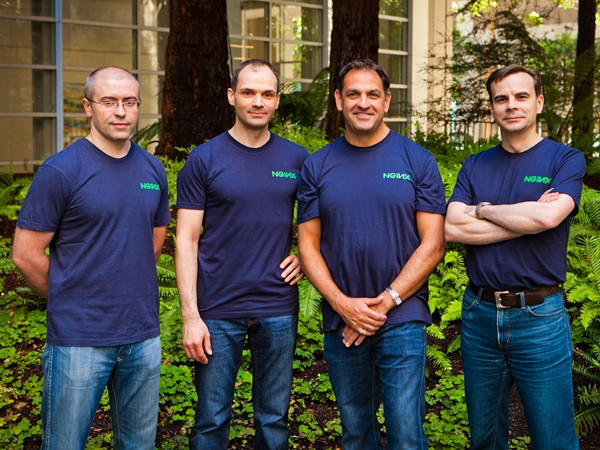
The photograph is taken from Dmitry Chikachev about the history of collaboration between NGINX and Runa Capital.
— Did you manage to identify the business model right away, or did it change later?
Dmitry: We managed to identify the model right away, but before that, we debated for a while about how and what to do. However, the main discussion revolved around whether to continue supporting the open-source project, to keep nginx free, or to gradually push everyone to pay.
We decided that it would be right to leverage the strength of the community supporting nginx, not to disappoint them, and to continue supporting the open-source project.
Therefore, we decided to keep nginx open source, but additionally create a special product called NGINX Plus. This is a commercial product based on nginx that we license to enterprise clients. Currently, the main business of NGINX is selling NGINX Plus licenses.
The main differences between the open and paid versions are:
- NGINX Plus offers additional functionality for enterprises, primarily load balancing.
- Unlike the open-source product, it includes user support.
- This product is easier to use. It is not a constructor that you need to assemble yourself, but a ready-made binary package that can be deployed on your infrastructure.
— How do the open-source and commercial products interact? Do some functions from the commercial product flow into open source?
Dmitry: The open source product continues to develop alongside the commercial one. Some features are added only to the commercial product, while others are incorporated into both. However, the core system is clearly the same.
An important point is that nginx itself is a very small product. In my opinion, it has about 200 thousand lines of code. The task was to develop additional products. But this happened after the next round of investments, when several new products were launched: NGINX Amplify (2014-2015), NGINX Controller (2016), and NGINX Unit (2017-2018). The product line for enterprises expanded.
— How quickly did you realize that you had guessed the model? Did you break even, or was it clear that the business was growing and would generate revenue?
Dmitry: The first year with revenue was 2014, when we earned our conditional first million dollars. At that moment, it was clear that there was demand, but the sales economics were not fully understood yet, particularly how scalable the model would be.
Two years later, in 2016-2017, we understood that the economics were good: client churn was low, there was upselling, and customers who started using NGINX were buying more and more. It became clear that this could be scaled further. This, in turn, led to additional funding rounds aimed at scaling up the sales organization and hiring more people in the US and other countries. Now, NGINX has sales offices in the US, Europe, Asia — all over the world.
— Is NGINX a large company now?
Dmitry: There are about 200 people now.
— Presumably, most of them are in sales and support?
Dmitry: Development is still quite a large part of the company. But sales and marketing are significant as well.
— Are the developers mainly Russian guys sitting in Moscow?
Dmitry: Development is currently taking place in three centers — Moscow, California, and Ireland. But Igor still spends most of his time living in Moscow, going to work, and programming.
We traced the entire journey: starting in 2002, releasing nginx in 2004, growth in 2008-2009, meeting investors in 2010, first sales in 2013, and our first million dollars in 2014. But what about 2019? Success?
Dmitry: In 2019 — it was a good exit.
— Is this a normal cycle for a startup in terms of time, or an exception to the rule?
Dmitry: This is a perfectly normal timeline — it depends on what you start counting from. When Igor was writing nginx — I didn't mention this backstory for nothing — nginx was not a mass product. Then, in 2008-2009, the internet changed, and nginx became very sought after.
If we count from around 2009-2010, a 10-year cycle is perfectly normal,considering that this is essentially the moment when the product began to gain popularity. If we start counting from the 2011 round, then 8 years from the first seed investments is also a reasonable timeframe.
— What can we say now, concluding the topic about NGINX, about F5, about their plans — what will happen to NGINX?
Dmitry: I don’t know — it’s F5’s corporate secret. The only thing I can add is that if you Google “F5 NGINX” now, the first ten links will be news about F5 acquiring NGINX. Two weeks ago, the same query would have returned ten links on how to migrate from F5 to NGINX.
— They wouldn't eliminate the competitor!
Dmitry: No, why? The press release stated that they intend to proceed in general terms.
— The press release is all good: we won’t be bothering anyone, everything will grow as before.
Dmitry: I think these companies have a very good cultural match. In this sense, they both operate in the same segment — networking and loads. So, everything will be fine..
— One last question: I’m a genius programmer, what should I do to replicate the success?
Dmitry: To replicate Igor Sysoev's success, you first need to come up with a problem to solve, because money is only paid for code when it addresses a widespread and painful problem.
— And then you come to you? And you will help further.
Dmitry: Yes, gladly.
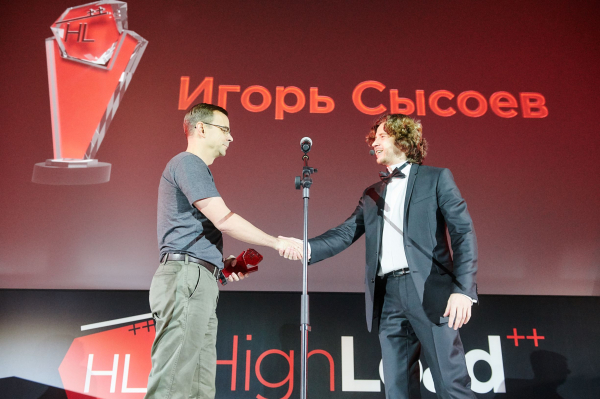
Thank you very much to Dmitry for the interview. We will soon meet again with the Runa Capital fund at . In a place that, now we can confidently affirm, gathers the best developers not just from Russia, but from all over the world. Who knows, maybe in a few years we will all be just as passionately discussing the success of one of you. Moreover, it is now clear where to start — by looking for a solution to an important problem!
Source: habr.com
