

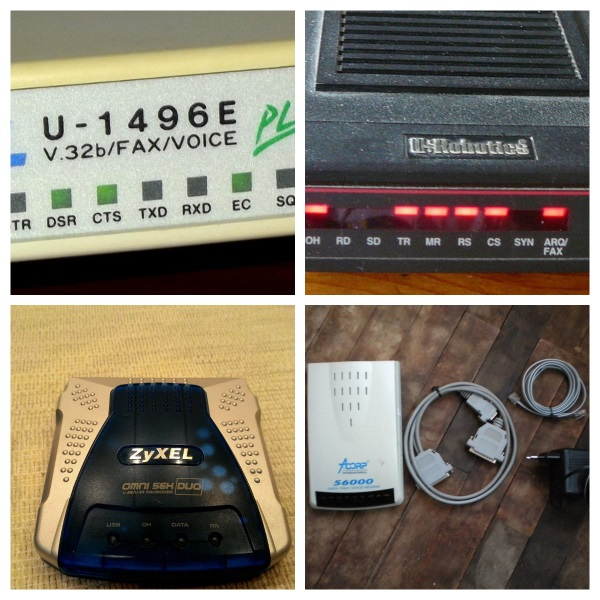
Anyone who has ever heard the sound of a modem connecting to the internet over a phone line will never forget it. For the uninitiated, it's not a particularly melodic combination of sounds. However, for those who depended on dial-up, these sounds were akin to magical music.
Now, in 2019, dial-up has become an outdated and unnecessary technology for the overwhelming majority. Indeed, the slow connection, prone to dropouts at the most exciting moments, can remain in the past. Today, let's talk not about the connection itself, but about the devices that facilitated it — the legendary modems of yesteryear.
And not just any modems, but those capable of providing relatively stable connections on domestic phone lines and switching systems. The connection speed back then was low (to put it mildly) — for many, 28,800 bps was a blessing, let alone 56,000. Then the era of ADSL came, which was pure happiness, but we will discuss that in another article; for now, let's focus on modems!
ZyXEL U-1496E+
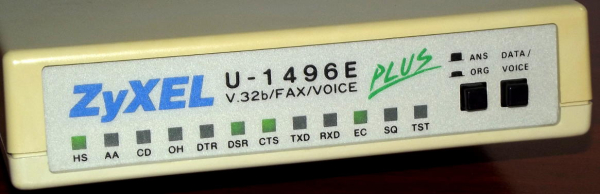
Many readers' first introduction to the internet likely began with this modem. At the time, it seemed like an extraordinarily modern device (and indeed it was). It was one of the most popular modems of its time, as it operated successfully on some of the most ancient telephone lines.
Its development was undertaken by ZyXEL and a Russian partner who helped adapt the modem to the realities of the CIS. The modem's foundation is based on ZyXEL's ASIC, plus additional features such as voice data processing and an automatic number identification system that complies with Russian (let's say, post-Soviet) standards. This is one of the few modems that was certified by the Ministry of Communications of the Russian Federation.
The list of protocols supported by the modem includes all standard protocols, including V.32bis, as well as proprietary ZyX protocols at 19.2 and 16.8 kbps, plus a cellular protocol for enhanced reliability, ZyCELL.
The modem maintained the connection for many hours (albeit not at the highest speed), while competitors could drop the connection after just half an hour.
USRobotics Courier HST Dual Standard V.34 Fax
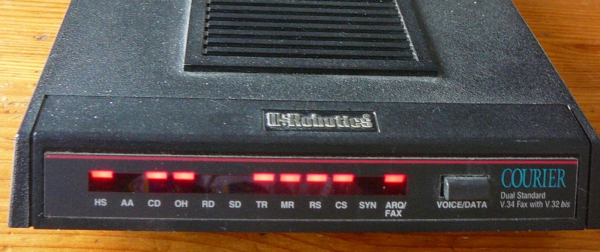
Another highly advanced modem for its time. Its core is a TMS340 signal processor with software developed by the company's engineers, along with a universal Intel 80C186 control processor. There were two versions of the modem — one for the USA and Canada, and an international version.
The latest version was used in the CIS, as the modem was adapted to line circuits that met European standards. The adaptation meant that the modem supported connections over lines with higher constant and variable voltages. This model also included galvanic isolation of the line circuits from the rest of the circuitry. So if something happened to the line, neither the modem nor the connected PC would burn out.
The modem supported a vast number of communication protocols, including V.32terbo and V.FC. It also featured the proprietary HST (High-Speed Transfer) protocol from USR. As a result, the device operated with two channels — one was high-speed for sending and receiving regular data, while the other was slower, dedicated solely to transmitting service data about the passage of packets, retransmission requests, etc.
The modem maintained the connection not much worse than the modem from ZyXEL. Notably, when the connection quality worsened, the speed was automatically reduced. When everything returned to normal, the speed increased again.
ZyXEL Omni 56K uno
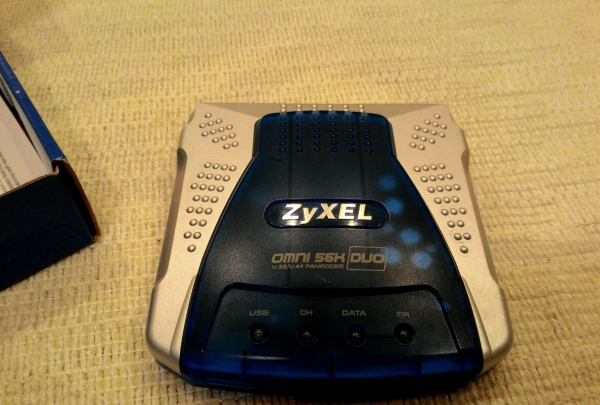
A USB-interface modem that retained the familiar form factor and indicators. However, instead of a Power indicator, there was a USB indicator, but there was nothing to be done about that. It’s worth noting that the modem lacked a reset button or something similar, so if the device "hung," it was necessary to disconnect the USB and reconnect the device. Nevertheless, hangs were rare.
The modem connected to the telephone line in a perfectly ordinary way, familiar to any dial-up user.
The software was top-notch. It even came with the well-known VentaVoice program featuring a Russian interface. The device could easily simulate the operation of real caller ID and fax, and everything worked without issues.
The connection was established very quickly, and the 'line busy' signal was practically always handled correctly. If the connection was obtained, the modem maintained it for many hours at approximately the same speed.
Acorp 56EMS
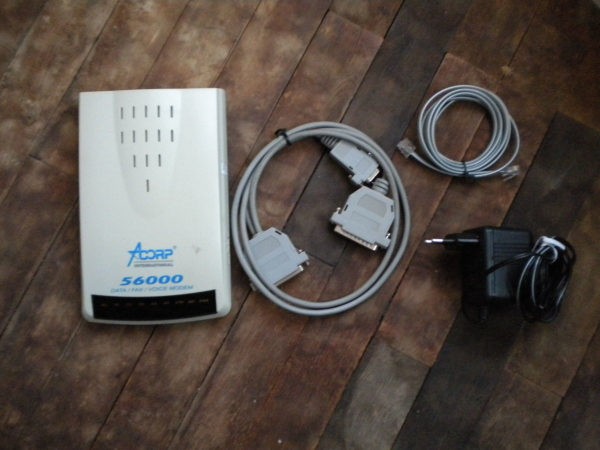
We cannot forget about Acorp modems, if we don't want to miss an important part of modem history. The devices from this manufacturer have always been stylish and stood out among similar products.
The Acorp 56EMS connected to the COM port. It was equipped with all necessary indicators; on the back panel, there were ports for connecting a microphone and headphones, plus two telephone ports. The core of the modem was a Rockwell chip. There was an option to update the firmware thanks to the presence of Flash ROM.
The device is compatible with the K56Flex standard, which allowed it to operate at speeds of up to 56k.
However, these modems were significantly affected by domestic lines, and quite notably. The claimed speed could be achieved, but it happened rarely. There were connection issues that were not always stable.
But Acorp modems were significantly cheaper than other legendary devices, which made them very widespread. Nevertheless, on older lines, the devices performed relatively well.
D-Link DU-562M
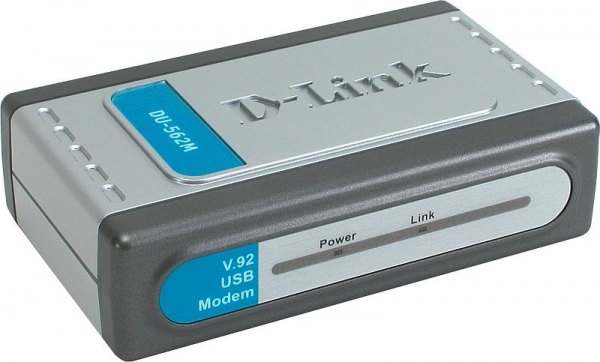
Another USB modem that appeared on the market towards the end of the dial-up era. By the way, this was also when D-Link products started to gain popularity, already featuring a recognizable design.
The modem was small, with only two indicators—Power and Link. Its popularity was explained by its low price. The issue was that there was no second socket for the telephone jack, so the phone had to be connected in parallel through an additional outlet.
Despite its size, it maintained the connection fairly well even on the oldest lines. However, the modem did not handle the 'busy' signal very well, often continuing to operate even after hearing the dial tone.
The package included Classic Phone Tools software, which allowed the modem to be used as a fax. The program worked without any complaints.
Actually, that's all for today—if the article proves to be popular, we will publish a second part. But better yet—mention in the comments those modem models that you particularly remember. Let's reminisce together.
Source: habr.com
