

And there are genetic reasons for this.
Virtually everyone who has completed high school knows that there is a concept of 'homeostasis' — the stability of the internal environment of the body. At the same time, few are aware of the concept of 'allostasis' — the stability of the internal environment through interactions between the body and the external environment.
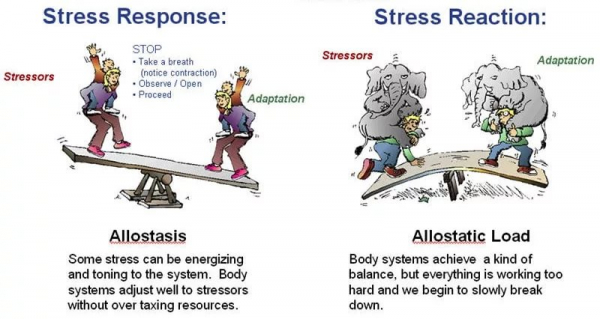
Allostasis and allostatic overload. A little stress invigorates and energizes the body. The body's systems adapt to stressors without overexertion. With allostatic overload, the body finds some balance, but it functions with difficulty and gradually breaks down.
In fact, maintaining homeostasis requires behavioral support from the organism: where to live, what to drink and eat, whom to avoid, and what to strive for. Just as the body is genetically programmed to maintain the stability of its internal environment, its behavior should not disrupt homeostasis; otherwise, the natural selection mechanisms for that organism will activate.
Allostasis through the example of eating behavior
A person's standard of living reflects in their life processes: if you are used to eating meat three times a day, the biochemistry of the body adapts to such nutrient intake for functioning and will rebel with a sudden change in diet.
If meat is consumed twice a day, the body will still endure; however, a transition to a vegetarian diet will trigger a pronounced adaptive response — for 2-3 weeks, the body will adjust to unfamiliar food. Depending on the adaptive reserves, overall well-being can either be very good or very poor. If one persists further, they may suffer from the depletion of adaptive responses and become ill amidst well-being or fall into a depressive state.
Usually, after 2-3 weeks, a rollback period occurs — when it becomes unbearable to eat unfamiliar food.
At this moment, old eating habits typically resurface, which prevents the exhaustion of adaptive mechanisms. This moment can be easily felt when returning from a country with exotic cuisine back home — it’s nice there, but home feels familiar and comforting.
The same situation occurs with income changes: a sharp increase or decrease in income triggers an adaptation reaction, causing the body to attempt to return to its previous level of well-being.
A simple test for your allostatic load with money
Reflect on your feelings about the amount of money you can comfortably spend. Write down your feelings at each level.
5 rubles
10 rubles
20 rubles
50 rubles
150 rubles
450 rubles
5,000 rubles
20,000 rubles
80,000 rubles
350,000 rubles
1,000,000 rubles
10,000,000 rubles
100,000,000 rubles
1,000,000,000 rubles
Initially, the amounts do not cause any tension; as the sum increases, there is a sense of certainty – I can easily afford this. The higher the amount goes beyond the optimal level, the more anxiety arises about how much money can be spent, reaching a point of horror ('I could never earn that amount in my lifetime').
At some point, the psyche simply stops perceiving large numbers, and for most people, spending 1,000,000,000 just seems unreal and they feel nothing about it – billion-dollar expenditures in budgets are read so easily.
Allostasis and a sharp increase in income
The same situation happens when you set new financial goals. Significantly increasing income or gathering money for a very expensive purchase is challenging since the body will try to maintain allostasis.
Many financial training programs set extreme goals for increasing income: 'Become a millionaire or die.' At the peak of adaptation, people sometimes achieve remarkable results, and positive testimonials about the training emerge in waves of success. However, after 2-3 weeks, a period arrives when the body says 'enough' – a regression occurs.
Often, incomes drop to such a level that it becomes better to remain in the old state – the body demands to return allostasis to its normal state and tries to convince the mind that such drastic experiments are unnecessary.
At the same time, there is a more comfortable model of growth – gradually adapting to increasing disposable incomes. Typically, for homeostasis to adjust to a 30% change in income level, it takes between 6 to 12 months.
Knowing that allostasis has a specific optimal rate of adaptation, it makes sense to gradually acclimate yourself to a better quality of life before increasing your disposable income: spend within your income to buy better food, slightly higher quality clothing or shoes, or even invest in expensive toilet paper. The more the body adapts to the new quality of life, the easier it becomes to find sources of income growth.
What should you do if your income has increased by more than 30% in a short period? The allostatic-safe behavior involves excluding this extra money from everyday life. Some may gamble it away, some might put it in a long-term bank deposit, and others may spend it on drinking or giving to the needy.
Allostasis and a Sudden Drop in Income
When the usual income level drops, the homeostasis system also requires restoring allostasis. This is evident from how quickly a similar-paying job is found after losing the previous one. Within about one to two months, a healthy person fulfills the need for the lifestyle they were accustomed to.
This characteristic of the organism is the basis for the recommendation regarding the financial "safety cushion" to cover two months of optimal living expenses.
More information on the concept of allostasis as an extension of homeostasis can be found in Robert Sapolsky's book "Why Zebras Don't Get Ulcers: The Acclaimed Guide to Stress, Stress-Related Diseases, and Coping".
P.S. Author's Experience
My second specialization as a neurologist is psychotherapy for anxiety and phobic disorders. Many people do not differentiate between a neurologist, psychiatrist, and psychotherapist. After 8 years of working in a clinic with around 18,000 patients a year, I had to develop a systematic approach to the health of patients not only within the neurology practice.
Time for each patient's appointment is limited, so only the most effective techniques, which quickly and efficiently reduce anxiety and help my patients adapt to stress, have survived. A systematic approach to health aids in recommending the best techniques for each case.
I invite you to get acquainted with the biopsychosocial approach in modern medicine at the open classes of Financial Intelligence as part of the men's training on March 26 and 28 at 20:20 MSK – join the online broadcast in the Facebook group.
Work plan:
Day 1
• Structure of the training, biopsychosocial approach in medicine, health as a skill
• Proper setting of financial goals – how to achieve them and remain healthy
• Monitoring income and expenses – how not to fall into pettiness and frugality at the expense of seeking growth
• Financial activity system – suppress anxiety and create conditions for financial growth
Day 2
• Budgeting and financial safety
• Neurophysiology of financial decisions
• Reframing unproductive financial illusions – changing beliefs to productive illusions
• Financial calculator – setting the filters of consciousness to seek money
• Financial boundaries – external and internal, how to defend and expand your financial boundaries
Join the group of open classes on Facebook and participate in the broadcast on March 26 and 28 at 20:20 MSK
Source: habr.com
