

We continue to recall the history of one of the most significant products in the open-source world. In the last article, we the developments that preceded the emergence of Linux and recounted the story of the birth of the first kernel version. This time, we will focus on the commercialization period of this open OS, which began in the 90s.
/ Flickr / / / Фото изменено
The Rise of Commercial Products
Last time, we stopped at the company SUSE, which in 1992 was the first to commercialize an OS based on Linux. It started releasing products for business clients based on the popular Slackware distribution. Thus, the company demonstrated that open-source development can be pursued not just for fun, but also for profit.
Among the first to follow this trend were entrepreneur Bob Young and developer Marc Ewing from the USA. In 1993, Bob founded a company called ACC Corporation and began selling products based on open source software. As for Marc, in the early 90s, he was working on a new Linux distribution. Ewing named the project Red Hat Linux in honor of the red hat he constantly wore while working at the computer lab at Carnegie Mellon University. The beta version of the distribution was released in the summer of 1994 based on Linux kernel 1.1.18.
The next release of Red Hat Linux came in October and was named Halloween. It differed from the first beta by the inclusion of documentation and the ability to choose between two kernel versions – 1.0.9 and 1.1.54. After this, updates were released approximately every six months. The developer community responded positively to this update schedule and enthusiastically participated in its testing.
Of course, the system's popularity did not go unnoticed by Bob Young, who hurried to add the product to his catalog. Disks and disks with early versions of Red Hat Linux flew off the shelves like hotcakes. After such success, the entrepreneur decided to meet Marc in person.
The meeting between Young and Ewing resulted in the founding of Red Hat in 1995. Bob was appointed its CEO. The first years of the company's existence were challenging. To keep the business afloat, Bob had to funds from credit cards. At one point, total debt reached $50,000. However, the first full release of Red Hat Linux based on kernel version 1.2.8 fixed the situation. The profit was substantial, allowing Bob to settle his debts with the banks.
By the way, it was then that the world saw the familiar , who holds a briefcase in one hand while adjusting his red hat with the other.
By 1998, the annual revenue from sales of the Red Hat distribution exceeded $5 million. The following year, this figure doubled, and the company an IPO at of several billion dollars.
Active development of the corporate segment
In the mid-90s, when the Red Hat Linux distribution its place in the market, the company focused on service development. The developers created a commercial version of the OS, which included documentation, additional tools, and a simplified installation process. Later, in 1997, the company provided technical support for clients.
In 1998, alongside Red Hat, the corporate segment of Linux was already Oracle, Informix, Netscape, and Core. That same year, IBM made its first move towards open-source solutions by introducing WebSphere, based on the open-source Apache web server.
Glyn Moody, author of books on Linux and Linus Torvalds, , noted that it was at this moment IBM embarked on a path that would lead it, 20 years later, to acquire Red Hat for $34 billion. Regardless, since then, IBM has increasingly aligned itself with the Linux ecosystem, particularly Red Hat. In 1999, the companies efforts to work on corporate systems based on Red Hat Linux.
A year later, Red Hat and IBM reached a new agreement—they would promote and implement Linux solutions from both companies in enterprises worldwide. The agreement concerned IBM products such as DB2, WebSphere Application Server, Lotus Domino, and IBM Small Business Pack. In 2000, IBM all its server platforms to Linux. By that time, several resource-intensive projects within the company were already operating on this operating system. Among them was a supercomputer at the University of New Mexico.
Besides IBM, Dell began collaborating with Red Hat during those years. Much of this led to the company the first server with a pre-installed Linux OS. In the late 90s and early 2000s, Red Hat entered into agreements with other corporations — with HP, SAP, Compaq. All of this helped Red Hat to establish itself in the enterprise segment.
A turning point in the history of Red Hat Linux came in 2002-2003, when the company renamed its main product to Red Hat Enterprise Linux and completely abandoned the free distribution of its distribution. Since then, it has completely refocused on the corporate segment and has somewhat become its leader — today companies account for about a third of the entire server market.
But despite all this, Red Hat did not turn its back on free software. The successor in this area became the Fedora distribution, the first version of which (released in 2003) on the kernel 2.4.22 of Red Hat Linux. Today, Red Hat actively supports the development of Fedora and utilizes the team's work in its products.

/ Flickr / /
The Beginning of Competition
The first half of this article is almost entirely dedicated to Red Hat. But this does not mean that there were no other developments in the Linux ecosystem during the first decade of the OS's operation. Red Hat largely defined the development vector of the operating system and many distributions, but even in the corporate segment, the company was not the only player.
In addition to it, there were SUSE, TurboLinux, Caldera, and others, who also enjoyed popularity and 'gained' a loyal community. Such activities did not go unnoticed by competitors, particularly Microsoft.
In 1998, Bill Gates made statements attempting to downplay the significance of Linux. For example, he , that 'he had never heard from customers about such an operating system.'
However, in the same year, in its annual report to the U.S. Securities and Exchange Commission, Microsoft Linux among its competitors. It was also at that time that the so-called — notes from a Microsoft employee analyzing competitive risks from Linux and open-source software — were leaked.
To affirm all Microsoft’s concerns, in 1999, hundreds of Linux users from around the world in one day in the offices of the corporation. They intended to get a refund for the pre-installed Windows system on their computers as part of the international campaign — Windows Refund Day. Thus, users expressed their discontent with Microsoft's OS monopoly in the PC market.
The unofficial conflict between the IT giant and the Linux community continued to escalate in the early 2000s. At that time, Linux more than a quarter of the server market and steadily increased its share. Against the backdrop of these reports, Microsoft CEO Steve Ballmer was forced to openly acknowledge Linux as the main competitor in the server market. Around the same time, he called the open OS a 'cancer' of intellectual property and effectively opposed any developments with GPL licensing.
We at collected OS statistics for the active servers of our clients.
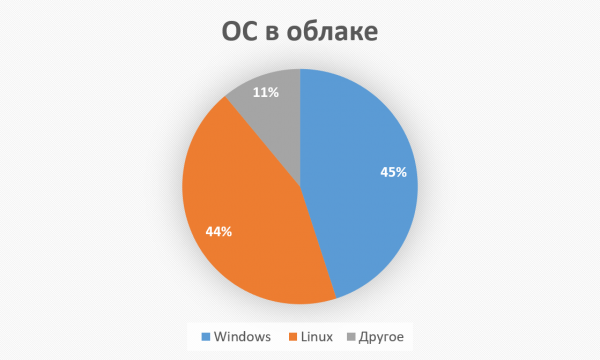
When it comes to individual distributions, the most popular among 1cloud clients remains Ubuntu — 45%, followed by CentOS (28%) and, with a small gap, Debian (26%).
Another front in Microsoft's battle with the developer community was the release of the Lindows OS based on the Linux kernel, a name that copied Windows. In 2001, Microsoft in the USA against the OS developer company, demanding a name change. In response, the company attempted to invalidate Microsoft’s rights to one of the English words and its derivatives. Two years later, the corporation emerged victorious in this dispute — the name LindowsOS to Linspire. However, the developers of the open OS made this decision voluntarily to avoid lawsuits from Microsoft in other countries distributing their operating system.
What about the Linux kernel?
Despite all the corporate confrontations and harsh statements against free software from leading managers of major companies, the Linux community continued to evolve. Developers worked on new open distributions and updated the kernel. Thanks to the spread of the internet, this became increasingly easier. In 1994, Linux kernel version 1.0.0 was released, and two years later — version 2.0. With each release, the OS supported operation on an increasing number of processors and mainframes.
By the mid-90s, Linux, which was already popular among developers, was evolving not only as a technological product but also as a brand. In 1995, the first Linux Expo exhibition and conference, where well-known speakers in the community, including Mark Ewing, presented. A few years later, Expo became one of the largest events in the Linux world.
In 1996, the world first saw the emblem featuring the famous penguin , who still accompanies Linux products. It was by programmer and designer Larry Ewing based on the story of a "ferocious penguin" that once attacked Linus Torvalds and infected him with a disease called "penguinitis."
In the late 90s, the releases of two important products in the history of Linux — GNOME and KDE — came one after another. Thanks to these tools, Unix systems, including Linux, gained user-friendly cross-platform graphical interfaces. The release of these tools can be considered one of the first steps toward the mass market. We will discuss this stage in the history of Linux in the next section.
On the corporate blog of 1cloud:
Source: habr.com
