

A few years ago, the author visited a flea market organized by W6TRW at the parking lot of Northrop Grumman in Redondo Beach, California. Among televisions resembling polar bears and numerous phone chargers and power bricks, a wooden box with a lock, a wooden handle, and a DB-25 connector on the side was in sight. Next to the connector was a switch: half-duplex – full duplex. The author realized what it was. A modem. A wooden modem. Specifically, a modem with acoustic coupling, produced by Livermore Data Systems around 1965.
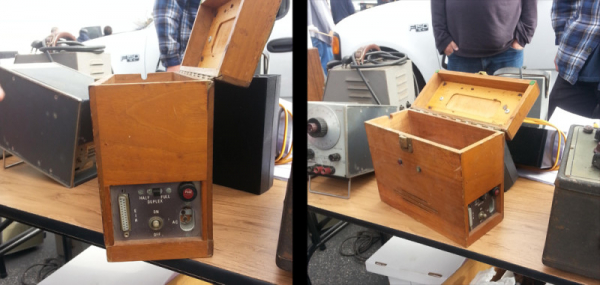
The modem was still at the flea market. Immediately after taking the photo, the author bought it for $20.
Since not everyone knows what an acoustic coupling modem is, here's a brief history. The problem was that once, telephone companies owned not only the lines. They also rented out the phone devices. Readers who experienced dial-up connected modems directly to telephone lines. However, when this modem was manufactured, that was prohibited. According to the 1934 U.S. law, connecting anything to a home phone was not allowed in any way. mechanically connection became possible. Hush-A-Phone is .
Formally, connecting various devices to a telephone line was allowed in the U.S. in 1968 (). But until 1978, this possibility could not be utilized because rates, specifications, and certification methods had not been developed. Therefore, from 1956 to 1978, there was a reason to use acoustically coupled modems and answering machines. In practice, their production lasted longer due to inertia.
This modem, currently sitting on the author's desk, is an integral yet unusual page in history. It was made before the Carterphone decision, so it cannot connect directly to the telephone network. It was designed before many chips that are considered classic today were developed. The first version of this modem was released just a year after the Bell 103, the first commercially successful modem. Here we have a wonderful example of just how much can be 'squeezed' out of merely thirteen transistors. Later, this modem was forgotten for a long time until two videos were made about it, one in 2009 and the other in 2011:


The video blogger phreakmonkey acquired an early model of the modem with a serial number just over 200. Such modems are distinguished by their walnut wood casings, whose parts are connected with 'dovetails'. According to phreakmonkey, this feature can indicate how old the modem is, as 'dovetails' are labor-intensive. Starting with serial number 850, modems began to be placed in teak wood casings with box joints. Then the parts of the casing started to be joined with tongue and groove joints. Livermore Data Systems needed to produce modems faster and faster.
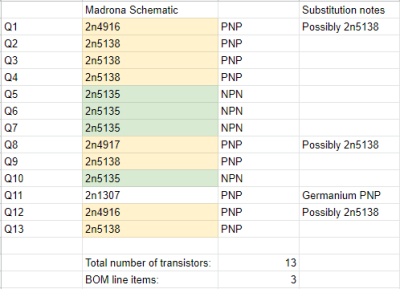
In 2007, blogger Brent Hilpert took a look inside such a modem and . Its schematic is particularly interesting. All thirteen transistors in the modem are standard and were widely used at the time. One germanium PNP transistor was used there for a reason that remains unclear to the author. Transistors of all these types are still easy to find in old inventories. For around twenty dollars, you can have a complete set of transistors needed to replicate exactly the same modem. However, other parts will also be required, including miniature transformers.
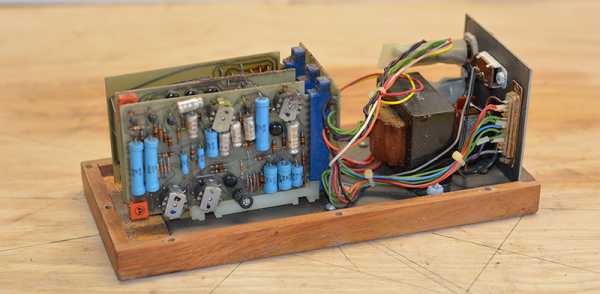
The actual acoustic coupling device from the modem was removed by someone, while the rest fully corresponds to the documentation. There are three boards on the cross plate. The first one contains all the power supply components except for the transformer, the second one has the modulator, and the third one has the demodulator. The date on the 2N5138 transistors indicates: week 37 of 1969. It was not possible to establish the exact production date of the modem itself, but it was likely manufactured and shipped before 1970.
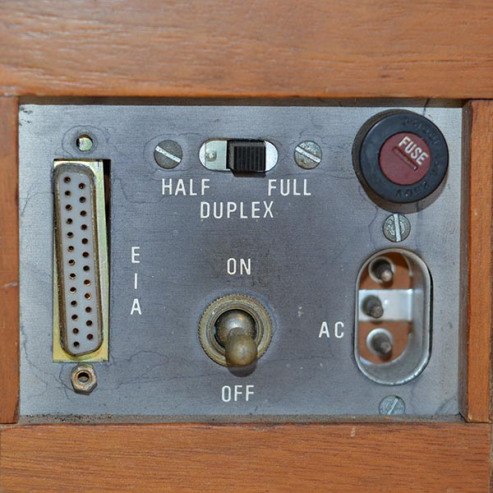
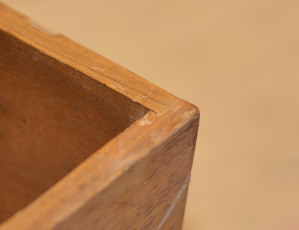
The tongue and groove connection means that the modem is of a later production.
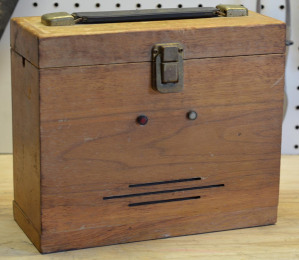
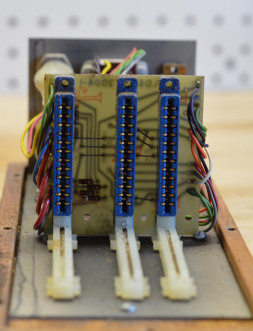
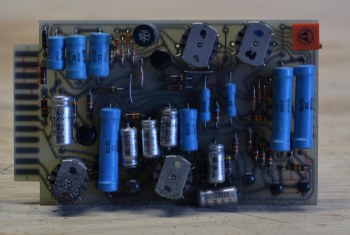
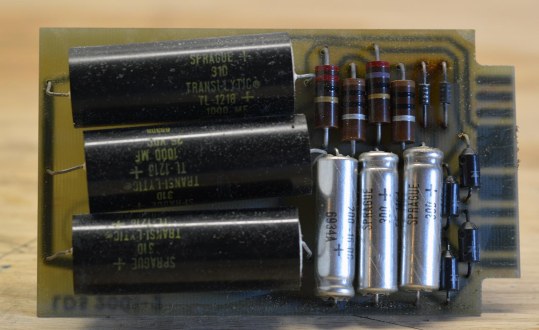
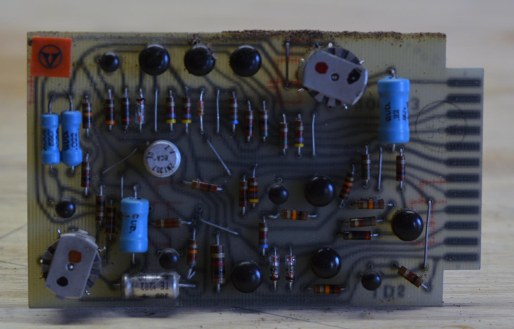
The author bought this modem just to keep it. It’s a wooden modem, but hardly anyone the author knows imagines how cool it is. It’s an art object filled with so many unusual elements. The author wanted to fix it but realized it was impractical.
First, it will be necessary to find the original acoustic coupler device. Due to its absence, flea market visitors didn't understand what kind of device was in front of them. The Livermore Data Systems logo and serial number were originally on this device, and now their absence only complicated the identification of the item as a modem by other visitors, as they are not employees of computer museums. It’s tempting, of course, to print the acoustic coupler details, but will it actually happen?
Secondly, many capacitor parameters have definitely 'drifted' in it. Of course, it would be interesting to take apart all the boards, but if the author wants a working modem with an acoustic coupler, there’s a better option.
This refers to an ingenious design called "", developed by the Chaos Computer Club in 1985 in response to a similar ban that was still in place in West Germany at the time. This modem is simpler in design but has more capabilities. It’s based on the AM7910 chip, which can still occasionally be found for sale, and operates at speeds up to 1200 baud. Building a modem from scratch on this chip can be done faster than using discrete transistors.
Overall, it makes no sense to restore this wooden modem, but it was very interesting to disassemble it, set up a photo session, and put everything back together as it was. This is roughly what the electronics looked like inside before it was stripped of its chips. But if the author happens to come across a suitable acoustic coupler device for this modem, he will certainly think again: maybe it’s worth considering a repair?
Source: habr.com
