

Yesterday, fully seriously and without any jokes, Cloudflare announced its new product — a VPN service based on the DNS application 1.1.1.1 for mobile devices using its own Warp encryption technology. The main feature of Cloudflare's new product is its simplicity—the target audience for this new service is the so-called 'moms' and 'friends' who are unable to purchase and configure a classic VPN or are unwilling to install energy-hungry third-party applications from unknown companies.
Recall that exactly one year and one day ago—on April 1, 2018—the company launched launched its public DNS 1.1.1.1, the audience of which has grown by 700% over the past period. Now 1.1.1.1 is competing for public attention with the classic Google DNS at 8.8.8.8. Later, on November 11, 2018, Cloudflare launched the mobile app 1.1.1.1 for iOS and Android, and now, based on it, the 'VPN at the push of a button' is being launched.
Frankly speaking, Cloudflare is a bit misleading when calling its update to the 1.1.1.1 app a full-fledged VPN, because in its pure form it is not. Rather, it's about encrypting DNS traffic with Warp, which, like a VPN, conceals what happens within our so-called 'tunneling' to the VPN server, that is, to the DNS 1.1.1.1 from Cloudflare.
The main marketing and practical justification for the importance of the new product's existence is that providers and other entities involved in the transmission of user data actively collect and even trade that data. HTTPS does not save us from this: it is enough to know about the mere fact of access to any page to create a 'portrait' of the user and then show them relevant ads.
What you need to know about the update to the 1.1.1.1 app and Warp in particular:
- End-to-end encryption to Cloudflare servers and the absence of any validating certificates. This means that Cloudflare itself refuses to look at your traffic.
- Works on the VPN protocol WireGuard.
- Default encryption of all unencrypted traffic when using apps or browsing unsafe HTTP pages, for example.
- Theoretical traffic optimization on Cloudflare's side while surfing and so on.
The team assures that the distinctive feature of Warp is that it was developed not only to improve mobile connectivity. CloudFlare points out that the TCP protocol is poorly suited for mobile network conditions, where packet loss can be caused by virtually any microwave. The situation is further exacerbated by the haphazard deployment of the same Wi-Fi in residential areas or public places, leading to a monstrous level of noise across all frequency channels (of course, channels at 2.4GHz are currently suffering the most, but conditions are beginning to worsen at 5GHz as well). In such conditions of constant packet loss not caused by the user, but due to external factors, TCP connections are not considered the optimal option. The recording states that Warp operates around the use of UDP packets, which, as we remember, do not require a response from the target server and are therefore actively used in game development to reduce ping. Additionally, CloudFlare assures that their application will carefully manage battery usage through moderate antenna usage and will not 'overheat' the device in an attempt to catch a network signal in areas with unstable connectivity. It is worth noting that Warp operates on the already mentioned VPN protocol. WireGuard. Full technical documentation on WireGuard can be found here.
. Furthermore, Warp was not specifically developed for the mobile application 1.1.1.1, but is part of CloudFlare's technical solution for protecting servers from attacks called Argo Tunnel, which uses some of the solutions Cloudflare Mobile SDK, which is in turn based on the project acquired in 2017, Neumob. In other words, Cloudflare actually began its meticulous work towards entering the mobile market back in 2017 — a year before the public DNS 1.1.1.1 was launched. This comprehensive approach instills some confidence in Cloudflare's strategic consistency and the existence of a clear long-term strategy, which is certainly reassuring.
Cloudflare assures that it does not intend to sell its users' data and will monetize Warp through subscriptions. Out of the box, users will have access to two versions of the program: Basic and Pro. The Basic version will be free but will have limited data transfer speeds, which will likely be sufficient only for casual browsing or messaging. The Pro version, for a monthly fee, promises a full channel to Cloudflare’s servers and maximum comfort.
Company representatives indicate that different subscription prices will be set for different regions to mitigate income disparities across various parts of the world. It's quite possible that the CIS region, along with Russia, will receive a more or less acceptable offer in the range of $3-10 per month instead of the standard €15-30 for the EU or the USA.
The company openly states that they are far from Google, but they are trying, so access to the new features of the 1.1.1.1 app will be rolled out gradually in a first-come, first-served manner. To get in line for this, you need to download the app for iOS or Android and express your desire to use "Cloudflare's VPN."
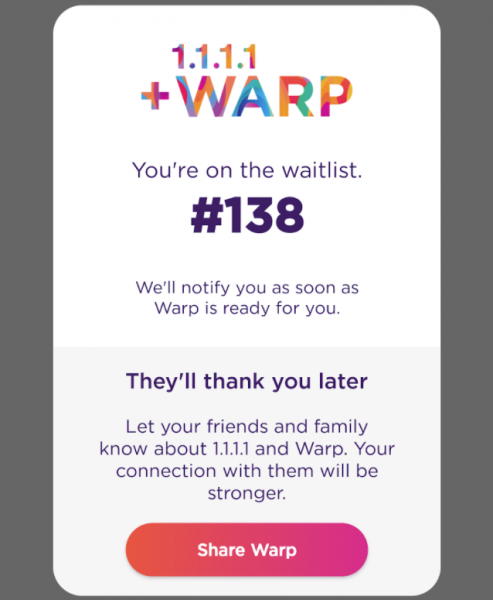
Looking at the reviews in the market, they are mostly positive, although the app has issues with non-dismissible notifications that annoy some users significantly. However, many note that Cloudflare’s solution is an excellent option for securely using public Wi-Fi hotspots: these usually don't offer high speeds anyway, so the free version of 1.1.1.1 should be more than enough.
Another important nuance from Cloudflare's recent presentation is that the company promises to soon bring its "DNS-VPN" to desktops, thus covering this quite sizable segment as well.
If Cloudflare's development turns out to be as good as described in the company's official blog, the market will finally see a quasi-free (keeping in mind the speed limitations) and user-friendly application for those who are not too familiar with how VPNs work and what information security actually is. Currently, it is all in the hands of Cloudflare's marketers — if they can reach the mass market and promote the idea that enabling the VPN mode in the 1.1.1.1 app is a mandatory element of internet hygiene, then for millions of users, the online world could become a much more friendly and welcoming place than before. This product will also be significant for countries where government authorities block access to certain resources.
And this applies not only to Russia, but also to countries like Iran or even France. By the way, the court of the Fifth Republic, quietly decided to block access to pirated scientific portals SciHub LibGen, stating that there is no need for scientists to read colleagues' works for free. But that's a different story altogether; the situation regarding free access to resources is getting worse and worse globally.
Be that as it may, a service like 1.1.1.1 is quite suitable for both younger users and older individuals who are not willing or able to figure out how to purchase, set up, and use a VPN even on desktops, let alone mobile devices.
Source: habr.com
