

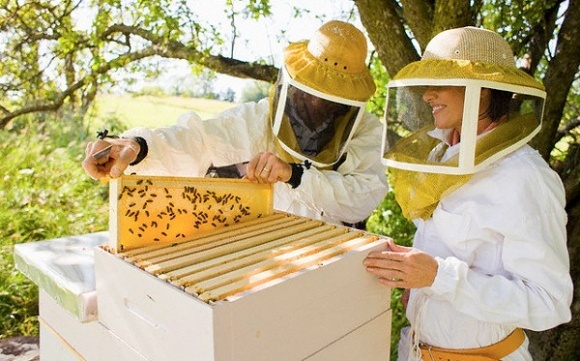
One of the most conservative human activities is beekeeping!
Since the invention of the frame hive and honey extractor about 200 years ago, progress in this field has been minimal.
This has manifested in the electrification of some honey extraction processes and the use of winter heating for hives.
Meanwhile, the global bee population is declining significantly due to climate change, widespread chemical use in agriculture, and our ongoing ignorance about what bees actually want.
Mine disappeared for the first reason, which greatly changed the original concept of the 'smart hive'.
In fact, the problem with existing projects in this area is that the people creating them are not beekeepers, and the beekeepers themselves are far removed from engineering sciences.
And of course, there’s the question of price—the cost of a bee colony is roughly equivalent to the cost of a simple hive and the value of the honey they produce in a season (year).
Now take the price of one of the emerging projects and multiply it by the number of hives in a commercial apiary (from 100 and up).
In general, if anyone is interested in the Friday musings of a geek-beekeeper, please read on!
My grandfather was an amateur beekeeper—with a couple of dozen hives—so I grew up near an apiary, although I was panic-stricken by bees.
But after decades, I eventually decided to have my own—the stings no longer frightened me, and the desire to have my own hive filled with honeybees fueled my determination.
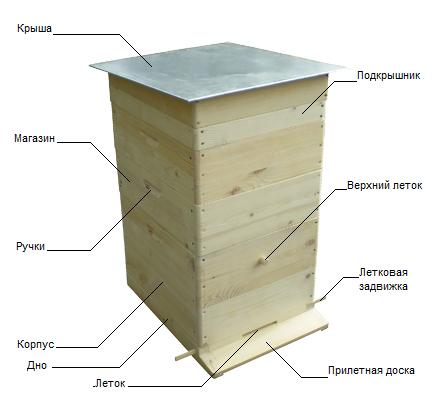
So, below is the design of the most common hive of the Dadant system.
In brief, bees are constantly present in the main body and winter there; the 'super' is added during the honey flow, and the cover serves to insulate and reduce condensation.
And you know, I wouldn't be myself if I didn't try to invent my own bicycle and install an Arduino on it 😉.
As a result, I assembled the hives of the Warré system (multi-box, frame-less—'frame' 300×200).
I got bees in the middle of summer; I didn't want to forcibly relocate them to a new home, and despite my efforts, they refused to acclimate to the new box.
As a result, in September, I gave up on these attempts, provided the necessary feeding, insulated the 12-frame Dadant (walls—single-layer pine 40mm—used hive), and left them for wintering.
Unfortunately, the alternation of numerous thaws with freezes has given the bees no chance — even experienced colleagues lost about 2/3 of their bee colonies.
As you might have guessed, I didn't have time to install the sensors, but I drew the appropriate conclusions.
This was just a prelude, so what's the deal with the smart hive?
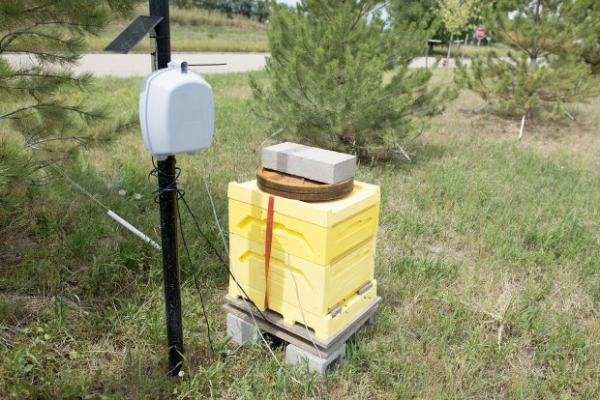
Let's consider an existing foreign project. — what's good and what's not:
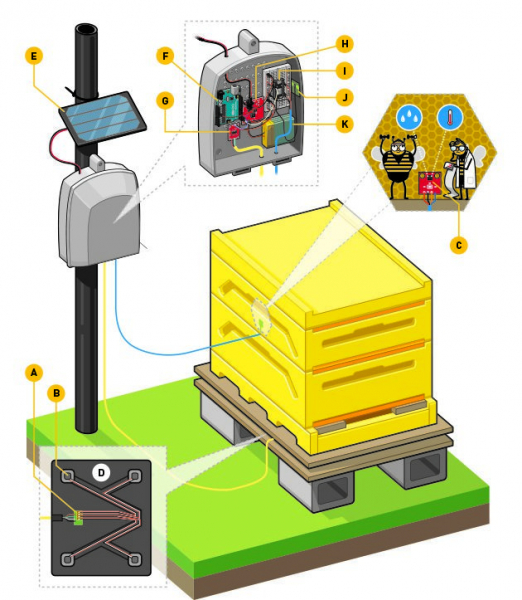
The main parameters for monitoring here are temperature, humidity, and the weight of the hive.
The last one is only relevant during the honey collection period, and humidity is also important only during the active period.
In my opinion, a noise sensor is missing — its intensity, along with temperature and humidity, can indicate the onset of swarming.
Let's delve further into temperature:
One sensor is relatively informative only in summer, when bees actively move air throughout the hive — preventing it from overheating and 'evaporating' water from the honey.
In winter, they cluster together in a 'bunch' about 15 cm in 'diameter', fall into a semi-dormant state, and migrate across the honeycombs, consuming the honey stored for winter.
The area for movement in a 12-frame 'Dadant' is 40x40x30 cm (L-W-H); measuring the 'average temperature in the hospital' under the ceiling is useless.
The absolute minimum, in my opinion, is 4 sensors placed 10 cm from the top of the frames — in a 20x20 cm square.
Humidity — yes, in the super, an electret microphone — placed where the bees won't seal it with propolis.
Now about humidity.
During winter, bees consume honey and release more than 10 liters of moisture!
Do you think living in a polystyrene hive contributes to health?
Would you want to live in a house made of such material?
What about honey with toxins?
Polystyrene releases quite a lot at around 40 degrees Celsius — that’s how warm the hive gets inside during summer.
The walls of the hive should 'breathe' like thermal underwear — ideally, wood — planed outside, unpainted inside, and definitely not painted!
And finally, how I think this can be done:
Remember, at the beginning I mentioned the cost of the issue?
I put this at the forefront, and therefore for now, the weight sensor is out of the picture.
Basic kit:
Microcontroller — Atmega328P, in sleep mode, powered for example — from a 9-volt battery through DC-DC (no solar panels!).
A 'frame' with the device — MCU, power supply, 4 temperature sensors, a humidity sensor, a microphone, and an external connector for connecting modules.
Extensions:
LCD1602-based indicator (can be one for the entire apiary)
Wi-Fi/Bluetooth — general wireless modules for smartphone control.
So, gentlemen, I am interested in your opinion —
- How interesting will the development of this topic be for the Habr community?
- Is it a viable idea for a startup?
- Any constructive criticism is welcome!
You were accompanied by IT beekeeper Andrey.
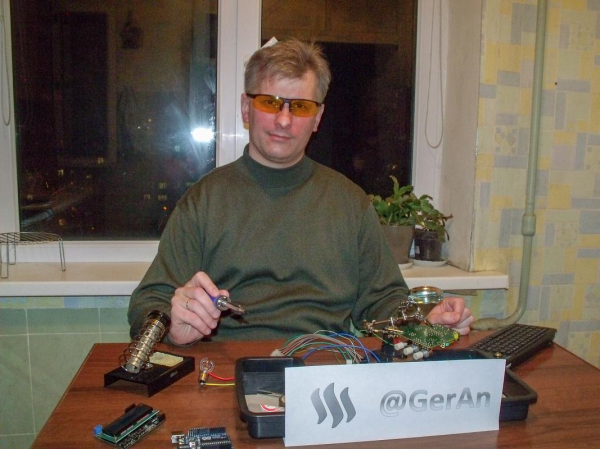
See you again on Habr!
UPD In disputes, truth is born; in discussions on Habr, it is refined!
I have decided on the hardware and methods — a minimal kit for one hive (3 parameters — temperature, humidity, noise level) + battery monitoring
the battery capacity should last during the active season — for a month, during wintering — for 5
P.S. And yes, the information will be transmitted via WiFi
P.P.S. The prototype just needs to be made
Only registered users can participate in the survey. , please.
Implementation of the "smart hive". Would you be interested in reading articles about the development of this topic?
Yes
No
313 users voted. 38 users abstained.
Implementation of the "smart hive". Can such a startup "take off"?
Yes
No
235 users voted. 90 users abstained.
Source: habr.com
