

We have long been accustomed to the fact that major IT companies not only produce products and provide services but also actively participate in developing internet infrastructure. Google's DNS, Amazon's cloud storage and hosting, Facebook's data centers around the world — fifteen years ago, this seemed overly ambitious, but now it is the norm we are all used to.
And now, the quartet of the largest IT companies represented by Amazon, Google, Microsoft, and Facebook has reached the point where they are investing not only in data centers and servers but also in the backbone cables themselves — entering an area that has traditionally been the responsibility of entirely different organizations. Moreover, judging by the conclusions , the mentioned quartet of tech giants is not just targeting land networks, but also transcontinental communication lines, i.e., the well-known underwater cables.
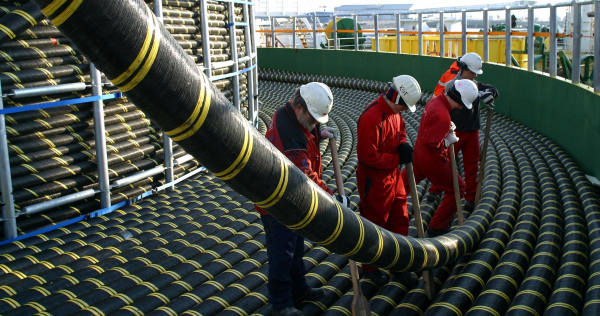
The most surprising thing is that there is no urgent need for new networks right now, but companies are actively increasing bandwidth 'just in case.' Unfortunately, finding clear statistics on global traffic generation is nearly impossible due to numerous marketers who refer to dimensions like '65 million posts on Instagram daily' or 'N search queries in Google' instead of transparent and understandable petabytes for technical specialists. One can cautiously assume that daily traffic is approximately 2.5*10^18 bytes or around 2500 petabytes of data.
One of the reasons why modern backbone networks need to expand is the increasing popularity of the streaming service Netflix and the simultaneous growth of the mobile segment. With the overall trend toward enhancing the visual aspect of video content in terms of resolution and bitrate, alongside increased mobile traffic consumption per user (against the backdrop of a general slowdown in mobile device sales worldwide), backbone networks still cannot be considered overloaded.
Let's turn to :
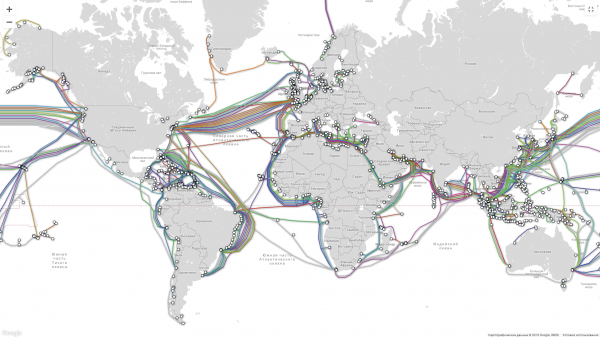
Visually, it's hard to determine how many new routes have been laid out, and the service itself is updated almost daily, without providing a clear change log or any other consolidated statistical data. Therefore, let’s refer to older sources. According to the information already , the bandwidth of existing intercontinental backbone networks in 2014 was about 58 Tbps, of which only 24 Tbps were actually used:
For those who are angrily stretching their fingers and preparing to write: 'I don't believe it! That's too little!', let's remind you that we are talking about intercontinental traffic, which is inherently much lower than traffic within a specific region, as we have not yet harnessed quantum teleportation, and there's no hiding from a ping of 300-400 ms.
In 2015, a forecast was made that from 2016 to 2020, a total of 400,000 km of backbone cables would be laid on the ocean floor, significantly increasing the capacity of the global network.
However, if we look at the statistics presented on the map above, specifically regarding the 26 Tbps load on a total channel of 58 Tbps, certain logical questions arise: why and for what purpose?
Firstly, IT giants have started laying their own backbone networks to enhance the connectivity of the internal infrastructure across different continents. Due to the previously mentioned ping of almost half a second between two opposing points on the globe, IT companies have to get creative in ensuring the stability of their operations. This issue is especially pressing for Google and Amazon; the former started laying their own networks back in 2014 when they decided to 'stretch' a cable between the east coast of the USA and Japan to connect their data centers, which was covered . Just to connect two separate data centers, the search giant was willing to spend $300 million and lay about 10,000 kilometers of cable on the ocean floor.
For those who didn't know or have forgotten, underwater cable installation is a high-difficulty quest, starting from the immersion of reinforced structures up to half a meter in diameter in coastal areas and culminating in endless landscape surveying to lay the main part of the trunk at depths of several kilometers. When it comes to the Pacific Ocean, the difficulty only increases in proportion to the depth and the number of mountain ridges on the ocean floor. Such projects require specialized vessels, a specially trained team of specialists, and essentially several years of hard work, considering the laying from the design and surveying stage to the final commissioning of the network section. Additionally, there is also coordination with local governments for construction of relay stations on the shore, and collaboration with ecologists monitoring the conservation of the most inhabited coastline (depth <200 m), and so on.
While new vessels may have been put into operation in recent years, just five years ago there was a significant backlog for the main cable-layers from Huawei (yes, the Chinese company is one of the leaders in this market), with long wait times extending for many months. Against this backdrop, the activity of technology giants in this segment looks increasingly interesting.
The official position of all major IT companies is to ensure connectivity (independence from common networks) of their data centers. Here’s how the underwater maps of different market players look according to data :
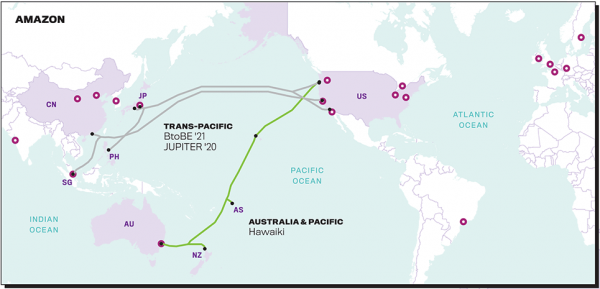
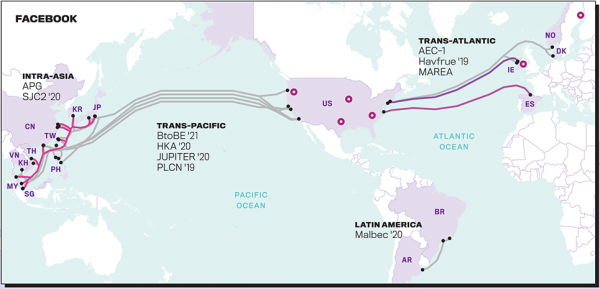
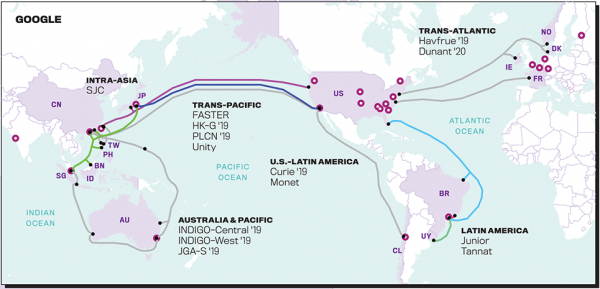
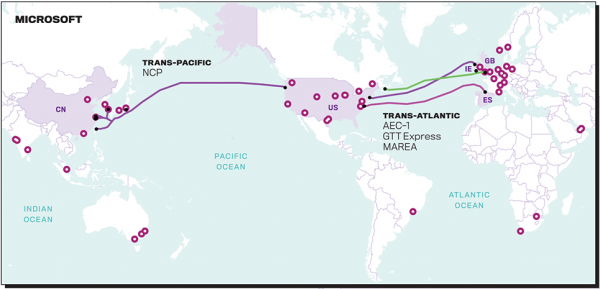
As seen on the maps, the most impressive ambitions are not from Google or Amazon, but from Facebook, which has long ceased to be 'just a social network.' There is also a clear interest from all major players in the Asia-Pacific region, with only Microsoft still looking towards the Old World. If we simply count the marked highways, we find that only this quartet of companies are co-owners or full owners of 25 already built or finally planned backbone lines, most of which lead towards Japan, China, and all of Southeast Asia. Moreover, we only present statistics concerning the aforementioned quartet of IT giants, while companies like Alcatel, NEC, Huawei, and Subcom are also actively building their own networks.
Overall, the number of private or privately capitalized transcontinental highways has significantly increased since 2014, when Google announced the earlier mentioned connection between its data center in the US and a data center in Japan:
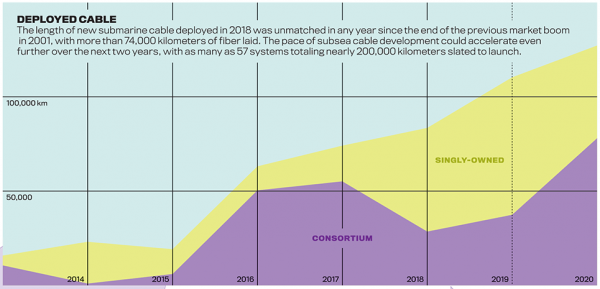
In fact, the motivation of 'we want to connect our data centers' is insufficient: it's unlikely that companies need connectivity just for the sake of connecting. Rather, they want to isolate the information being transmitted and safeguard their own internal infrastructure.
If we were to pull out a tinfoil hat, straighten it, and pull it tighter, we could formulate a very careful hypothesis along the following lines: we are currently witnessing the emergence of a new formation of the Internet, essentially a global corporate network. If we recall that Amazon, Google, Facebook, and Microsoft account for at least half of the world's traffic consumption (Amazon hosting, Google search and services, Facebook and Instagram social networks, and Windows desktops from Microsoft), then we need to pull out a second tinfoil hat. Because theoretically, in a very vague theory, if projects like Google Fiber (the one where Google attempted to become a provider for the population) start appearing in various regions, we are currently witnessing the birth of a second Internet, which is coexisting with the already constructed one. How dystopian and nonsensical this is — you can decide for yourselves.
Only registered users can participate in the survey. , please.
What do you think, does it really resemble the construction of a 'parallel Internet' or are we just being overly sensitive?
Yes, it seems so.
No, they just need a stable connection between data centers and there are no threats here.
You definitely need a less tight tin foil hat; this one is pressing on your brain.
Share your version in the comments.
22 users voted. 2 users abstained.
Source: habr.com
