

Introducing the new Gartner quadrant — Magic Quadrant for Application Performance Monitoring 2019.
This year's report was released on March 14. Gartner predicts a fourfold growth in the APM monitoring market due to the digitization of business processes, with coverage of 20% of all business applications by 2021. Unfortunately, the report lacks details on the methodology behind such growth, but when the words digitization or digital transformation are mentioned, one thinks of the game 'Bullshit Bingo'.
See what this game looks like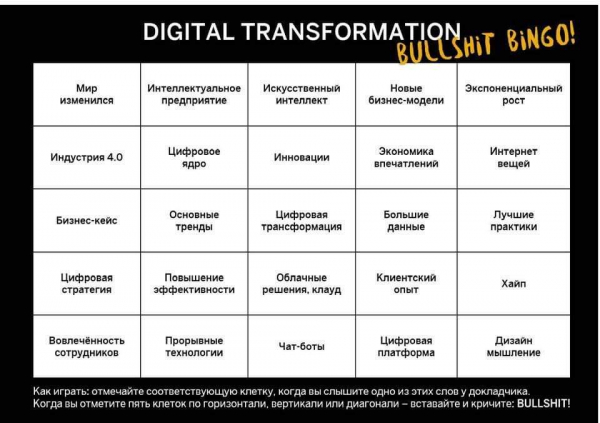
In this article, I'll avoid game elements and provide my brief analysis of the APM solutions market according to the Gartner report. Below, you'll also find a link to the original report.
This year, the criteria for including APM solutions in the report still include three key requirements:
Digital Experience Monitoring (DEM). DEM is a discipline of monitoring availability and performance that enhances the experience of everyone interacting with enterprise applications and services. For the purposes of this study, real user monitoring (RUM) and synthetic transaction monitoring for both end users and mobile devices are included.
Application Discovery, Tracking, and Diagnostics (ADTD). Application Discovery, Tracking, and Diagnostics is a set of processes designed to understand the relationships between application servers, map transactions between these nodes, and ensure deep verification methods using bytecode instrumentation (BCI) and distributed tracing.
Artificial Intelligence for IT Operations (AIOps). AIOps platforms combine big data functionality and machine learning to support IT operations. AIOps for applications provides automatic detection of performance patterns and events or clusters, anomaly detection in time series event data, and root cause identification of application performance issues. AIOps accomplishes this through machine learning, statistical inference, or other methods.
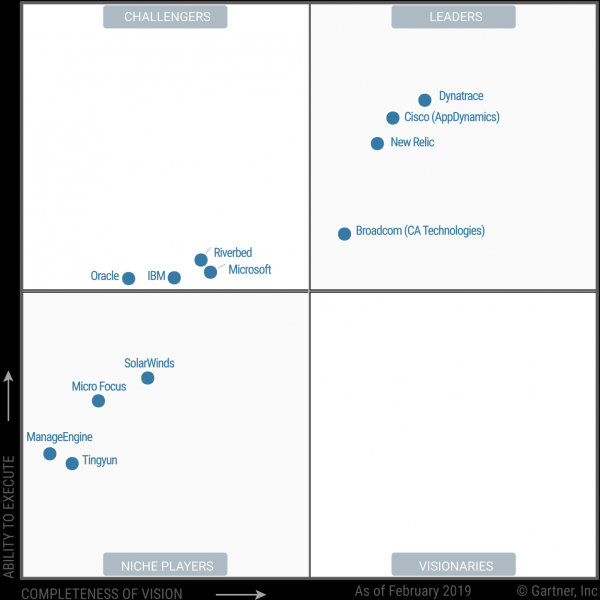
Gartner's Magic Quadrants are divided into four sectors: Leaders, Challengers, Visionaries, and Niche Players. Each vendor is positioned in the quadrant based on their strengths and weaknesses, market share, and user feedback, as well as other metrics. The 12 vendors included by Gartner this time are: Broadcom (CA Technologies), Cisco (AppDynamics), Dynatrace, IBM, ManageEngine, Micro Focus, Microsoft, New Relic, Oracle, Riverbed, SolarWinds, and Tingyun.
So, drumroll…
Last year's quadrant is here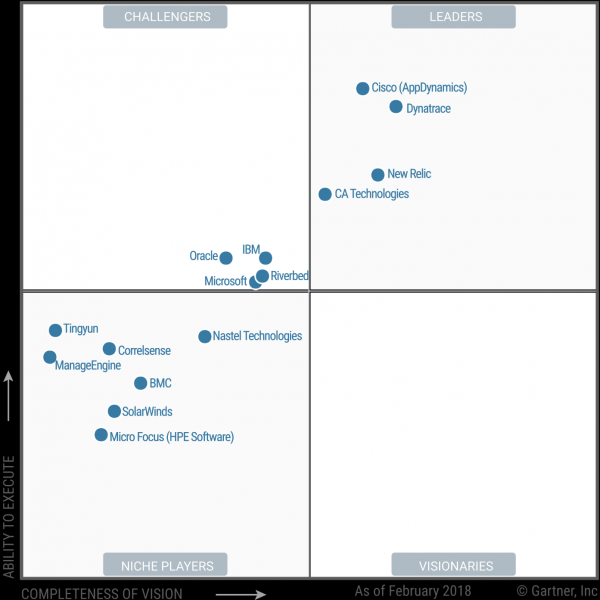
The current Magic Quadrant remarkably corresponds to . The "Leaders" and "Challengers" sectors have remained completely unchanged. Broadcom, Cisco, Dynatrace, and New Relic have firmly established themselves in the Leaders sector, while IBM, Microsoft, Oracle, and Riverbed are in the Challengers sector. However, there are no Visionaries this year (it was the same last year).
The only changes occurred in the Niche Players category, where three vendors were removed based on last year's results: BMC, Correlsense, and Nastel. BMC no longer offers an APM tool, and Correlsense and Nastel failed to meet Gartner's requirements this year.
This year, Gartner continues the trajectory of last year's Magic Quadrant and has left the Visionaries sector empty. Gartner describes Visionaries as vendors that "offer products that have developed a compelling strategy for competitively meeting today's and tomorrow's APM solution market demands, but whose current product portfolio is still under development."
The absence of Visionaries indicates that the APM market is in a state of stagnation in terms of development. This may suggest that current APM solutions are fully functional for addressing emerging issues. All leaders, except Broadcom, have been in that position for seven consecutive years, so perhaps their visions and strategies are sufficient to drive the market forward.
If no new events occur in the market (such as mergers or acquisitions), next year's Magic Quadrant is unlikely to change significantly. Gartner has concluded that the market is healthy despite the lack of movements in the quadrants. However, they noted that new vendors need to introduce new functionality or focus on a specific niche to compete with established vendors (that’s about the leaders).
In its research, Gartner also reported that APM solution providers are expanding monitoring capabilities across most areas, including applications, networks, databases, and servers. Clearly, vendors want to capitalize on every monitoring market they can.
Below is a list of vendors that seem to be close to inclusion in the quadrant but do not meet the criteria:
- Correlsense;
- Datadog;
- Elastic;
- Honeycomb;
- Instana;
- JenniferSoft;
- LightStep;
- Nastel Technologies;
- SignalFx;
- Splunk;
- Sysdig.
I think if any of them merge, we may see a new leader next year. The question is how quickly they can create a cohesive solution by integrating their products.
Please take the survey at the end of the article. Let's see how Gartner's analytics compare with Russian realities.
Only registered users can participate in the survey. , please.
What monitoring product do you use in your company?
Broadcom (CA Technologies)
Cisco (AppDynamics)
Dynatrace
IBM
ManageEngine
Micro Focus
by Microsoft
New Relic
Oracle
Riverbed
SolarWinds
Tingyun
Other commercial
Other free
7 users have voted. 1 user abstained.
Source: habr.com
