

Starting today, real-time ray tracing is supported not only by GeForce RTX graphics cards but also by some GeForce GTX 16xx and 10xx models. The GeForce Game Ready driver 425.31 WHQL, which equips these graphics cards with this feature, is already available for download from the official NVIDIA website or can be updated through the GeForce Now application.
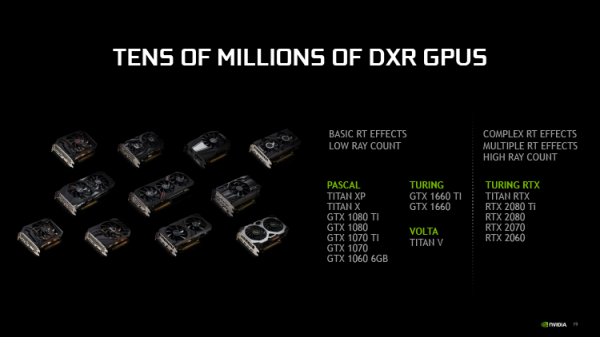
The list of graphics cards supporting real-time ray tracing has been expanded to include the GeForce GTX 1660 Ti and GTX 1660, Titan Xp and Titan X (Pascal), GeForce GTX 1080 Ti and GTX 1080, GeForce GTX 1070 Ti and GTX 1070, as well as the GeForce GTX 1060 with 6 GB of memory. Of course, ray tracing will work here with some limitations compared to the GeForce RTX graphics cards. The older the graphics card, the more pronounced the limitations will be. However, the fact that even owners of the less powerful GeForce GTX 1060 can experience this new technology is certainly uplifting.
While the GeForce RTX graphics cards have specialized computing units (RT cores) that provide hardware acceleration for ray tracing, the GeForce GTX models lack such components. Therefore, ray tracing in these cards is implemented via the DXR extension for Direct3D 12, with regular compute shaders on the array of CUDA cores handling the ray processing.
This approach certainly does not allow graphics cards based on Pascal and older Turing GPUs to achieve the same level of ray tracing performance as the GeForce RTX series models. Published NVIDIA slides with performance testing results for various graphics cards using ray tracing show a huge difference between the GeForce RTX and GeForce GTX models.
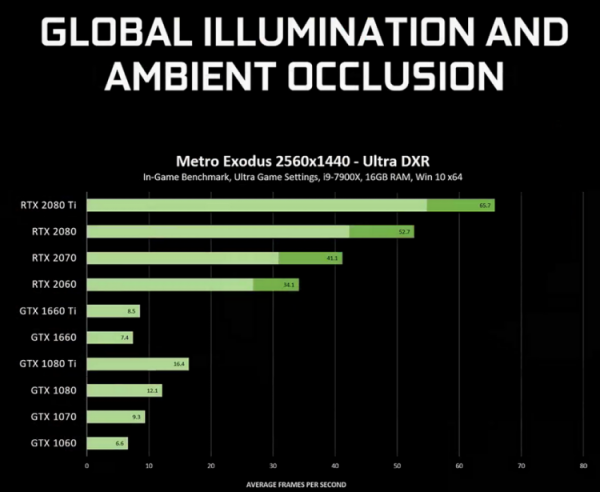
For example, in the game Metro Exodus, where ray tracing provides global illumination, none of the GeForce GTX graphics cards were able to deliver an acceptable FPS. Even the flagship of the previous generation, the GeForce GTX 1080 Ti, could only manage 16.4 fps. However, in Battlefield V, where ray tracing handles only reflections, the Pascal generation flagship still managed to achieve 30 FPS.
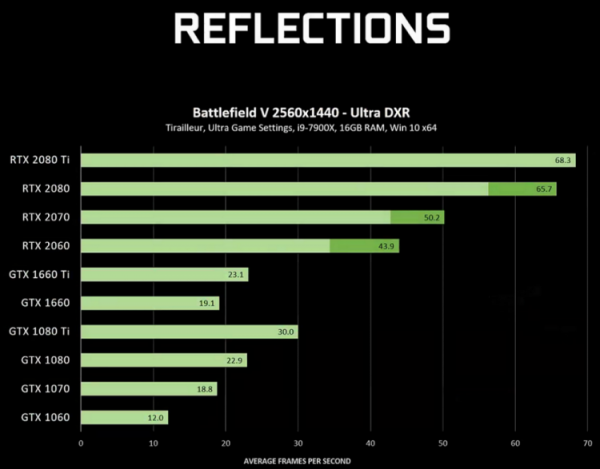
However, NVIDIA tested the graphics cards under the highest graphics settings, with maximum ray tracing intensity, and at a resolution of 2560 × 1440 pixels. In other words, the conditions were, to put it mildly, quite unfavorable: the same GeForce GTX 2060 averaged just over 34 FPS in Metro Exodus. Achieving a 'playable' FPS on older graphics cards can be done by lowering the resolution and graphics quality. But primarily, their performance will be affected by the ray tracing intensity settings.
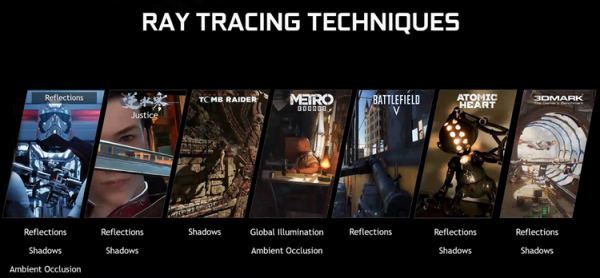
Let's recall that currently, ray tracing can be experienced in three games: Battlefield V, Metro Exodus, and Shadow of the Tomb Raider. It is also available in three demos: Atomic Heart, Justice, and Reflections. In both games and demos, various implementations of ray tracing are offered. In some cases, it handles reflections and shadows, while in others, it deals with global illumination.
Source: 3dnews.ru
