

Preface or how the idea of partitioning came about
The beginning of the story starts here: After nearly exhausting all resources for query optimization at that time, the question arose — what next? This is how the idea of partitioning came into being.

A lyrical digression:
It was ‘at that time’ because . Thank you and Habr!
So, how else can we make the client somewhat happy while also improving our own skills?
If we simplify everything to the maximum, then there are only two radical ways to improve database performance:
1) Extensive path — increase resources, change configuration;
2) Intensive path — optimize queries
Since, I reiterate, at that time it was already unclear what else could be changed in the query to speed it up, the path chosen was — changing the table design.
So — the main question arises — what and how will we change?
Initial conditions
First of all, we have an ERD like this (shown conditionally simplified):
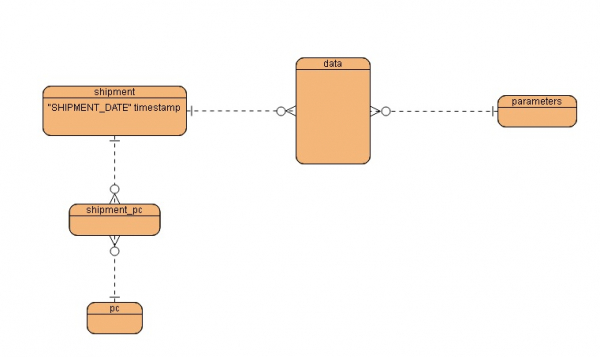
Main features:
- many-to-many relationships
- the table already has a potential partitioning key
Initial query:
SELECT
            p."PARAMETER_ID" as  parameter_id,
            pc."PC_NAME" AS pc_name,
            pc."CUSTOMER_PARTNUMBER" AS customer_partnumber,
            w."LASERMARK" AS lasermark,
            w."LOTID" AS lotid,
            w."REPORTED_VALUE" AS reported_value,
            w."LOWER_SPEC_LIMIT" AS lower_spec_limit,
            w."UPPER_SPEC_LIMIT" AS upper_spec_limit,
            p."TYPE_CALCUL" AS type_calcul,
            s."SHIPMENT_NAME" AS shipment_name,
            s."SHIPMENT_DATE" AS shipment_date,
            extract(year from s."SHIPMENT_DATE") AS year,
            extract(month from s."SHIPMENT_DATE") as month,
            s."REPORT_NAME" AS report_name,
            p."SPARAM_NAME" AS SPARAM_name,
            p."CUSTOMERPARAM_NAME" AS customerparam_name
        FROM data w INNER JOIN shipment s ON s."SHIPMENT_ID" = w."SHIPMENT_ID"
             INNER JOIN parameters p ON p."PARAMETER_ID" = w."PARAMETER_ID"
             INNER JOIN shipment_pc sp ON s."SHIPMENT_ID" = sp."SHIPMENT_ID"
             INNER JOIN pc pc ON pc."PC_ID" = sp."PC_ID"
             INNER JOIN ( SELECT w2."LASERMARK" , MAX(s2."SHIPMENT_DATE") AS "SHIPMENT_DATE"
                          FROM shipment s2 INNER JOIN data w2 ON s2."SHIPMENT_ID" = w2."SHIPMENT_ID"
                          GROUP BY w2."LASERMARK"
                         ) md ON md."SHIPMENT_DATE" = s."SHIPMENT_DATE" AND md."LASERMARK" = w."LASERMARK"
        WHERE
             s."SHIPMENT_DATE" >= '2018-07-01' AND s."SHIPMENT_DATE" <= '2018-09-30' ;
Execution results on the test database:
Cost : 502 997.55
Execution time: 505 seconds.
What do we see? A typical query for a time slice.
Let's make a simple logical assumption: if there is a time slice, then what can help us? That's right — partitioning.
What to partition?
At first glance, the choice is obvious — declarative partitioning of the 'shipment' table by the 'SHIPMENT_DATE' key (jumping ahead — it turned out a bit differently in production).
How to partition?
This question is also not too difficult. Fortunately, in PostgreSQL 10, there is now a human-friendly partitioning mechanism.
So:
- We save a dump of the original table — pg_dump source_table
- We delete the original table — drop table source_table
- We create a parent table with range partitioning — create table source_table
- We create sections — create table source_table, create index
- We import the dump created in step 1 — pg_restore
Scripts for partitioning
For simplicity and convenience, steps 2, 3, and 4 have been combined into one script.
So:
We save a dump of the original table
pg_dump postgres --file=/dump/shipment.dmp --format=c --table=shipment --verbose > /dump/shipment.log 2>&1We delete the original table + Create a parent table with range partitioning + Create sections
--create_partition_shipment.sql
do language plpgsql $$
declare
rec_shipment_date RECORD ;
partition_name varchar;
index_name varchar;
current_year varchar ;
current_month varchar ;
begin_year varchar ;
begin_month varchar ;
next_year varchar ;
next_month varchar ;
first_flag boolean ;
i integer ;
begin
  RAISE NOTICE 'CREATE TEMPORARY TABLE FOR SHIPMENT_DATE';
  CREATE TEMP TABLE tmp_shipment_date as select distinct "SHIPMENT_DATE" from shipment order by "SHIPMENT_DATE" ;

  RAISE NOTICE 'DROP TABLE shipment';
  drop table shipment cascade ;

  CREATE TABLE public.shipment
  (
    "SHIPMENT_ID" integer NOT NULL DEFAULT nextval('shipment_shipment_id_seq'::regclass),
    "SHIPMENT_NAME" character varying(30) COLLATE pg_catalog."default",
    "SHIPMENT_DATE" timestamp without time zone,
    "REPORT_NAME" character varying(40) COLLATE pg_catalog."default"
  )
  PARTITION BY RANGE ("SHIPMENT_DATE")
  WITH (
      OIDS = FALSE
  )
  TABLESPACE pg_default;

  RAISE NOTICE 'CREATE PARTITIONS FOR TABLE shipment';

  current_year:='0';
  current_month:='0';

  begin_year := '0' ;
  begin_month := '0'  ;
  next_year := '0' ;
  next_month := '0'  ;

  FOR rec_shipment_date IN SELECT * FROM tmp_shipment_date LOOP

      RAISE NOTICE 'SHIPMENT_DATE=%',rec_shipment_date."SHIPMENT_DATE";

      current_year := date_part('year' ,rec_shipment_date."SHIPMENT_DATE");
      current_month := date_part('month' ,rec_shipment_date."SHIPMENT_DATE") ;

      IF to_number(current_month,'99') = to_date( begin_year||'.'||begin_month, 'YYYY.MM') AND
         to_date( current_year||'.'||current_month, 'YYYY.MM') < to_date( next_year||'.'||next_month, 'YYYY.MM') AND
         NOT first_flag
      THEN
         CONTINUE ;
      ELSE
       --NEW borders only for second and after time
       begin_year := current_year ;
       begin_month := current_month ;

        IF current_month = '12' THEN
          next_year := date_part('year' ,rec_shipment_date."SHIPMENT_DATE" + interval '1 year') ;
        ELSE
          next_year := current_year ;
        END IF;

       next_month := date_part('month' ,rec_shipment_date."SHIPMENT_DATE" + interval '1 month') ;

      END IF;

      partition_name := 'shipment_shipment_date_'||begin_year||'-'||begin_month||'-01-'|| next_year||'-'||next_month||'-01'  ;

     EXECUTE format('CREATE TABLE ' || quote_ident(partition_name) || ' PARTITION OF shipment FOR VALUES FROM ( %L ) TO ( %L )  ' , current_year||'-'||current_month||'-01' , next_year||'-'||next_month||'-01'  ) ;

      index_name := partition_name||'_shipment_id_idx';
      RAISE NOTICE 'INDEX NAME =%',index_name;
      EXECUTE format('CREATE INDEX ' || quote_ident(index_name) || ' ON '|| quote_ident(partition_name) ||' USING btree ("SHIPMENT_ID") TABLESPACE pg_default ' ) ;

      --Drop first time flag
      first_flag := false ;

  END LOOP;

end
$$;
Importing dump
pg_restore -d postgres --data-only --format=c --table=shipment --verbose shipment.dmp > /tmp/data_dump/shipment_restore.log 2>&1Checking the partitioning results
So, what do we have as a result? The complete execution plan is lengthy and dull, so it's reasonable to stick to the final figures.
Was
Cost: 502 997.55
Execution time: 505 seconds.
Became
Cost: 77 872.36
Execution time: 79 seconds.
A pretty good result. We've reduced both cost and execution time. Thus, using partitioning delivers the expected effect, overall — without surprises.
Delight the client
The testing results were presented to the client for review. And after their review, they issued a somewhat unexpected verdict: 'Great, partition the table "data".'
Yes, but we were investigating a completely different table "shipment"; the table "data" does not have the field "SHIPMENT_DATE".
No problem, add and change as needed. As long as the client is satisfied with the outcome, the implementation details are not particularly important.
We are partitioning the main table "data"
In general, there were no particular difficulties. Although, the partitioning algorithm has changed slightly.
Adding the column "SHIPMENT_DATE" to the table "data"
psql -h host -U database -d user
=> ALTER TABLE data ADD COLUMN "SHIPMENT_DATE" timestamp without time zone ;
Filling the values of the column "SHIPMENT_DATE" in the table "data" with the values from the corresponding column in the table "shipment"
-----------------------------
--update_data.sql
--updating for altered table "data" to values of "shipment_data" from the table "shipment"
--version 1.0
do language plpgsql $$
declare
rec_shipment_data RECORD ;
shipment_date timestamp without time zone ;
row_count integer ;
total_rows integer ;
begin

  select count(*) into total_rows from shipment ;
  RAISE NOTICE 'Total %',total_rows;
  row_count:= 0 ;

  FOR rec_shipment_data IN SELECT * FROM shipment LOOP

   update data set "SHIPMENT_DATE" = rec_shipment_data."SHIPMENT_DATE" where "SHIPMENT_ID" = rec_shipment_data."SHIPMENT_ID";

   row_count:=  row_count +1 ;
   RAISE NOTICE 'row count = % , from %',row_count,total_rows;
  END LOOP;

end
$$;
Saving the dump of the table "data"
pg_dump postgres --file=/dump/data.dmp --format=c --table=data --verbose > /dump/data.log 2>&1<sourceRecreating the partitioned table "data"
--create_partition_data.sql
--create partitions for the table "wafer data" by range column "shipment_data" with one month duration
--version 1.0
do language plpgsql $$
declare
rec_shipment_date RECORD ;
partition_name varchar;
index_name varchar;
current_year varchar ;
current_month varchar ;
begin_year varchar ;
begin_month varchar ;
next_year varchar ;
next_month varchar ;
first_flag boolean ;
i integer ;

begin

  RAISE NOTICE 'CREATE TEMPORARY TABLE FOR SHIPMENT_DATE';
  CREATE TEMP TABLE tmp_shipment_date as select distinct "SHIPMENT_DATE" from shipment order by "SHIPMENT_DATE" ;


  RAISE NOTICE 'DROP TABLE data';
  drop table data cascade ;


  RAISE NOTICE 'CREATE PARTITIONED TABLE data';

  CREATE TABLE public.data
  (
    "RUN_ID" integer,
    "LASERMARK" character varying(20) COLLATE pg_catalog."default" NOT NULL,
    "LOTID" character varying(80) COLLATE pg_catalog."default",
    "SHIPMENT_ID" integer NOT NULL,
    "PARAMETER_ID" integer NOT NULL,
    "INTERNAL_VALUE" character varying(75) COLLATE pg_catalog."default",
    "REPORTED_VALUE" character varying(75) COLLATE pg_catalog."default",
    "LOWER_SPEC_LIMIT" numeric,
    "UPPER_SPEC_LIMIT" numeric ,
    "SHIPMENT_DATE" timestamp without time zone
  )
  PARTITION BY RANGE ("SHIPMENT_DATE")
  WITH (
    OIDS = FALSE
  )
  TABLESPACE pg_default ;


  RAISE NOTICE 'CREATE PARTITIONS FOR TABLE data';

  current_year:='0';
  current_month:='0';

  begin_year := '0' ;
  begin_month := '0'  ;
  next_year := '0' ;
  next_month := '0'  ;
  i := 1;

  FOR rec_shipment_date IN SELECT * FROM tmp_shipment_date LOOP

      RAISE NOTICE 'SHIPMENT_DATE=%',rec_shipment_date."SHIPMENT_DATE";

      current_year := date_part('year' ,rec_shipment_date."SHIPMENT_DATE");
      current_month := date_part('month' ,rec_shipment_date."SHIPMENT_DATE") ;

      --Init borders
      IF   begin_year = '0' THEN
       RAISE NOTICE '***Init borders';
       first_flag := true ; --first time flag
       begin_year := current_year ;
       begin_month := current_month ;

        IF current_month = '12' THEN
          next_year := date_part('year' ,rec_shipment_date."SHIPMENT_DATE" + interval '1 year') ;
        ELSE
          next_year := current_year ;
        END IF;

       next_month := date_part('month' ,rec_shipment_date."SHIPMENT_DATE" + interval '1 month') ;

      END IF;

--      RAISE NOTICE 'current_year=% , current_month=% ',current_year,current_month;
--      RAISE NOTICE 'begin_year=% , begin_month=% ',begin_year,begin_month;
--      RAISE NOTICE 'next_year=% , next_month=% ',next_year,next_month;

      -- Check current date into borders NOT for First time

      RAISE NOTICE 'Current data = %',to_char( to_date( current_year||'.'||current_month, 'YYYY.MM'), 'YYYY.MM');
      RAISE NOTICE 'Begin data = %',to_char( to_date( begin_year||'.'||begin_month, 'YYYY.MM'), 'YYYY.MM');
      RAISE NOTICE 'Next data = %',to_char( to_date( next_year||'.'||next_month, 'YYYY.MM'), 'YYYY.MM');

      IF to_date( current_year||'.'||current_month, 'YYYY.MM') >= to_date( begin_year||'.'||begin_month, 'YYYY.MM') AND
         to_date( current_year||'.'||current_month, 'YYYY.MM') < to_date( next_year||'.'||next_month, 'YYYY.MM') AND
         NOT first_flag
      THEN
         RAISE NOTICE '***CONTINUE';
         CONTINUE ;
      ELSE
       --NEW borders only for second and after time
       RAISE NOTICE '***NEW BORDERS';
       begin_year := current_year ;
       begin_month := current_month ;

        IF current_month = '12' THEN
          next_year := date_part('year' ,rec_shipment_date."SHIPMENT_DATE" + interval '1 year') ;
        ELSE
          next_year := current_year ;
        END IF;

       next_month := date_part('month' ,rec_shipment_date."SHIPMENT_DATE" + interval '1 month') ;


      END IF;

      IF to_number(current_month,'99') < 10 THEN
        current_month := '0'||current_month ;
      END IF ;

      IF to_number(begin_month,'99') < 10 THEN
        begin_month := '0'||begin_month ;
      END IF ;

      IF to_number(next_month,'99') < 10 THEN
        next_month := '0'||next_month ;
      END IF ;

      RAISE NOTICE 'current_year=% , current_month=% ',current_year,current_month;
      RAISE NOTICE 'begin_year=% , begin_month=% ',begin_year,begin_month;
      RAISE NOTICE 'next_year=% , next_month=% ',next_year,next_month;

      partition_name := 'data_'||begin_year||begin_month||'01_'||next_year||next_month||'01'  ;

      RAISE NOTICE 'PARTITION NUMBER % , TABLE NAME =%',i , partition_name;

      EXECUTE format('CREATE TABLE ' || quote_ident(partition_name) || ' PARTITION OF data FOR VALUES FROM ( %L ) TO ( %L )  ' , begin_year||'-'||begin_month||'-01' , next_year||'-'||next_month||'-01'  ) ;

      index_name := partition_name||'_shipment_id_parameter_id_idx';
      RAISE NOTICE 'INDEX NAME =%',index_name;
      EXECUTE format('CREATE INDEX ' || quote_ident(index_name) || ' ON '|| quote_ident(partition_name) ||' USING btree ("SHIPMENT_ID", "PARAMETER_ID") TABLESPACE pg_default ' ) ;

      index_name := partition_name||'_lasermark_idx';
      RAISE NOTICE 'INDEX NAME =%',index_name;
      EXECUTE format('CREATE INDEX ' || quote_ident(index_name) || ' ON '|| quote_ident(partition_name) ||' USING btree ("LASERMARK" COLLATE pg_catalog."default") TABLESPACE pg_default ' ) ;

      index_name := partition_name||'_shipment_id_idx';
      RAISE NOTICE 'INDEX NAME =%',index_name;
      EXECUTE format('CREATE INDEX ' || quote_ident(index_name) || ' ON '|| quote_ident(partition_name) ||' USING btree ("SHIPMENT_ID") TABLESPACE pg_default ' ) ;

      index_name := partition_name||'_parameter_id_idx';
      RAISE NOTICE 'INDEX NAME =%',index_name;
      EXECUTE format('CREATE INDEX ' || quote_ident(index_name) || ' ON '|| quote_ident(partition_name) ||' USING btree ("PARAMETER_ID") TABLESPACE pg_default ' ) ;

      index_name := partition_name||'_shipment_date_idx';
      RAISE NOTICE 'INDEX NAME =%',index_name;
      EXECUTE format('CREATE INDEX ' || quote_ident(index_name) || ' ON '|| quote_ident(partition_name) ||' USING btree ("SHIPMENT_DATE") TABLESPACE pg_default ' ) ;

      --Drop first time flag
      first_flag := false ;

  END LOOP;
end
$$;
Loading the dump created in step 3.
pg_restore -h host -U user -d database --data-only --format=c --table=data --verbose data.dmp > data_restore.log 2>&1Creating a separate section for old data
---------------------------------------------------
--create_partition_for_old_dates.sql
--create partitions for keeping old dates
--version 1.0
do language plpgsql $$
declare
rec_shipment_date RECORD;
partition_name varchar;
index_name varchar;

begin

      SELECT min("SHIPMENT_DATE") AS min_date INTO rec_shipment_date from data;

      RAISE NOTICE 'Old date is %',rec_shipment_date.min_date;

      partition_name := 'data_old_dates';

      RAISE NOTICE 'PARTITION NAME IS %',partition_name;

      EXECUTE format('CREATE TABLE ' || quote_ident(partition_name) || ' PARTITION OF data FOR VALUES FROM ( %L ) TO ( %L )  ', '1900-01-01',
              to_char(rec_shipment_date.min_date,'YYYY')||'-'||to_char(rec_shipment_date.min_date,'MM')||'-01' );

      index_name := partition_name||'_shipment_id_parameter_id_idx';
      EXECUTE format('CREATE INDEX ' || quote_ident(index_name) || ' ON '|| quote_ident(partition_name) ||' USING btree ("SHIPMENT_ID", "PARAMETER_ID") TABLESPACE pg_default ');

      index_name := partition_name||'_lasermark_idx';
      EXECUTE format('CREATE INDEX ' || quote_ident(index_name) || ' ON '|| quote_ident(partition_name) ||' USING btree ("LASERMARK" COLLATE pg_catalog."default") TABLESPACE pg_default ');

      index_name := partition_name||'_shipment_id_idx';
      EXECUTE format('CREATE INDEX ' || quote_ident(index_name) || ' ON '|| quote_ident(partition_name) ||' USING btree ("SHIPMENT_ID") TABLESPACE pg_default ');

      index_name := partition_name||'_parameter_id_idx';
      EXECUTE format('CREATE INDEX ' || quote_ident(index_name) || ' ON '|| quote_ident(partition_name) ||' USING btree ("PARAMETER_ID") TABLESPACE pg_default ');

      index_name := partition_name||'_shipment_date_idx';
      EXECUTE format('CREATE INDEX ' || quote_ident(index_name) || ' ON '|| quote_ident(partition_name) ||' USING btree ("SHIPMENT_DATE") TABLESPACE pg_default ');

end
$$;
Final results:
Was
Cost: 502 997.55
Execution time: 505 seconds.
Became
Cost: 68 533.70
Execution time: 69 seconds
Quite worthy, very worthy. Considering that along the way, we managed to somewhat grasp the partitioning mechanism in PostgreSQL 10 — an excellent result.
A philosophical digression
Can it be done even better — YES, IT CAN!To do this, it is necessary to use a MATERIALIZED VIEW.
CREATE MATERIALIZED VIEW LASERMARK_VIEW
CREATE MATERIALIZED VIEW LASERMARK_VIEW
AS
SELECT w."LASERMARK", MAX(s."SHIPMENT_DATE") AS "SHIPMENT_DATE"
FROM shipment s INNER JOIN data w ON s."SHIPMENT_ID" = w."SHIPMENT_ID"
GROUP BY w."LASERMARK";

CREATE INDEX lasermark_vw_shipment_date_ind on lasermark_view USING btree ("SHIPMENT_DATE") TABLESPACE pg_default;
analyze lasermark_view;
Once again, we rewrite the query:
Query using materialized view
SELECT
            p."PARAMETER_ID" as  parameter_id,
            pc."PC_NAME" AS pc_name,
            pc."CUSTOMER_PARTNUMBER" AS customer_partnumber,
            w."LASERMARK" AS lasermark,
            w."LOTID" AS lotid,
            w."REPORTED_VALUE" AS reported_value,
            w."LOWER_SPEC_LIMIT" AS lower_spec_limit,
            w."UPPER_SPEC_LIMIT" AS upper_spec_limit,
            p."TYPE_CALCUL" AS type_calcul,
            s."SHIPMENT_NAME" AS shipment_name,
            s."SHIPMENT_DATE" AS shipment_date,
            extract(year from s."SHIPMENT_DATE") AS year,
            extract(month from s."SHIPMENT_DATE") as month,
            s."REPORT_NAME" AS report_name,
            p."STC_NAME" AS STC_name,
            p."CUSTOMERPARAM_NAME" AS customerparam_name
        FROM data w INNER JOIN shipment s ON s."SHIPMENT_ID" = w."SHIPMENT_ID"
             INNER JOIN parameters p ON p."PARAMETER_ID" = w."PARAMETER_ID"
             INNER JOIN shipment_pc sp ON s."SHIPMENT_ID" = sp."SHIPMENT_ID"
             INNER JOIN pc pc ON pc."PC_ID" = sp."PC_ID"
             INNER JOIN LASERMARK_VIEW md ON md."SHIPMENT_DATE" = s."SHIPMENT_DATE" AND md."LASERMARK" = w."LASERMARK"
        WHERE
              s."SHIPMENT_DATE" >= '2018-07-01' AND s."SHIPMENT_DATE" <= '2018-09-30';
And we get another result:
Was
Cost: 502 997.55
Execution time: 505 seconds
Became
Cost: 42 481.16
Execution time: 43 seconds.
Although, of course, such a promising result is misleading, the presentations need refreshing. So the final data retrieval time won't be of much help. But it's quite interesting as an experiment.
In fact, as it turned out, thanks again and to Habr !-
Afterword
So, the client is satisfied. And we need to take advantage of the situation.
New task: What can be thought of to deepen and expand?
And here we remember — guys, we actually don't have monitoring for our PostgreSQL databases.
To be honest, there is some monitoring in the form of Cloud Watch on AWS. But what good is this monitoring for the DBA? Essentially, none at all.
If the opportunity arises to create something useful and interesting for ourselves, we cannot miss such an opportunity …
FOR

This is how we approached the most interesting part:
December 3, 2018.
A decision was made to start working on exploring the existing monitoring capabilities for PostgreSQL query performance.
But that’s a completely different story.
To be continued…
Source: habr.com
