

Despite obvious difficulties in producing sufficient quantities of 14nm chips, Intel continues to steadily expand its ninth generation Core processors lineup, known by the codename Coffee Lake Refresh. However, this is met with varying degrees of success. Formally, new products are indeed being added to the lineup, but they appear in retail very reluctantly, and some models introduced right after the New Year still haven't made it to store shelves.
Nevertheless, according to official data, there are currently at least nine desktop models of Core processors from the nine-thousand series for the LGA1151v2 platform, including processors with four, six, and eight computing cores. Moreover, this family includes not only the obvious representatives with predictable specifications but also unexpected CPUs that ideologically differ from all predecessors. This refers to the F-series processors – mass-market desktop chips that do not specify an integrated graphics core in their specifications.
What is surprising about their appearance is that such offerings have expanded the range of consumer processors from Intel for the first time in the last eight years, during which the company had exclusively offered solutions with integrated graphics for the mass segment. However, something has changed now, and the microprocessor giant has been forced to reconsider its principles. We even know why: planning errors and difficulties in launching the 10nm process technology have led to a serious shortage of Intel processors in the market, which the company is trying to mitigate by all means. The release of processors without integrated graphics is one of the quite obvious measures aimed at achieving this goal. This allows the manufacturer to use previously considered defective semiconductor chips with damaged graphics cores in mass-produced processors, which even in the case of the eight-core Coffee Lake Refresh “consumes” up to 30% of the area of the 174mm chip. In other words, such a measure can increase the yield of usable products and significantly reduce waste.
However, while for Intel the rationale behind releasing F-series processors is quite clear, whether consumers benefit from the emergence of such offerings is a highly controversial question. The manufacturer's chosen tactic is that the fundamentally stripped-down processors are sold without any discount, at the same price as their 'full-featured' counterparts. To thoroughly investigate this situation, we decided to test one of the representatives of the ninth-generation Core lineup that lacks integrated graphics and see if it has any hidden advantages.
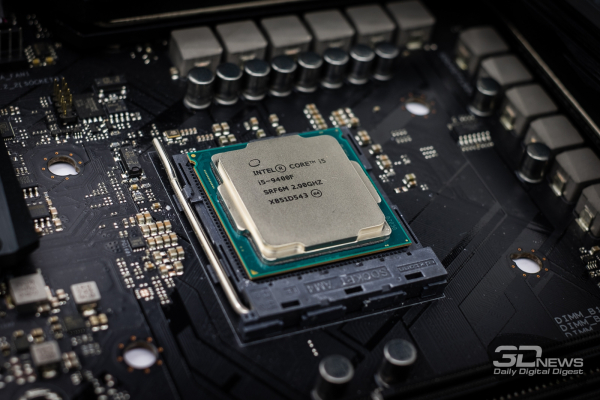
The subject selected for the study was the Core i5-9400F – the lower-tier six-core processor of the Coffee Lake Refresh generation. This chip is of particular interest: its predecessor, , in its time, was very popular due to its exceptionally attractive price-performance ratio. Officially announced four months ago, the Core i5-9400 (without the F in its name) offers slightly higher clock frequencies at the same price; however, finding it for sale is practically impossible. On the other hand, the Core i5-9400F is available on store shelves everywhere, and moreover, since there is no shortage of this model, its actual retail price is very close to the recommended one. Nevertheless, this does not automatically make the Core i5-9400F a good option for 'basic' configurations, especially since AMD now offers six-core Ryzen 5 processors in the same price range, which, unlike the Core i5 series, support simultaneous multithreading (SMT). Therefore, today's test promises to be particularly informative: it should answer several questions and clearly demonstrate whether the Core i5-9400F has a chance of repeating the success of the legendary Core i5-8400.
Coffee Lake Refresh Series
By now, there have already been two waves of announcements for processors that are conditionally referred to as the Coffee Lake Refresh generation. Although these CPUs are largely similar to their predecessors from the Coffee Lake family, Intel classifies them as the ninth generation of Core processors and numbers them with indices starting with the digit 9. While this classification may be somewhat justified for the Core i7 and Core i9, as they have gained eight computing cores for the first time, the new Core i5 and Core i3 processors have mainly received model number increases for the sake of it. Essentially, they only offer increased clock frequencies.
However, there are no improvements at the microarchitecture level to speak of at all. And honestly, this doesn’t come as a surprise. Intel's development concept is such that deep changes in processors are tied to advancements in production technologies. Therefore, delays in implementing the 10nm process lead us once again to deal with the Skylake microarchitecture, which first appeared back in 2015. What is surprising, however, is that for some reason Intel is not eager to change specifications that don't require significant transformations. For example, the Coffee Lake Refresh officially continues to focus on dual-channel DDR4-2666 memory, while AMD repeatedly adds support for faster modes, reaching DDR4-3200 in the latest mobile Raven Ridge versions. The only thing Intel did in response was increase the supported memory volume in Coffee Lake Refresh systems to 128GB.
Nevertheless, despite the lack of changes in microarchitecture, Intel is still managing to launch quite interesting models through extensive methods—by increasing the number of computational cores and clock frequencies. The first wave of Coffee Lake Refresh announcements, which took place in October last year, introduced three flagship overclockable processors that conquered new performance milestones: the eight-core Core i9-9900K and Core i7-9700K, as well as the six-core Core i5-9600K. With the second wave during the New Year, the list of the latest processors was further expanded by six simpler CPU models. As a result, the entire lineup of Coffee Lake Refresh looks as follows.
| Cores/Threads | Base frequency, GHz | Turbo Frequency, GHz | L3 Cache, MB | iGPU | iGPU Frequency, GHz | Memory | TDP, W | Price | |
|---|---|---|---|---|---|---|---|---|---|
| Core i9-9900K | 8/16 | 3,6 | 5,0 | 16 | UHD 630 | 1,2 | DDR4-2666 | 95 | $488 |
| Core i9-9900KF | 8/16 | 3,6 | 5,0 | 16 | No | — | DDR4-2666 | 95 | $488 |
| Core i7-9700K | 8/8 | 3,6 | 4,9 | 12 | UHD 630 | 1,2 | DDR4-2666 | 95 | $374 |
| Core i7-9700KF | 8/8 | 3,6 | 4,9 | 12 | No | — | DDR4-2666 | 95 | $374 |
| Core i5-9600K | 6/6 | 3,7 | 4,6 | 9 | UHD 630 | 1,15 | DDR4-2666 | 95 | $262 |
| Core i5-9600KF | 6/6 | 3,7 | 4,6 | 9 | No | — | DDR4-2666 | 95 | $262 |
| Core i5-9400 | 6/6 | 2,9 | 4,1 | 9 | UHD 630 | 1,05 | DDR4-2666 | 65 | $182 |
| Core i5-9400F | 6/6 | 2,9 | 4,1 | 9 | No | — | DDR4-2666 | 65 | $182 |
| Core i3-9350KF | 4/4 | 4,0 | 4,6 | 8 | No | — | DDR4-2400 | 91 | $173 |
The core of the newly released processors, which later added to the initially launched overclockable K models, consists of chips devoid of an integrated graphics core. Technically, the Core i9-9900KF, Core i7-9700KF, and Core i5-9600KF are based on the exact same semiconductor foundation and have absolutely identical specifications as the Core i9-9900K, Core i7-9700K, and Core i5-9600K, differing only in that they do not offer an integrated GPU, which is hardware blocked during production.
However, in the new second wave, we can see truly new models. First and foremost is the Core i3-9350KF – the only four-core processor among the Coffee Lake Refresh lineup with an unlocked multiplier. If we overlook the lack of an integrated GPU, it can be viewed as an updated version of the Core i3-8350K, which has been boosted by the addition of Turbo Boost 2.0 technology and now has the ability to automatically overclock to 4.6 GHz.
Another relatively legitimate newcomer in the second wave can be considered the Core i5-9400 and its counterpart, the Core i9-9400F, which lacks integrated graphics. The value of these models lies in the fact that Intel has significantly reduced the cost of the lower-end six-core Coffee Lake Refresh, allowing the latest generation of CPUs to be used in entry-level configurations. However, there aren't many formal differences between the Core i5-9400 and last year's hit, the Core i5-8400. Clock speeds have only increased by 100 MHz, likely due to the microprocessor giant's desire to keep its lower-end six-cores within a 65-watt thermal package. As a result, the gap in maximum turbo frequencies between the higher and lower six-core processors in the Coffee Lake Refresh family has increased to 500 MHz, whereas in the Coffee Lake generation, it was only 300 MHz.
Based on the specifications, it seems that there's not much to brag about the new Core i5-9400 and Core i5-9400F in comparison to the old Core i5-8400. However, the specifications in this case do not provide a complete picture. During the announcement of the first Coffee Lake Refresh, Intel mentioned the advantages of an indirect nature. For instance, a change in the internal thermal interface was promised for the new generation of chips: instead of polymer thermal paste, high-performance flux-free solder was to be used. But does this apply to the lower-end six-core Core ninth-generation processors? It turns out, not always.
Details about the Core i5-9400F
It just so happened that when releasing the Coffee Lake Refresh processors, Intel lumped together several different variants of semiconductor chips based on the 14++ nm process, and not all of them are actually new. The Core ninth-generation processors may be based on semiconductor chips specifically designed for them, as well as relatively older silicon variants that were actively used in the eighth-generation processors categorized under the Coffee Lake family.
In particular, it is currently known that at least four steppings of chips exist, which are installed in various mass-produced Core processors with numbers from the nine-thousand series:
- P0 – the only currently "genuine" chip option that can rightly be called Coffee Lake Refresh. This chip has eight computing cores and is used in overclocking processors Core i9-9900K, Core i7-9700K, and Core i5-9600K, as well as in their F-variants Core i9-9900KF, Core i7-9700KF, and Core i5-9600KF, and in Core i5-9400;
- U0 – a six-core chip that was previously used in Coffee Lake processors, that is, in the eighth generation of Core. It is now used to create the six-core Core i5-9400F;
- B0 – a four-core chip used for Core i3-9350K processors. This silicon variant also came into this processor directly from the four-core Coffee Lake, including Core i3-8350K;
- R0 – a new stepping of the crystal, which is expected to be used for the higher-end ninth generation Core processors starting in May. Currently, it is not found in production CPUs, and therefore, there is no specific information about its features or reasons for its introduction.
Thus, the Core i5-9400F, which we discuss in this review, is an outlier: the only processor of its kind that differs in its internal architecture from the other six-core and eight-core counterparts of the Coffee Lake Refresh generation. Strictly speaking, it is not a cut-down or underclocked version of the Core i5-9600K or Core i5-9400, but rather a slightly overclocked variant of the old Core i5-8400 with its integrated graphics core disabled.
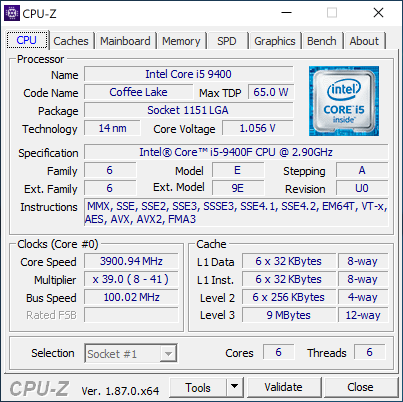
And it should be noted that this is not only apparent in the screenshots of diagnostic tools, which will show the Core i5-9400F as having the old U0 stepping instead of the new P0. The Core i5-9400F does not actually feature any innovations typical of Coffee Lake Refresh. In particular, during the assembly of these chips, the die is not soldered to the heat spreader, and the internal thermal interface is the same polymer thermal paste used in Coffee Lake processors.
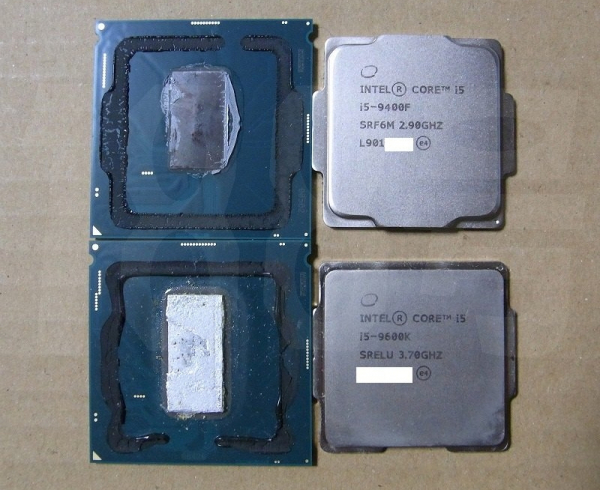
Furthermore, unlike other processors of the Coffee Lake Refresh generation, the Core i5-9400F is assembled on a printed circuit board with thinner laminate – the same as that used for standard Coffee Lake.
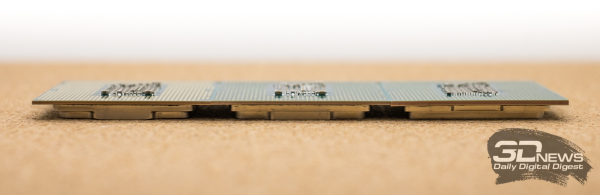
Moreover, even the shape of the heat spreader on the Core i5-9400F reveals this processor’s family ties with the eighth generation Core series. The heat spreader has changed for purebred Coffee Lake Refresh models.
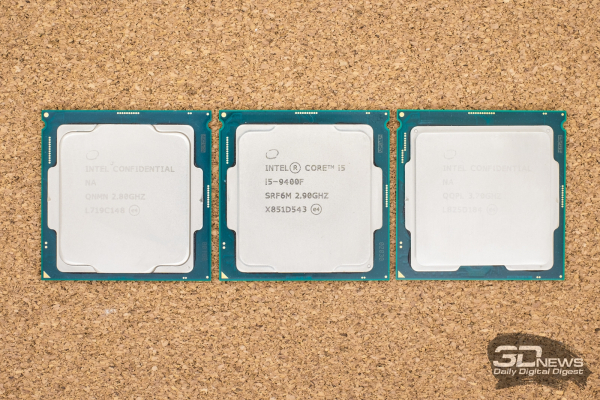
In other words, there is no doubt that the Core i5-9400F is not actually a Coffee Lake Refresh, but rather a rejected processor from the previous generation with its integrated graphics core disabled. This applies to all currently supplied production Core i5-9400Fs, which largely explains the widespread availability of these processors at a time when there are significant supply issues with the rest of the Coffee Lake Refresh products. For instance, the 'full' counterpart of the Core i5-9400F, which was formally announced at the same time and supposed to be based on the 'genuine' P0 stepping die, is still absent from retail sales.
At the same time, the microprocessor giant does not exclude the possibility of transitioning the Core i5-9400F to the 'correct' stepping P0 in the medium term. However, this will evidently only occur once all the defective integrated GPU Coffee Lake chips accumulated in the company's warehouses are successfully sold out.
However, for most users, the fact of silicon crystal forgery is unlikely to matter much. In any case, the Core i5-9400F is a true six-core processor without Hyper-Threading support, which operates at 100 MHz faster than its predecessor, the Core i5-8400, under any load. This means that, based on the frequency formula, the Core i5-9400F corresponds to the $10 more expensive Core i5-8500.
Despite the relatively low base frequency of 2.9 GHz for the Core i5-9400F, in reality, this processor can operate significantly faster thanks to Turbo Boost 2.0 technology. With the Multi-Core Enhancements feature enabled (which is the default mode for the overwhelming majority of motherboards), under full load, the Core i5-9400F is capable of maintaining a frequency of 3.9 GHz, boosting to 4.1 GHz under a single-core load.
| Nominal frequency | Maximum Turbo Boost 2.0 frequency | ||||||
| 1 core | 2 cores | 3 cores | 4 cores | 5 cores | 6 cores | ||
| Core i5-8400 | 2.8 GHz | 4.0 GHz | 3.9 GHz | 3.9 GHz | 3.9 GHz | 3.8 GHz | 3.8 GHz |
| Core i5-8500 | 3.0 GHz | 4.1 GHz | 4.0 GHz | 4.0 GHz | 4.0 GHz | 3.9 GHz | 3.9 GHz |
| Core i5-9400(F) | 2.9 GHz | 4.1 GHz | 4.0 GHz | 4.0 GHz | 4.0 GHz | 3.9 GHz | 3.9 GHz |
Of course, there is no talk of any overclocking capabilities here. The most the Core i5-9400F can do is operate at the maximum frequency allowed under the Turbo Boost 2.0 technology. Also, on motherboards with H370, B360, or H310 chipsets, one cannot utilize memory faster than DDR4-2666. Higher-speed modes are available only on boards with higher-end Z370 or Z390 chipsets.
Source: 3dnews.ru
