

IP address masking may be required for various tasks, from accessing blocked content to bypassing anti-bot systems of search engines and other online resources. I found an interesting discussion on how this technology can be applied to corporate challenges and prepared an adapted translation of it.
There are several options for implementing proxies:
- Residential Proxies – residential proxies are IP addresses provided by internet service providers to homeowners, and they are recorded in the databases of regional internet registries (RIR). Residential proxies use these types of IP addresses, making requests from them indistinguishable from those sent by real users.
- Datacenter Proxies. These proxies are not associated with internet providers for individual households. Addresses of this type are allocated by hosting providers that have purchased blocks of addresses.
- Shared Proxies. In this case, one proxy is used simultaneously by several users; they can either be server-based or provided by ISPs for their users.
- Private Proxies. With a private or dedicated proxy, access to the IP address is limited to one user only. Such proxies are offered by specialized services, hosting providers, internet providers, and VPN services.
All these options have their advantages, but residential proxies are increasingly used for corporate purposes. The main reason for this is that such proxies utilize real addresses from different internet providers in various locations (countries, states/regions, and cities). As a result, any interaction appears to be carried out by a real user. No online service would think to block requests from real addresses, as it could be a contact from a potential client.
This opens up a range of opportunities for companies. Let's discuss how they use residential proxies to solve business problems.
Why Do Businesses Need Proxies
According to Distil Networks, a company that fights bot traffic, up to 40% of web traffic on the internet today is generated by non-human sources.
However, not all bots are beneficial (like search engine crawlers). Many website owners strive to protect their sites from bots to prevent them from accessing sensitive data or important business information.
The number of bots that are typically not blocked was 20.40% in 2017, while another 21.80% were considered 'bad' bots: website owners attempted to ban them.
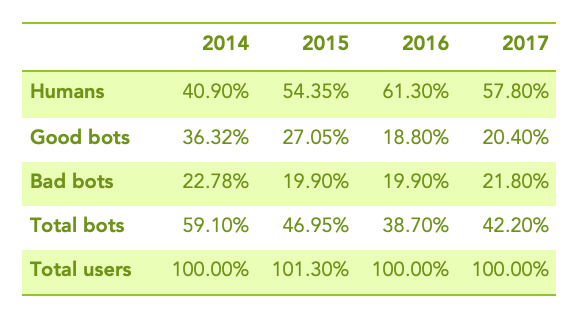
Why might companies try to circumvent such blocks?
To gather real information from competitors' websites
One primary use of residential proxies is competitive intelligence. Today, there are tools available that make it easy to trace the use of server proxies; the pools of proxy provider addresses are well-known, making them easy to block. Many popular online services—such as Amazon, Netflix, Hulu—implement blocking systems based on ranges of IP addresses from hosting providers.
When using a residential proxy, any request appears as though it was sent by a regular user. If a large number of requests need to be sent, residential proxies can send them from addresses in any country, city, and that are associated with local internet providers.
Brand protection
Another practical application of residential proxies is brand protection and fighting counterfeiting. For example, pharmaceutical manufacturers—like those behind the drug Viagra—constantly combat sellers of counterfeit generics.
Sellers of these replicas often restrict access to their sites from countries where the manufacturer's official representatives are located. This complicates the identification of counterfeit traders and the filing of legal actions against them. With residential proxies using addresses from the same country as the counterfeit sales website, this task can be easily accomplished.
Testing new features and monitoring performance
Another important use of residential proxies is testing new features on your websites or applications. This allows you to see how everything works from the perspective of an average user. Sending a large number of requests from IP addresses in different countries and cities also helps to test the performance of applications under heavy loads.
This function is also useful for performance monitoring. For international services, it is important to understand, for example, how quickly a website loads for users from specific countries. Using residential proxies in performance monitoring systems helps obtain the most relevant information.
Marketing and advertising optimization
Another application of residential proxies is testing advertising campaigns. With residential proxies, you can see how a particular ad appears, for example, in search results for residents of a specific region and whether it is shown at all.
Furthermore, when promoting in various markets, residential proxies help understand how effectively a website performs in terms of search engine optimization: whether the site ranks in the top search results for relevant queries in target languages and how its positions change over time.
Search engines are highly negative towards data collection using their resources. Hence, they continually improve mechanisms to identify data collectors and effectively block them. As a result, data collection from search engines is currently completely impossible.
However, executing a large number of identical search queries through residential proxies cannot be blocked — search engines cannot restrict access for real users. Therefore, this tool is excellent for guaranteed data collection from search engines.
Residential proxies are also useful for analyzing competitors' advertising and marketing activities and their effectiveness. This technology is used both by companies themselves and by agencies engaged in promotional services.
Content aggregation
In the era of Big Data, many businesses are built on aggregating content from various sites and consolidating it on their own platform. Such companies often have to use residential proxies; otherwise, it will be challenging to maintain an up-to-date database of prices, for example, for specific categories of products across various online stores: the risk of being banned is too high.
For example, to create a regularly updated comparison table of vacuum cleaner prices in online stores, a bot is needed that will continuously visit the relevant pages of these resources and update them. To bypass anti-bot systems, using this tool will be the most effective.
Data collection and analysis on demand
In recent years, companies that specialize in custom data collection and analysis have been thriving. One prominent player in this market is the PromptCloud project, which develops its own crawler tools to gather information for marketing, sales, or competitive analysis.
It's logical that the bots of such companies are constantly being banned, but thanks to the use of residential IPs, doing so effectively is impossible.
Savings from acquiring local discounts
Additionally, having private local IP addresses can contribute to resource savings. For example, many ticket and hotel booking sites display geo-targeted promotions. Only customers from specific regions can take advantage of them.
If a company needs to organize a business trip to such a country, it can use residential proxies to attempt to find better prices and save money.
Conclusion
The ability to simulate requests from real users with a genuine local IP address proves very useful, including for businesses. Companies use residential proxies for data collection, various tests, accessing necessary but blocked resources, and more.
Source: habr.com
