


The signal transmitted over the cable television network represents a broadband, frequency-divided spectrum. The parameters of the signal, including frequencies and channel numbers in Russia, are regulated by GOST 7845-92 and GOST R 52023-2003, but the content of each channel is at the operator's discretion.
Contents of the article series
- Part 2: Composition and form of the signal
- Part 3: Analog component of the signal
- Part 4: Digital component of the signal
- Part 5: Coaxial distribution network
- Part 6: RF-signal amplifiers
- Part 7: Optical receivers
- Part 8: Optical backbone network
- Part 9: Headend
- Part 10: Troubleshooting in the CATV network
I remind you that I am not writing a textbook, but an overview to broaden horizons and introduce the world of cable TV. Therefore, I try to write in simple language, leaving key terms for those interested and not delving into descriptions of technologies that have been perfectly described hundreds of times without me.
How we measure
To obtain information about the signal in a coaxial cable, our technical staff mainly uses the Deviser DS2400T device.
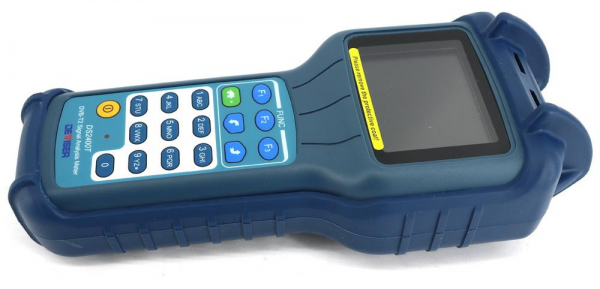
Essentially, this is a television receiver, but instead of images and sound, we see quantitative and qualitative characteristics of the entire spectrum as well as individual channels. The illustrations provided later are screenshots from this device.
Such a Deviser even has somewhat redundant functionality, but there are devices that are even better: with a screen showing actual TV images, optical signal reception, and, what the Deviser lacks, reception of satellite signals DVB-S (but that's a whole different story).
Signal Spectrum
The spectrum display mode allows you to quickly assess the state of the signal visually.
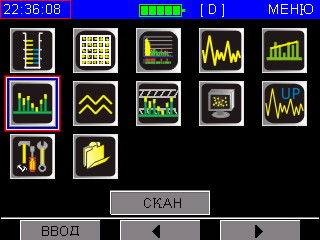
In this mode, the device scans channels according to a preset frequency plan. For convenience, unused frequencies in our network have been removed from the full spectrum, so the resulting image represents a palisade of channels.
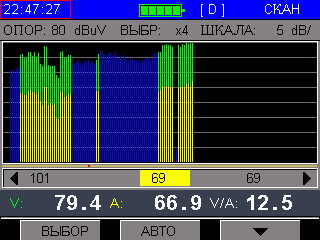
Digital channels are marked in blue, analog ones in yellow. The green part of the analog channel indicates its audio component.
The difference in levels of different channels is clearly visible: the individual unevenness depends on the settings of the transponders at the head station, while the overall difference between upper and lower frequencies has a specific meaning, which I will explain below.
In this mode, significant deviations from the norm will be clearly visible, and if there are serious problems in the network, they will be immediately apparent. For example, in the image provided, there is a dropout of two digital channels in the high-frequency zone: they are only present as short streaks, barely reaching the level of 10 dBμV (the reference level is indicated at 80 dBμV at the top — this is the upper limit of the graph), which is effectively noise that the cable picks up like an antenna or generated by active equipment. These two channels are test channels and were turned off at the time of writing the article.
The uneven distribution of digital and analog channels may cause confusion. This is certainly not ideal and happened due to the evolutionary development of the network: additional channels were simply added to the free part of the spectrum within the frequency plan. If a frequency plan were created from scratch, it would be appropriate to place all analog channels in the lower part of the spectrum. Moreover, the station equipment designed to generate signals for European countries has restrictions on frequency usage for broadcasting digital signals, and though such restrictions do not exist in our country, using such equipment means placing digital channels in the spectrum contrary to logic.
Signal shape
As known from fundamental physics, the higher the frequency of the wave, the greater its attenuation as it propagates. When transmitting a broadband signal, such as that in a cable television network, the attenuation in the distribution network can reach tens of decibels per segment, while in the lower part of the spectrum it will be several times lower. Therefore, having sent a uniform signal from the basement to the riser, we will see approximately the following on the 25th floor:
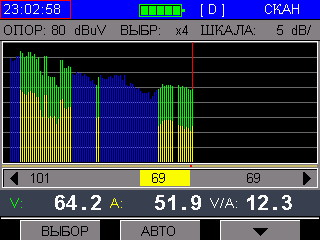
The level of the upper frequencies is noticeably lower than that of the lower frequencies. In reality, a television may mistakenly consider the weaker channels as noise and filter them out. If an amplifier is installed in the apartment, trying to adjust it for good reception of channels from the upper part of the range will lead to over-amplification in the lower part. Standards stipulate a difference of no more than 15 dBμV across the entire range.
To avoid this, we initially set a higher level in the high-frequency zone when configuring active equipment. This is called a "direct slope," or simply a "slope." What is shown in the image is a "reverse slope," and such a situation indicates a failure. Or, at the very least, it signals that there is an issue with the cable to the measurement point.
There can also be the opposite situation, where low frequencies are almost non-existent, while the highs barely break above the noise level:
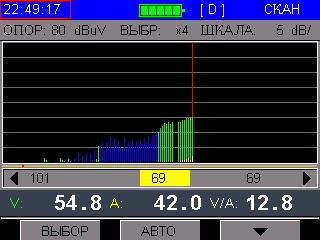
This also indicates damage to the cable, specifically its central conductor: the higher the frequency, the closer it propagates to the edge of the waveguide (skin effect in coaxial cable). Therefore, we only see the channels that propagate at higher frequencies, but generally, the television will not be able to receive them at such a level.
Source: habr.com
